The 5-3-1 Rule: The Social Wellness Habit You're Probably Missing

Many employees spend entire workdays surrounded by people yet still feel socially disconnected.
Workplace wellbeing conversations often focus on:
- Nutrition
- Fitness
- Sleep
- Stress
- Productivity
But social wellbeing is frequently overlooked.
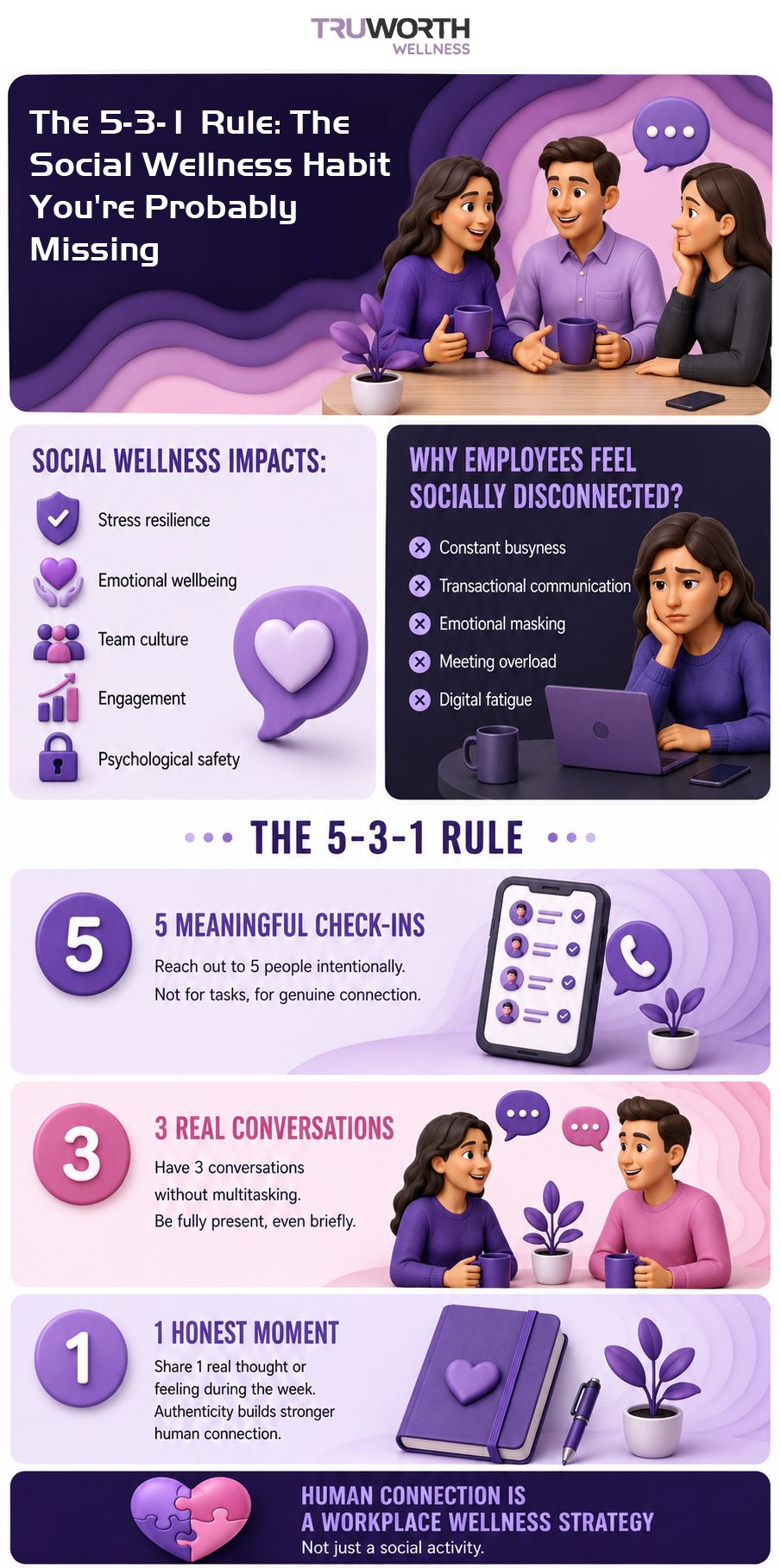
Humans are not designed to function in emotional isolation for long periods. A lack of meaningful social connection can affect:
- Mood
- Motivation
- Stress levels
- Engagement
- Psychological resilience
The challenge is that modern work culture often creates interaction without genuine connection. Employees attend meetings, share files, and exchange messages, but rarely ask each other how they are actually feeling. This gap between physical proximity and emotional closeness is one of the most underrecognised drivers of workplace fatigue. When people feel unseen as humans, their sense of belonging erodes, and with it, their willingness to contribute fully.
That is where small social wellness habits can make a difference. These habits do not require hours of free time or extroverted personalities. They simply require noticing the people around you and choosing connection over efficiency, even briefly.
What Is The 5-3-1 Rule?
The 5-3-1 Rule is a simple social wellbeing framework designed to encourage meaningful human connection without feeling overwhelming.
1) 5 Meaningful Check-Ins Per Week
Reach out intentionally to five people. Not for work updates. For genuine human connection.
Examples:
- Asking how someone is really doing
- Sending appreciation
- Checking on a colleague after a stressful week
These check-ins can take less than two minutes each. A quick message that says, "Thinking of you, hope today is lighter," or a short conversation before a meeting starts. The key is intent. You are not checking a box. You are signalling that the other person matters beyond their output. Over a full week, five such moments create a rhythm of presence that both the giver and receiver benefit from.
2) 3 Real Conversations Per Week
Have three conversations without multitasking. No scrolling. No rushed replies. No divided attention.
Even short conversations can strengthen emotional connection. Real conversation means your phone is facedown. Your screen is closed. Your eyes are on the other person. You listen to understand, not to reply. This might happen over tea for five minutes or while walking to a different floor. The duration is less important than the quality of attention. Three such conversations per week is achievable even in the busiest schedules.
3) 1 Vulnerable Or Honest Moment Per Week
Share something authentic. Not performative positivity. Not constant professionalism.
Real connection often begins when people feel emotionally safe enough to be human. This could be admitting you felt overwhelmed by a project, sharing that you made a mistake and learned from it, or simply saying, "I am having a rough day and could use some patience." Vulnerability is not weakness at work. It is the foundation of trust. Without it, relationships stay surface level. With it, colleagues become allies rather than just co-workers.
Why Social Wellness Matters At Work?
Employees who feel socially connected are often:
- More engaged
- More collaborative
- Less emotionally exhausted
- More resilient during stress
Strong workplace relationships can improve psychological safety and reduce feelings of isolation.
Connection acts as a protective factor against stress. When a difficult deadline arrives, socially connected employees do not suffer alone. They reach out, ask for help, or simply vent to someone who listens. That support absorbs some of the emotional impact. Conversely, socially disconnected employees carry the full weight of every challenge by themselves. Over months, that weight becomes unsustainable. Social wellness is not a luxury. It is an operational buffer against burnout.
The Hidden Problem With Hyper-Productive Cultures
Many workplaces unintentionally discourage social wellness.
Employees often feel pressure to:
- Stay constantly busy
- Avoid emotional conversations
- Prioritise efficiency over connection
- Appear endlessly productive
Over time, this creates emotionally distant workplaces.
People collaborate professionally while struggling personally. A hyper-productive culture treats every interaction as transactional. "What do you need from me?" replaces "How are you doing?" Teams celebrate output metrics but never measure whether members feel seen. The result is a workforce that achieves short term goals while slowly losing the relational glue that makes long term collaboration possible. Productivity improves on paper, but creativity, loyalty, and discretion effort quietly decline.
Social Wellness Does Not Mean Forced Fun
Not everyone enjoys loud team-building activities or mandatory social events.
Healthy social wellbeing is usually built through:
- Trust
- Emotional safety
- Consistent support
- Small everyday interactions
- Genuine listening
Simple human moments often matter more than grand wellness campaigns. An employee who dreads an offsite bowling night might still feel deeply connected because a manager remembered their child's name or because a teammate sent a kind message after a bad presentation. Forced fun often backfires because it demands emotional performance. Authentic connection requires the opposite. It requires lowering the mask and allowing realness, even messy realness, to show up naturally.
How Organisations Can Support Social Wellbeing?
1) Encourage Psychological Safety
Employees should feel safe speaking honestly without fear of judgment. This means leaders respond to bad news with curiosity rather than blame. It means mistakes become learning conversations, not punishment opportunities. Without psychological safety, the 5-3-1 Rule cannot take root because people will not risk vulnerability.
2) Train Managers In Human-Centred Leadership
Employees often feel more connected when managers demonstrate empathy and emotional awareness. A manager who starts one on one meetings with "How are you really doing?" and waits for an honest answer sends a powerful signal. Training managers to notice withdrawal, offer support without fixing, and share appropriate vulnerability themselves changes team culture from the top.
3) Reduce Meeting Overload
Excessive meetings can reduce genuine human interaction instead of improving it. When calendars are filled back to back, employees rush from one virtual room to another. There is no time for the five minute check-in or the unhurried conversation. Reducing meeting volume and protecting focus blocks creates space for social wellbeing to happen spontaneously.
4) Create Space For Informal Connection
Not every workplace conversation needs to be transactional. Watercooler moments, virtual coffee chats, or simply a shared virtual channel dedicated to non work topics can help. The key is that these spaces feel optional and low pressure. Forced participation ruins the effect. Open invitation without obligation allows introverts and extroverts alike to engage at their own comfort level.
How Truworth Wellness Can Help?
Sustainable employee wellbeing includes emotional and social health, not only physical wellness.
Truworth Wellness helps organisations strengthen workplace wellbeing through:
- Mental wellness initiatives
- Employee engagement programs
- Counselling support
- Behavioural wellbeing interventions
- Workplace culture programs
- Preventive wellbeing strategies
Because healthier workplaces are built through stronger human connection. Truworth Wellness does not simply hand over the 5-3-1 Rule and step away. It helps organisations embed social wellness into daily operations, train teams on psychological safety, and measure connection alongside productivity. The goal is to shift from a culture of constant doing to a culture of genuine being, where employees feel seen, heard, and valued as people first. When that shift happens, retention improves, stress lowers, and work stops feeling like a solitary struggle.