Calories Are Not The Problem. Your Workday Is.

For decades, the conversation around weight gain and poor health has been reduced to one simple equation. Eat less. Move more. Count calories. Stay disciplined.
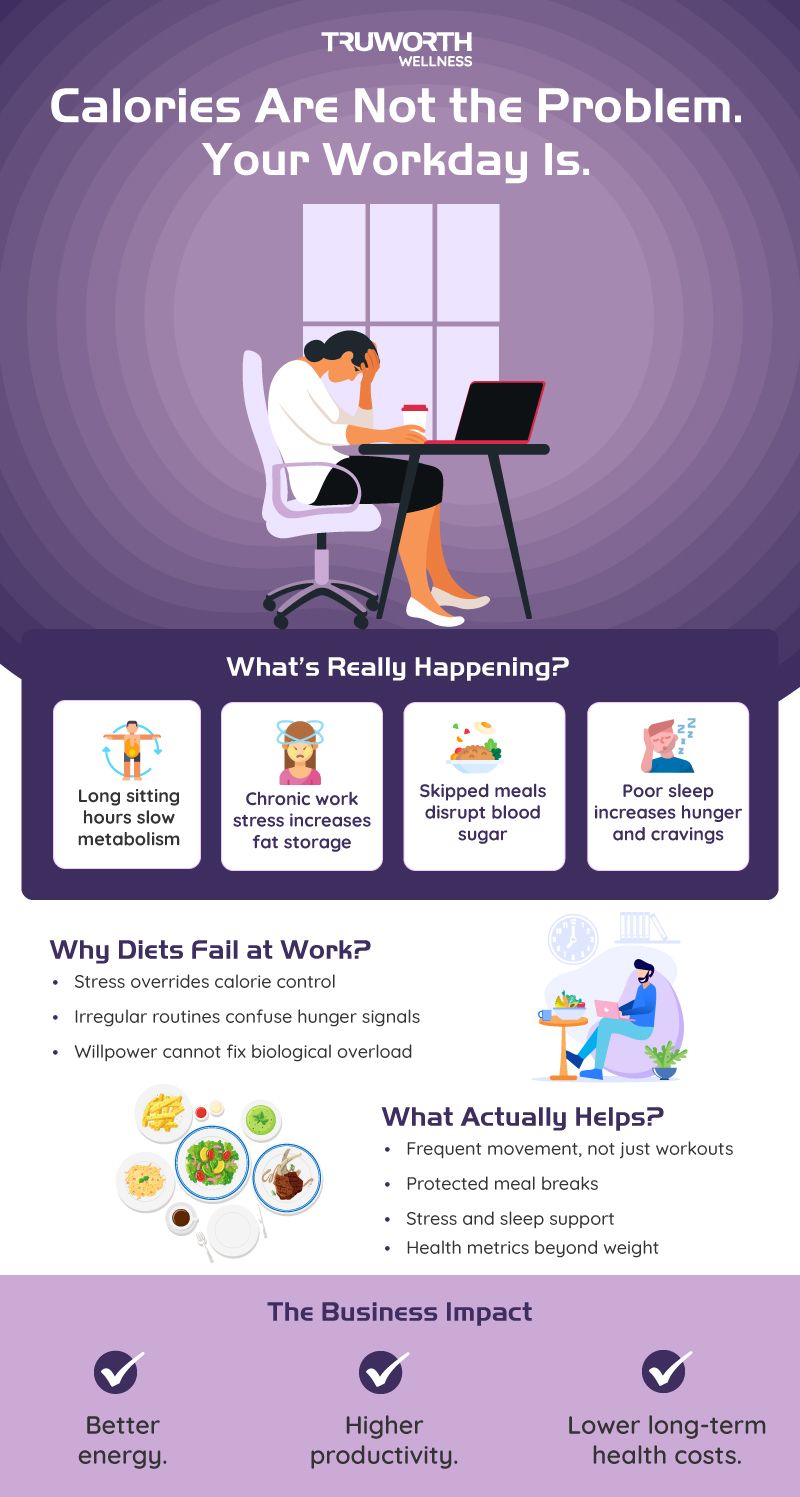
Yet across workplaces globally, employees are doing exactly that and still struggling with weight gain, fatigue, digestive issues, and declining energy. The problem is not calories alone. The problem is how modern workdays disrupt human biology.
Understanding this shift is critical for employers who want real health outcomes rather than short-lived wellness campaigns.
Also Read: 11 Easy Ways To Burn Calories While You Work
The Calorie Myth In Modern Work Culture
Calories measure energy intake, but they say nothing about how the body processes that energy. Two employees may consume the same number of calories and experience entirely different outcomes. One feels energized and stable. The other feels sluggish, hungry, and gains weight.
This difference is not about willpower. It is about physiology.
Research from global health bodies including the World Health Organization highlights that obesity and metabolic disorders are influenced by lifestyle patterns such as prolonged sitting, chronic stress, poor sleep, and irregular eating. These factors are deeply embedded in modern work structures.
When the workday is misaligned with biological needs, calorie control becomes ineffective.
How The Workday Disrupts Metabolism?
From a research lens, four workday patterns consistently interfere with metabolic health.
1) Prolonged Sitting And Inactivity
Most employees spend seven to ten hours seated daily. Prolonged sitting reduces muscle activity, lowers insulin sensitivity, and slows glucose uptake. Even employees who exercise before or after work are not fully protected if the rest of the day is sedentary.
Metabolism is not driven by workouts alone. It is driven by frequent, low-intensity movement throughout the day.
Also Read: The Ill-Effects Of Prolonged Sitting In The Workplace: How HR Can help?
2) Chronic Stress And Cortisol Overload
Deadlines, constant notifications, job insecurity, and high cognitive load keep the nervous system in a near-constant state of alert. This elevates cortisol, a stress hormone that directly affects fat storage, appetite, and blood sugar regulation.
Under chronic stress, the body prioritizes survival over fat loss. Cravings increase, digestion weakens, and the body becomes resistant to weight loss even when calorie intake is reduced.
This is why highly stressed employees often gain weight despite eating less.
3) Irregular Meal Timing
Back-to-back meetings, skipped lunches, late dinners, and rushed eating disrupt circadian rhythms. Research published in journals such as Cell Metabolism shows that irregular eating patterns impair glucose metabolism and increase fat storage.
The body thrives on rhythm. When meals are unpredictable, hunger hormones become dysregulated, leading to overeating later in the day.
4) Sleep Deprivation As A Workplace Norm
Sleep loss alters appetite hormones by increasing ghrelin and reducing leptin. This creates increased hunger, poor satiety, and preference for high-energy foods.
Adults sleeping fewer than six hours per night have a higher risk of obesity and metabolic disease. Long work hours and digital overload make sleep deprivation a structural issue, not a personal failure.
Why Diet Advice Alone Fails Employees?
Most workplace nutrition advice focuses on what to eat. Very little attention is given to when, how, and under what physiological state employees are eating.
When employees are stressed, under-slept, and sedentary:
- Calorie restriction increases fatigue
- Diet plans feel unsustainable
- Weight loss plateaus quickly
- Engagement with wellness programs drops
From a corporate wellness research perspective, this is not a motivation problem. It is a design problem.
Also Read: Can Following A Diet Plan Help Increase Productivity?
The Real Cost To Employers
When metabolic health declines, employers feel the impact long before clinical disease appears.
Common outcomes include:
- Persistent fatigue and brain fog
- Increased sick days due to pain, migraines, and digestive issues
- Lower focus and decision quality
- Rising healthcare claims linked to lifestyle conditions
- Reduced engagement with wellness initiatives
The OECD and International Labour Organization have repeatedly highlighted that productivity loss from presenteeism often exceeds absenteeism costs. Employees are present but not functioning at full capacity.
Calories do not explain this. Work design does.
What Employers Can Do Differently?
Effective corporate wellness strategies shift the focus from calorie control to workday alignment.
1) Design For Movement, Not Just Exercise
Encourage regular movement breaks, walking meetings, and flexible work setups. Small, frequent movement has a greater metabolic impact than a single workout.
Also Read: 8 Ways To Add More Movement Throughout Your Day
2) Address Stress As A Metabolic Risk Factor
Stress regulation practices such as breathwork, recovery pauses, and realistic workload design directly support metabolic health. This is supported by growing research in psychoneuroendocrinology.
3) Normalize Regular, Mindful Eating
Work cultures that respect meal breaks and discourage eating at desks support better digestion, glucose control, and energy regulation.
4) Support Sleep As A Health Metric
Sleep education alone is insufficient. Employers must also examine meeting schedules, after-hours communication expectations, and workload cycles.
Shift Success Metrics In Wellness Programs
Instead of focusing only on weight loss or step counts, track:
- Energy stability
- Stress levels
- Digestive comfort
- Sleep quality
- Functional movement
These markers change earlier than weight and predict long-term health outcomes.
Why This Matters For Corporate Wellness Strategy?
When organizations treat obesity and fatigue as individual diet problems, results remain limited. When they recognize the workday as a biological environment, outcomes improve.
Health is not built in isolated wellness sessions. It is built in everyday work patterns.
Also Read: Obesity In The Workplace: Managing Obesity Through Wellness Programs
How Truworth Wellness Helps Organizations Get This Right?
At Truworth Wellness, we approach nutrition and weight health through a systems lens. We do not isolate calories from context.
Our programs help organizations:
- Redesign workdays that support metabolic health
- Integrate nutrition, stress regulation, movement, and sleep into one coherent strategy
- Provide personalized employee support without stigma or extremes
Measure outcomes that matter to both health and business performance
We work with leadership, HR, and employees to create sustainable well-being frameworks that fit real work lives.
Because when the workday changes, health follows.
Final Thought
Calories matter, but they are not the starting point. The modern workday shapes how calories are processed, stored, or used.
If organizations want healthier employees, better productivity, and controlled healthcare costs, the solution lies not in stricter diet rules, but in smarter work design.
And that is where true corporate wellness begins.