The Heavy Price Of Clusters: Why Corporate Wellness Must Move From Access To Outcomes?

Corporate wellness has come a long way in India. Organisations today offer health apps, step challenges, webinars, annual health checkups, and mental wellbeing sessions. On paper, access to wellness has never been better. Yet, beneath these numbers lies a quieter, more expensive problem that often goes unnoticed: health risks do not occur alone. They cluster.
At TRWC 2025, this idea surfaced strongly in discussions around employee wellbeing. While organisations celebrate participation metrics, deeper data reveals a concerning pattern. Employees are not just dealing with isolated issues like stress or poor sleep. They are experiencing multiple, interconnected health risks at the same time. These clusters carry a heavy price for both individuals and businesses.
What Do We Mean By Health Clusters?
In healthcare, a cluster refers to multiple health risks or conditions that exist together and reinforce each other. In the workplace, this may look like poor sleep combined with chronic stress, weight gain, digestive issues, early cardiac risk, and low energy levels.
These are not random occurrences. When one risk is ignored, it often triggers another. A stressed employee sleeps poorly. Poor sleep affects metabolism and immunity. Low energy leads to reduced physical activity. Over time, weight gain and metabolic risks follow. Productivity declines, healthcare claims rise, and disengagement sets in.
The issue is not that employees lack wellness resources. The issue is that these resources often fail to interrupt the cycle early enough.
Also Read: 10 Easy Ways To Rev Up Your Metabolism
Why Clusters Are So Expensive for Organisations?
The financial impact of clustered health risks is rarely visible on a single balance sheet line. Instead, it appears gradually across multiple areas.
Productivity loss is one of the biggest hidden costs. Employees dealing with multiple health challenges may still show up to work, but they function at reduced capacity. This presenteeism often costs more than absenteeism.
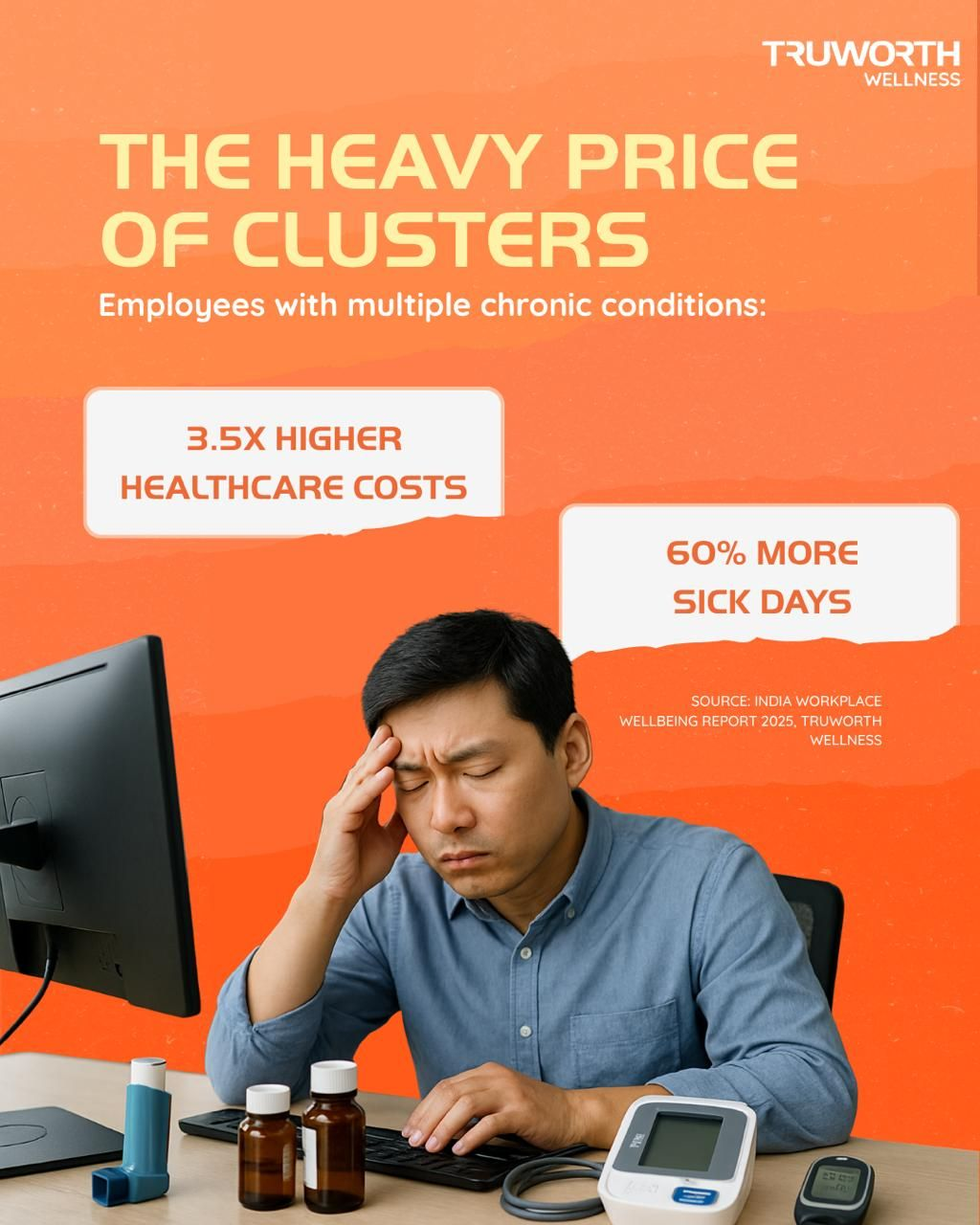
Healthcare expenses also rise faster when risks cluster. Treating one condition in isolation is manageable. Treating multiple chronic risks over time significantly increases insurance claims and long-term medical costs.
There is also a cultural cost. Teams with widespread fatigue, burnout, or disengagement struggle with collaboration, innovation, and morale. Attrition increases, especially among high performers who value sustainable work environments.
Simply put, clusters multiply costs. They do not add them.
Access Does Not Equal Impact
One of the strongest messages emerging from modern wellbeing data is this: access alone does not change outcomes.
Many organisations proudly report high participation rates in wellness initiatives. Thousands of employees may have attended sessions or signed up for challenges. However, outcome data often tells a different story.
Health risks continue to rise. Sleep quality remains poor. Stress scores stay elevated. Preventive screening uptake remains inconsistent. This disconnect exists because most wellness programs focus on activity, not impact.
Also Read: How Much Sleep Does A Corporate Professional Need As They Age?
Attendance is easy to measure. Behaviour change is not. But without tracking outcomes, organisations remain unaware of whether their investments are actually reducing risk clusters or simply creating short-term engagement.
How Workplace Culture Fuels Clusters?
Health clusters do not form in isolation from work environments. Several workplace factors accelerate their formation.
Chronic work stress is one of the strongest drivers. Long hours, constant digital availability, unclear expectations, and pressure-driven cultures keep employees in a state of continuous alertness. Over time, this disrupts sleep, digestion, immunity, and emotional regulation.
Lack of recovery is another major contributor. When rest is undervalued, employees struggle to recharge physically and mentally. Even high performers eventually pay the price.
Surface-level wellness efforts can also unintentionally worsen the problem. One-off initiatives without follow-up create awareness but not change. Employees may know what to do, but lack the support, time, or structure to sustain healthier habits.
The Shift From Access To Outcomes
To address the heavy price of clusters, organisations must fundamentally rethink how they define success in wellness.
The first shift is measurement. Instead of focusing only on participation, companies need to track meaningful indicators. These include improvements in sleep quality, reductions in stress levels, better metabolic markers, fewer sick days, and improved engagement scores.
Also Read: Workplace Stress Hits Different: Why Aging Employees Feel It More Than Younger Ones?
The second shift is targeting. Not all employees face the same risks. Outcome-driven wellness programs identify high-risk groups early and provide personalised interventions instead of generic solutions.
The third shift is prevention. Preventive health screenings, when paired with follow-up care and guidance, can stop clusters from forming in the first place. Prevention is not just clinically effective. It is financially smart.
Finally, wellness must move beyond campaigns. Sustainable change happens when wellbeing is integrated into daily work practices, leadership behaviours, and organisational policies.
Leadership Has A Defining Role
Wellness outcomes improve significantly when leaders treat wellbeing as a strategic priority rather than an optional benefit.
This means leaders model healthy behaviours, respect recovery time, and support realistic workloads. It also means holding teams accountable for creating psychologically safe and sustainable work environments.
When leadership commitment is visible, employees are more likely to engage meaningfully with wellness initiatives. Trust increases. Behaviour change becomes possible.
Events like TRWC 2025 highlight a growing realisation across industries. Employee wellbeing is no longer an HR initiative alone. It is a leadership responsibility.
Why Clusters Demand Immediate Attention?
Ignoring clustered health risks is no longer an option. The data is clear. When risks are left unmanaged, costs rise quietly but steadily. Productivity erodes. Healthcare spends escalate. Workforce resilience weakens.
On the other hand, organisations that invest in outcome-driven wellness see measurable benefits. Health risks reduce. Engagement improves. Employees feel supported rather than managed.
Wellness, when done right, becomes a performance enabler.
Conclusion: Paying Attention Before the Price Gets Higher
The heavy price of clusters is not paid overnight. It is paid gradually through lost energy, reduced focus, rising costs, and declining morale. But it is also preventable.
The future of corporate wellness lies in moving beyond access and into outcomes. It lies in recognising patterns early, intervening intelligently, and supporting employees holistically.
Wellbeing is not about how many people sign up. It is about how many lives improve.
And that is where real organisational success begins.