Corporate Wellness Programs That Turn Intent Into Action

Every January, gyms fill up. Corporate wellness programs also see a familiar rise in interest as employees set new goals for their health and wellbeing.
Fitness apps see a surge in downloads. People buy new running shoes, order healthier groceries, explore employee wellness programs, and make promises to themselves about the year ahead.
By March, much of that momentum has disappeared.
The interesting part isn't that people give up. It's that most of them never lacked information in the first place.
Ask almost anyone what contributes to better health and the answers are remarkably consistent. People know exercise matters. They know sleep matters. They know stress affects wellbeing. They know a preventive health checkup can identify risks before symptoms appear.
The challenge isn't knowledge.
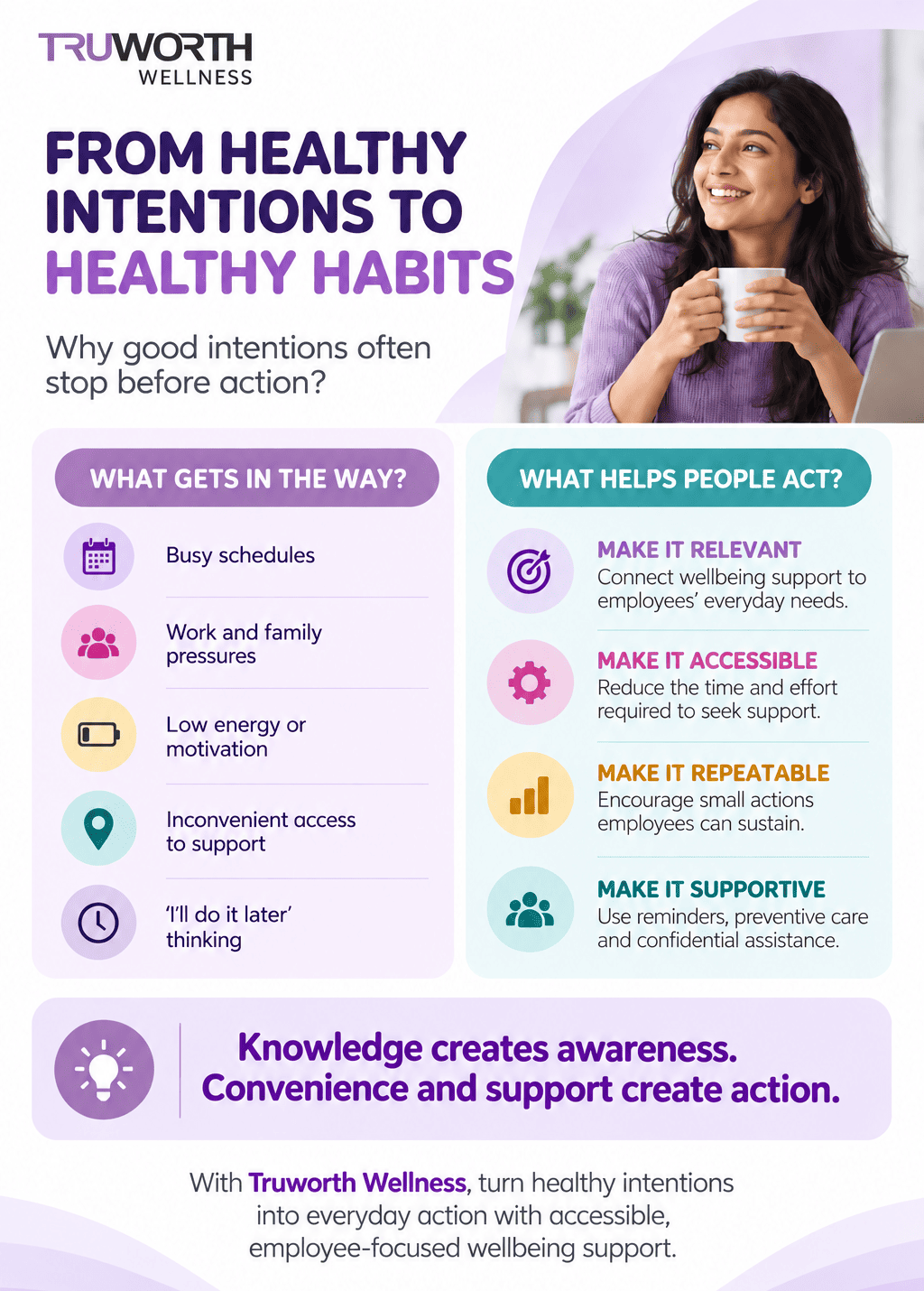
The challenge is turning that knowledge into something people can sustain on a random Tuesday afternoon when work is busy, family responsibilities are piling up, and health feels like something that can wait until next week.
Why Corporate Wellness Programs Need More Than Health Information?
Open any social media platform and you'll find an endless stream of health advice.
- One expert recommends walking 10,000 steps a day.
- Another talks about protein intake.
- Someone else is discussing meditation, sleep cycles, gut health, or longevity.
Information is everywhere.
In fact, many employees today have access to more health information than previous generations ever did, both independently and through workplace wellness programs.
Yet organizations still struggle with low participation, delayed health checkups, rising stress levels, and preventable concerns that affect employee health and wellbeing.
Clearly, information alone isn't enough.
Why Employees Do Not Use Wellness Programs Consistently?
Imagine an employee who genuinely wants to improve their health and has access to workplace support.
- They plan to exercise after work.
- They intend to schedule a preventive health checkup.
- They have even bookmarked guidance about stress management at the workplace.
Then the week begins.
A client escalation appears unexpectedly. Meetings run longer than planned. Family commitments take priority. The gym session gets postponed. The health checkup gets pushed to next month.
Nothing dramatic happens.
That's precisely the point.
This helps explain why employees do not use wellness programs consistently, even when they value the support.
Health competes with everything else in daily life.
And unlike deadlines or meetings, it rarely demands immediate attention.
Must Check: Simple Ways Leaders Can Prioritize Workplace Wellbeing
Why Preventive Health Checkups Get Delayed?
One of the biggest reasons people postpone healthy behaviours is that many health risks do not announce themselves loudly.
Someone with rising stress levels may continue functioning normally for months.
- Poor sleep often becomes routine.
- A sedentary lifestyle rarely feels urgent in the moment.
- An annual health checkup for employees is frequently delayed because nothing feels wrong today.
This creates an interesting paradox.
Many health decisions, including a corporate health checkup, are most valuable before symptoms appear. Yet symptoms are often what finally motivate people to act.
By the time health feels urgent, the opportunity for prevention may already be smaller than it once was.
Must Check: How To Design A Workplace Wellness Programs That Employees Actually Use?
Motivation Alone Cannot Sustain Employee Wellness Programs
Popular wellness advice often focuses on motivation.
Stay motivated. Find motivation. Increase motivation.
The problem is that motivation is unreliable. Some days people feel energized and committed to their goals. Other days they don't.
Healthy habits that depend entirely on motivation rarely survive busy schedules, unexpected challenges, or periods of stress.
This is why effective employee wellness programs focus as much on convenience and access as they do on awareness.
People are more likely to:
- Walk when movement is built into their routine
- Attend a corporate health checkup when scheduling is simple
- Use workplace mental health support when access feels private and easy
- Exercise when it fits naturally into their day
- Maintain healthy behaviours when workplace barriers are reduced
Convenience often influences behaviour more than intention.
Why Workplace Wellness Programs Matter?
This challenge helps explain why organizations are rethinking traditional corporate wellness programs.
For years, many initiatives focused on awareness.
The assumption was simple: if employees understand the importance of health, they will make healthier choices.
Reality turned out to be more complicated.
This is why workplace wellness programs are moving beyond education alone. The strongest approaches create environments that make healthy behaviours easier, while keeping support relevant to employees' real lives.
The distinction matters. One approach provides information. The other helps people take action and demonstrates the practical benefits of employee wellness programs.
Employee Wellness Program Ideas That Turn Intention Into Action
Health improvements rarely arrive through dramatic transformations. They usually emerge through small actions repeated consistently. Useful employee wellness program ideas therefore reduce friction and make the next healthy step obvious.
Consider the difference between:
- One annual burst of motivation versus regular movement built into the workday
- Reading about stress management at the workplace versus practising brief recovery habits daily
- Planning an annual health checkup for employees versus offering simple scheduling and reminders
- Intending to improve sleep versus making small adjustments to evening routines
The gap between intention and action often appears small on a given day.
Over months and years, it becomes significant.
This is why corporate preventive healthcare remains an important conversation. Its benefits are rarely immediate, but they accumulate through earlier action, consistent support, and timely preventive health checkups.
The Hidden Cost of Delaying Employee Health and Wellbeing
When healthy intentions remain intentions for too long, the consequences are not always visible right away.
The impact often appears gradually:
- Stress becomes chronic rather than temporary
- Minor health concerns become larger concerns
- Healthcare costs increase as opportunities for early support are missed
- Energy levels decline
- Productivity and participation decline
- Recovery takes longer
This isn't meant to create fear.
It's simply a reminder that health outcomes are often shaped by what people do consistently rather than what they know intellectually.
Knowledge creates awareness. Action creates change.
How to Increase Participation in Wellness Programs?
Organizations already spend considerable time helping employees understand health. The next opportunity is helping them act on what they know.
Improving participation begins by removing the small barriers that repeatedly turn intention into delay.
That may mean simplifying access to consultations, offering corporate health checkup packages for employees, sending timely reminders, strengthening workplace mental health support, or making wellbeing resources easier to use during a busy week.
The most effective employee wellness program ideas are not always the most elaborate. They make healthy action convenient, relevant, confidential, and easy to repeat.
That is how organizations can improve employee wellbeing without expecting motivation alone to carry the entire program.
Because the biggest challenge in health has never been a lack of information.
It is turning good intentions into everyday behaviour.
Must Check: How To Motivate Employees to Sign Up For A Health Check Camp Without Being Pushy?
Frequently Asked Questions
Why do employees not use wellness programs even when they want to be healthier?
Employees often face practical barriers such as limited time, competing priorities, unclear access, low energy, privacy concerns, and programs that do not fit naturally into the workday. Participation improves when support is convenient, relevant, and easy to repeat.
How can organizations increase participation in wellness programs?
Organizations can simplify enrolment, reduce scheduling friction, communicate confidentiality clearly, offer timely reminders, provide manager-supported flexibility, and design initiatives around real employee needs rather than generic awareness campaigns.
What are effective employee wellness program ideas?
Useful ideas include movement breaks, preventive screening reminders, accessible counselling, sleep and stress-support resources, health coaching, simple habit challenges, and convenient consultations. The best idea is one employees can realistically use during an ordinary week.
What are the benefits of employee wellness programs?
Well-designed programs can encourage earlier preventive action, improve access to support, strengthen health awareness, and help employees sustain healthier routines. Outcomes depend on relevance, trust, accessibility, and consistent participation.
How does a corporate health checkup support preventive healthcare?
A corporate health checkup can make screening easier to access and may help identify health risks before symptoms become disruptive. Packages should be appropriate for the workforce and connected to clear follow-up guidance rather than treated as a one-time event.
How do mental health and stress management fit into workplace wellness?
Workplace mental health support and practical stress-management resources help employees respond before pressure becomes chronic. Confidential access, clear communication, supportive work practices, and simple recovery habits all contribute to employee health and wellbeing.