Your Wellness Program Is Competing With 17 Other Notifications

At 11:42 AM, an employee opens their phone to check a work message. Within seconds, the screen lights up again. A food delivery offer. A banking alert. A Slack ping. A social media notification. A calendar reminder.
And somewhere in that crowded stack sits your wellness program notification.
Unread. Unnoticed. Unprioritized.
This is the invisible competition most wellness programs are losing.
Not because employees do not care about their health. But because attention today is fragmented, finite, and fiercely contested.
The Real Problem Is Not Engagement. It Is Attention Economics.
Most organizations still measure wellness success through participation rates, step counts, or login metrics. But these are outcomes, not realities.
The real battle is happening much earlier.
- Before an employee clicks.
- Before they read.
- Before they even notice.
Your program has to first win attention.
And attention today is not neutral. It is designed, engineered, and fought over by apps that spend billions to capture it.
So when your wellness message arrives, it is not entering a calm, receptive mind.
It is entering noise.
If your wellness program disappeared tomorrow, would employees notice immediately or eventually or never?
That answer says more than your engagement dashboard ever will.
Why Wellness Gets Ignored Even When People Care?
It is easy to assume employees ignore wellness because they are not interested. That assumption is flawed.
People want to feel better. They want more energy, less stress, better sleep.
But wanting something and acting on it are two very different things.
Here is what actually happens:
- Wellness feels like effort, notifications feel like urgency
- Health benefits feel long-term, notifications feel immediate
- Wellness requires intention, notifications demand reaction
The human brain is wired to respond to immediacy.
So even if your program is meaningful, it is competing against things that feel urgent.
And urgency almost always wins.
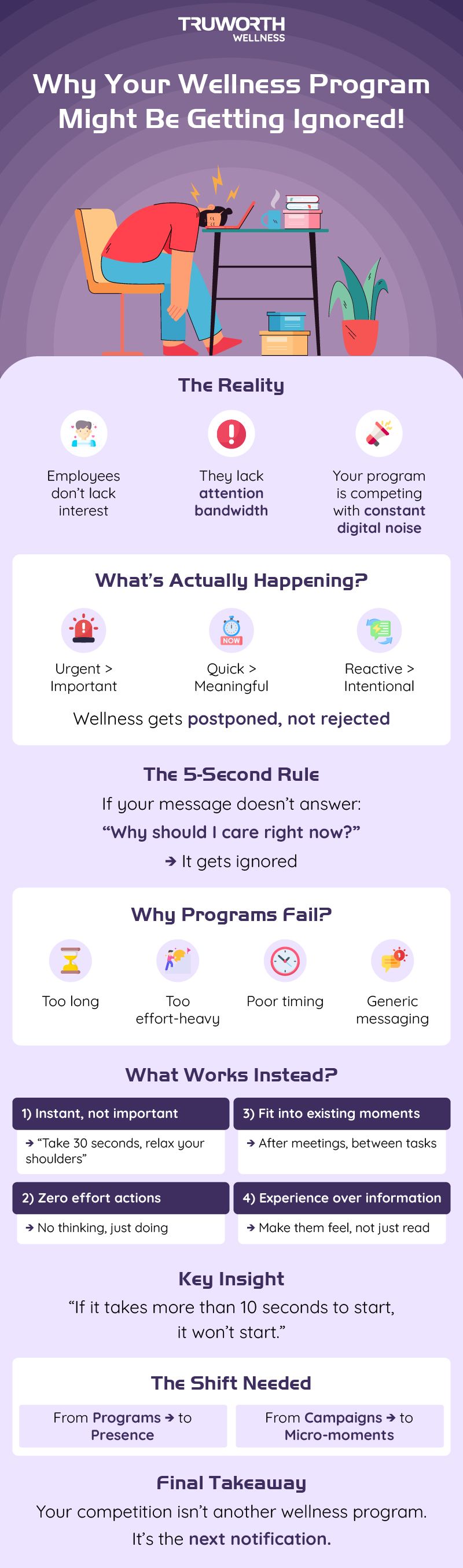
The 5-Second Window You Are Missing
Most wellness communication is designed as if employees are sitting down to read it.
They are not.
They are glancing.
Scrolling.
Half-paying attention.
You do not have minutes.
You have seconds.
If your message does not answer this instantly, it gets ignored:
Why should I care right now?
Not this week. Not this quarter. Right now.
Employees are not rejecting wellness. They are postponing it indefinitely. And in a world of constant notifications, “later” often means “never.”
Now that you know the 5-second rule, it’s time to understand what truly shapes your choices: the “5-Minute Window.” [👈 Click here]
The Hidden Design Flaw in Most Wellness Programs
Most wellness programs are built like events.
- Join this webinar
- Sign up for this challenge
- Complete this module
But attention does not work in events anymore. It works in micro-moments.
Short, context-aware, low-effort interactions.
The problem is not the quality of your program. It is the format.
You are asking for time in a system where time is already overbooked.
 Truworth Wellness
What Actually Cuts Through the Noise?
To compete with 17 notifications, your wellness program cannot just be informative. It has to be irresistible in the moment.
Here is what works:
1) Make It Feel Immediate, Not Important
Importance does not drive action. Immediacy does.
Instead of:
“Join our stress management session this Friday”
Try:
“Take 30 seconds. Drop your shoulders. Unclench your jaw. Notice the difference.”
One demands time. The other fits into it.
2) Reduce the Effort to Almost Zero
Every extra step is a drop-off point.
If employees have to:
- Click
- Read
- Understand
- Decide
- Act
You have already lost most of them.
The best wellness interactions feel like they require no decision.
If it takes more than 10 seconds to start, it will not start at all.
3) Anchor Wellness to Existing Behavior
You do not need more time. You need better timing.
Attach wellness to things employees already do:
- After a meeting ends
- While waiting for a file to load
- Before opening the next email
Wellness does not need a new slot in the day. It needs to live inside existing ones.
Do Check! Top 10 Wellness Program Features That Work In A Hybrid Office
4) Replace Information with Experience
Most wellness communication tells.
- Very little lets employees feel.
- Information is easy to ignore.
- Experience is harder to forget.
A simple breathing prompt, a posture reset, a 10-second reflection can create a shift.
And that shift builds trust.
If your program only works when employees are “free,” it will rarely work at all. Because most employees are never truly free.
Must Check: Which Engagement Elements Should You Prioritize In Wellness Programs Based On Organizational Goals?
The Role of Emotional Relevance
Another reason wellness gets ignored is because it often feels generic.
- “Stay healthy”
- “Take care of yourself”
- “Manage stress”
These are correct, but not relatable.
Employees engage with things that feel personal.
- “Feeling drained by 3 PM again?”
- “Is your sleep leaving you more tired?”
- “Do meetings leave you more exhausted than work?”
Now the message is not about wellness. It is about them.
And that changes everything.
From Program to Presence
Wellness programs often behave like campaigns.
They appear. They push. They fade.
But what employees need is not occasional reminders.
They need consistent presence.
Small nudges. Repeated gently. Integrated seamlessly.
Not loud enough to annoy.
Not rare enough to forget.
Just present enough to matter.
 Truworth Wellness
The Shift Organizations Need to Make
If your wellness program is competing with notifications, then it needs to behave like one.
Not in volume. In design.
- Short, not long
- Timely, not inconsistent
- Actionable, not informational
- Personal, not generic
Because attention is not earned by being available.
It is earned by being relevant in the moment.
Your biggest competitor is not another wellness program. It is the next notification.
And that notification is designed to win.
Where Structured Support Makes the Difference?
This is where most organizations struggle. Translating wellness intent into real-world behavior change requires more than good ideas.
It requires systems that understand employee behavior, attention patterns, and context.
Programs like those offered by Truworth Wellness focus on this exact gap. Instead of relying only on traditional formats, they integrate personalized nudges, behavior insights, and micro-engagement strategies that fit into an employee’s actual day.
Because wellness should not feel like an additional task.
It should feel like a natural part of how the day unfolds.
Closing Thought
Employees are not ignoring wellness because they do not care.
- They are ignoring it because everything else is louder.
- The question is not whether your program is valuable.
- The question is whether it can be noticed.
And in today’s world, being noticed is the first step to making any difference at all.