Hobbies Are Not A Distraction. They Are A Performance Strategy.

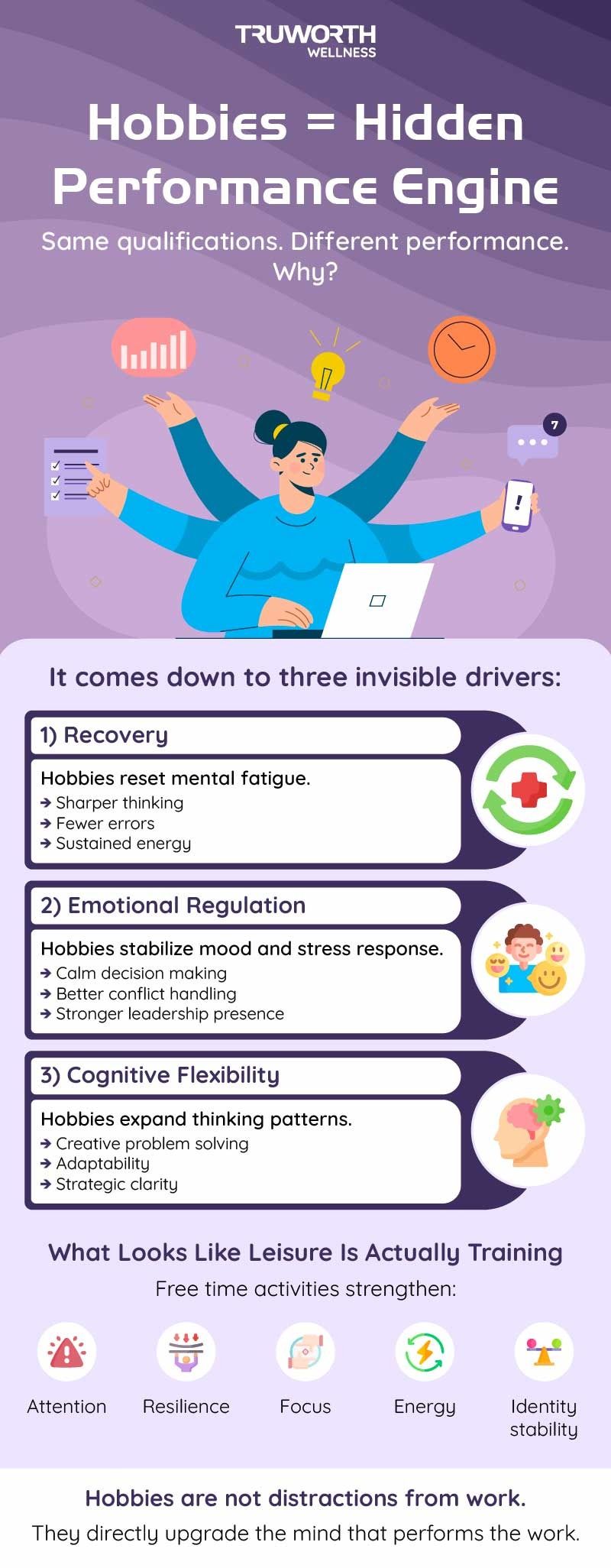
Two professionals with the same qualifications can perform very differently. The difference is often not talent. It is recovery, emotional regulation, and cognitive flexibility.
Hobbies strengthen all three.
What looks like free time activity is actually neurological training. It sharpens attention, builds resilience, improves creativity, and stabilizes mood. In high performance environments, these are not soft traits. They are competitive advantages.
Let us unpack why.
Recovery Is A Performance Skill
Most professionals underestimate the role of recovery. They measure effort, not renewal.
When the brain is constantly engaged in deadlines, decisions, and digital inputs, cognitive fatigue accumulates. You may still be working, but the quality of thinking drops. You become reactive instead of reflective. Errors increase. Patience reduces.
A hobby creates structured recovery.
When you play music, garden, paint, swim, cook, or practice a sport, your brain shifts out of performance pressure mode. The nervous system stabilizes. Stress hormones reduce. Attention resets.
This is not laziness. It is mental recalibration.
Professionals who recover well:
- Think more clearly under pressure
- Sustain energy through long work cycles
- Avoid burnout driven dips in productivity
Recovery is not separate from performance. It protects it.
Emotional Regulation Determines Leadership Quality
Workplaces are emotionally charged environments. Targets, feedback, hierarchy, competition, and uncertainty create constant micro stress.
The ability to regulate emotions is what separates consistent performers from volatile ones.
Hobbies act as emotional training grounds.
- A long distance runner learns endurance and discomfort tolerance.
- A musician practices discipline and repetition.
- A dancer channels expression and control.
- A chess player develops patience and foresight.
These experiences strengthen emotional balance.
At work, this shows up as:
- Responding instead of reacting
- Managing conflict calmly
- Taking feedback without defensiveness
- Maintaining composure during uncertainty
Emotional stability builds trust. Trust builds influence. Influence drives performance outcomes.
Also Read: Subtle Leadership Responses That Build Trust And Respect In The Workplace
Cognitive Flexibility Drives Innovation
Modern work rarely rewards rigid thinking. It rewards adaptability.
Cognitive flexibility is the brain’s ability to switch perspectives, generate alternative solutions, and adapt to new information. Hobbies naturally train this ability.
Creative hobbies such as writing, photography, or music enhance pattern recognition and abstract thinking. Strategic hobbies such as board games or coding improve structured problem solving. Physical hobbies improve coordination between body and brain, strengthening executive function.
When professionals regularly engage in diverse activities, they expand their mental models.
This translates into:
- Faster problem solving
- Better strategic planning
- Improved decision quality
- Greater openness to change
Innovation rarely comes from mental monotony. It comes from cognitive diversity.
Attention Is Strengthened Outside The Office
In distraction heavy work environments, attention has become fragile.
Constant notifications, multitasking, and digital interruptions weaken sustained focus. Yet high quality output demands deep concentration.
Many hobbies require uninterrupted attention.
- Playing an instrument demands precision.
- Yoga requires breath awareness.
- Crafting requires steady hands and focus.
- Reading long form books builds cognitive endurance.
These activities train the brain to stay present.
Professionals who cultivate focused hobbies often:
- Complete tasks faster
- Make fewer careless mistakes
- Produce higher quality deliverables
- Stay engaged during long meetings
Focus is not an inbuilt trait. It is practiced.
Hobbies Expand Identity And Reduce Burnout Risk
When work becomes your only identity, every setback feels personal. Every performance review feels like a judgment of self worth.
Also Read: Pre-Burnout Detection: How To Spot Decline Before It Hits HR Records?
This creates chronic stress.
- Hobbies create psychological diversification.
- You are not only your designation. You are also a runner, painter, singer, cyclist, writer, or chef.
This broader identity builds resilience. When one area of life feels challenging, other areas provide stability and accomplishment.
Resilient professionals:
- Recover faster from setbacks
- Maintain motivation over time
- Stay engaged during change
- Sustain long term performance
Burnout often begins where identity becomes narrow.
Physical Energy Fuels Cognitive Output
Performance is not just mental. It is physiological.
Physical hobbies such as swimming, strength training, dance, or cycling increase circulation, improve sleep quality, and regulate mood. Better sleep improves attention. Better mood improves collaboration. Better physical stamina improves cognitive stamina.
Energy compounds.
An energized professional:
- Makes sharper decisions
- Thinks more clearly late in the day
- Handles stress more effectively
- Avoids mid week productivity crashes
Sustained performance requires sustained energy.
Engagement Improves When Life Feels Full
There is a misconception that people deeply invested in hobbies are less committed to work.
In reality, people who feel fulfilled outside work often bring more energy into it. They are not seeking emotional validation solely through professional achievement. They are not chronically depleted.
They work because they choose to contribute, not because work is their only source of identity.
This mindset builds healthier ambition.
And healthy ambition sustains high performance longer than pressure driven overwork.
The Bigger Insight
Hobbies are not an escape from work. They are preparation for it.
They train:
- Recovery capacity
- Emotional balance
- Cognitive flexibility
- Focus
- Physical energy
- Identity resilience
In high performance environments, these qualities determine consistency, leadership effectiveness, innovation, and long term output.
Two professionals may start with the same qualifications.
But the one who invests in neurological training outside work often outperforms the one who only invests in work itself.
Because performance is not just built at your desk.
It is built in the hours when you are doing something that has nothing to do with your job, and everything to do with strengthening the mind that does it.