India’s Workforce Is Tired in New Ways

There was a time when workplace exhaustion looked simpler.
Long hours. Physical fatigue. Tight deadlines. Lack of sleep.
Today, exhaustion has become harder to identify because it often hides behind functioning employees, active calendars, and people who still show up on time, smile during meetings, and continue delivering work.
India’s workforce is not just tired. It is tired in new ways.
And many organisations are still trying to solve modern exhaustion with outdated wellness thinking.
The result is a workforce that appears productive on the surface but feels emotionally depleted underneath.
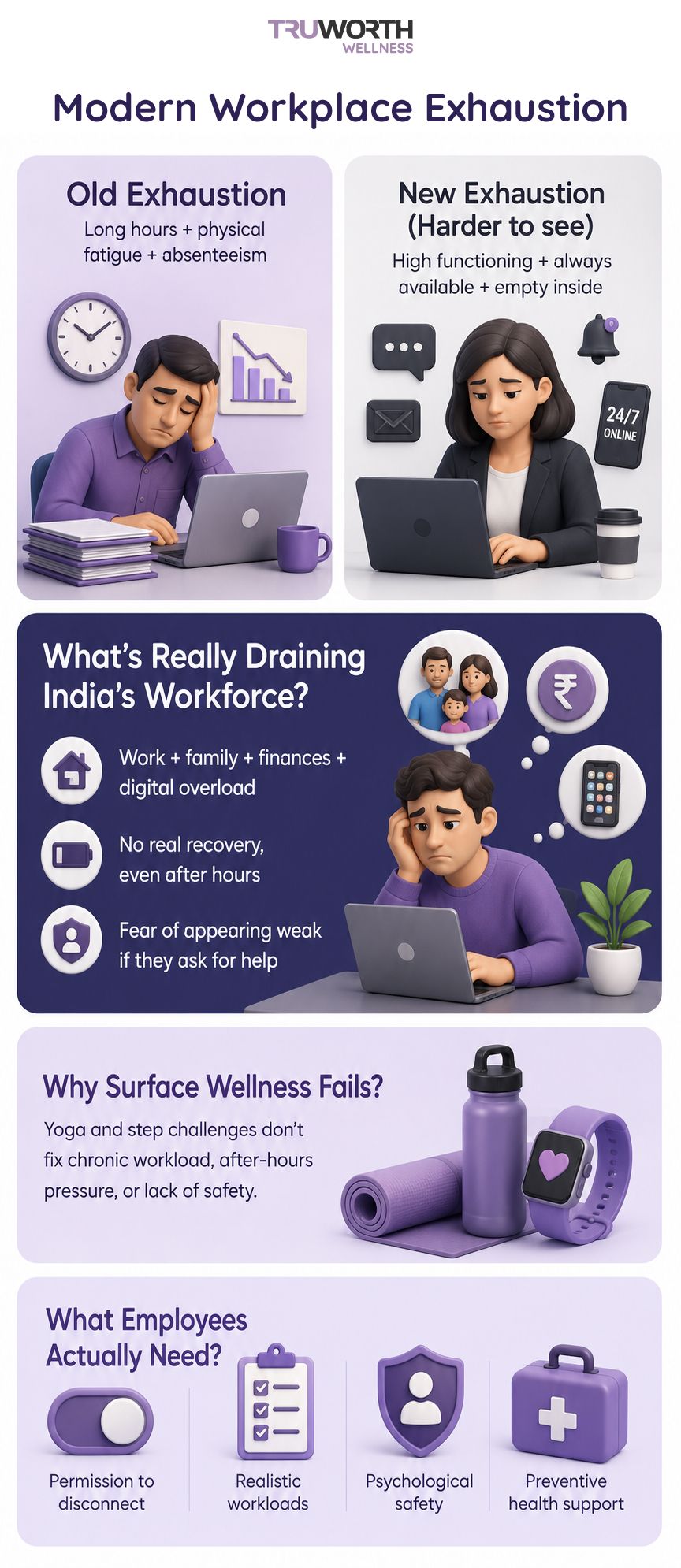
The Nature of Fatigue Has Changed
Traditional workplace fatigue was easier to spot. Employees visibly slowed down. Absenteeism increased. Energy dropped.
Now, many employees remain highly functional while carrying constant mental overload.
They are:
- Replying To Messages Late Into The Night
- Switching Between Apps, Meetings, And Conversations All Day
- Dealing With Financial Pressure And Rising Living Costs
- Managing Caregiving Responsibilities At Home
- Consuming Endless Digital Information
- Staying Emotionally “Available” At Work Even When Exhausted
- Feeling Pressure To Continuously Improve, Upskill, And Perform
This creates a different kind of tiredness, one that is cognitive, emotional, and deeply cumulative.
Employees may not completely break down. They simply stop feeling recovered.

India’s Workforce Is Facing Layered Pressure
In India, workplace fatigue is rarely caused by work alone.
Employees are often balancing multiple invisible pressures simultaneously.
A young professional may be managing:
- Demanding Work Expectations
- Family Financial Responsibilities
- Long Commutes
- Social Comparison Online
- Health Anxiety
- Pressure To Support Parents
- Fear Of Falling Behind Professionally
- Limited Personal Time
Many employees are also part of the “sandwich generation,” supporting both children and ageing parents while trying to maintain careers.
Others are navigating unstable economic realities, rising EMIs, and increasing uncertainty around long-term financial security.
This means recovery has become harder, even outside office hours.
People are technically resting. But mentally, many never fully switch off.
Digital Exhaustion Is Becoming a Major Wellness Issue
One of the biggest shifts in workplace wellness is the rise of digital fatigue.
Employees today are not just doing work. They are constantly processing information.
Notifications. Chats. Emails. Calls. Meetings. Dashboards. Updates. Alerts.
The brain rarely gets uninterrupted space.
Many employees now experience:
- Attention Fatigue
- Difficulty Concentrating
- Emotional Numbness
- Increased Irritability
- Decision Fatigue
- Sleep Disruption
- Reduced Motivation
And because digital overload has become normalised, it often goes unnoticed until productivity, mental health, or physical wellbeing begin declining.
This is especially visible in hybrid and remote work environments, where the boundaries between “available” and “offline” have become blurred.
High Functioning Exhaustion Is Rising
One of the most concerning workplace wellness trends is the rise of high functioning exhaustion.
These employees:
- Continue Performing Well
- Rarely Complain
- Meet Deadlines
- Appear Reliable
- Stay Professionally Composed
But internally, they may feel emotionally drained for months.
In many Indian workplaces, exhaustion is still seen as something employees should quietly manage.
People hesitate to ask for support because they fear appearing weak, ungrateful, or incapable.
As a result, organisations often notice the problem only when:
- Engagement Drops
- Employees Resign Unexpectedly
- Conflicts Increase
- Motivation Disappears
- Health Issues Worsen
By then, the exhaustion has usually been building for a long time.
Wellness Is Still Too Focused on Surface Solutions
Many workplace wellness initiatives still focus heavily on visible activities:
- Step Challenges
- Yoga Sessions
- Wellness Days
- Motivational Talks
- Fitness Campaigns
While these can help, they do not always address the deeper causes of exhaustion.
An employee cannot meditate their way out of:
- Chronic Workload Imbalance
- Constant After-Hours Communication
- Lack Of Psychological Safety
- Emotional Isolation
- Unclear Expectations
- Recovery Deprivation
Modern workplace wellness requires a broader understanding of human energy.
Employees do not only need stress management.
They need:
- Emotional Recovery
- Healthier Work Rhythms
- Psychological Safety
- Realistic Workloads
- Permission To Disconnect
- Supportive Leadership
- Preventive Healthcare Access
- Environments Where Asking For Help Feels Safe
The Conversation Around Productivity Needs to Change
Many employees today are not struggling because they are incapable.
They are struggling because they have been operating without adequate recovery for too long.
Constant productivity without restoration eventually creates diminishing returns:
- Creativity Declines
- Patience Reduces
- Emotional Resilience Weakens
- Focus Drops
- Engagement Becomes Performative
Yet many workplaces still reward visible busyness more than sustainable performance.
Employees often feel pressure to:
- Respond Immediately
- Remain Constantly Reachable
- Appear Energetic
- Overcommit
- Prove Dedication Through Availability
Over time, this creates a culture where exhaustion becomes normal instead of concerning.
Younger Employees Are Experiencing Fatigue Earlier
Another major shift is how early workplace fatigue is appearing.
Many young professionals today report:
- Burnout Symptoms Within The First Few Years Of Work
- Emotional Detachment
- Anxiety Around Career Progression
- Chronic Stress
- Difficulty Maintaining Work-Life Boundaries
This generation entered workplaces during periods of rapid uncertainty, digital acceleration, and economic pressure.
They are highly connected, highly aware, and often highly overstimulated.
At the same time, social media has intensified comparison culture. Employees are no longer only comparing themselves with colleagues. They are comparing themselves with entire industries, creators, peers, and online success narratives every day.
The psychological load is heavier than many organisations realise.
Preventive Wellness Matters More Than Ever
The future of workplace wellness in India cannot rely only on reacting after burnout happens.
Preventive wellness will become increasingly important.
That includes:
- Regular Health Screenings
- Accessible Mental Health Support
- Emotional Wellbeing Programs
- Sleep And Recovery Education
- Nutrition And Lifestyle Support
- Flexible Wellbeing Strategies
- Manager Sensitisation
- Healthier Communication Cultures
Most importantly, organisations need to recognise that employee wellbeing is not separate from business performance.
A workforce that is constantly depleted cannot sustain innovation, creativity, collaboration, or long-term productivity.
The Real Wellness Challenge Ahead
India’s workforce is not simply asking for perks.
It is asking for sustainability.
Employees want to work hard. Many are ambitious, capable, and deeply committed.
But increasingly, people are questioning whether success should require constant emotional depletion.
The organisations that will stand out in the coming years are not necessarily the ones offering the most visible wellness activities.
They will be the ones that genuinely understand human energy, recovery, and emotional health in a modern work environment.
Because the future of workplace wellness is no longer just about helping employees cope.
It is about creating workplaces people can sustainably live through.