You’re Probably Wasting Your OPD Budget. Here’s Why CarePass Makes More Sense.

Your employees are using it every time they see a doctor, buy medicines or get a blood test. Most of them have no idea their company could be covering it. Here is what cashless OPD actually means and why CarePass changes everything.
Ask ten employees in your office what their health benefits cover.
Most will mention hospitalisation. A few will mention insurance. One or two might mention a health check that happened once, somewhere, in a van in the parking lot.
Almost nobody will mention OPD.
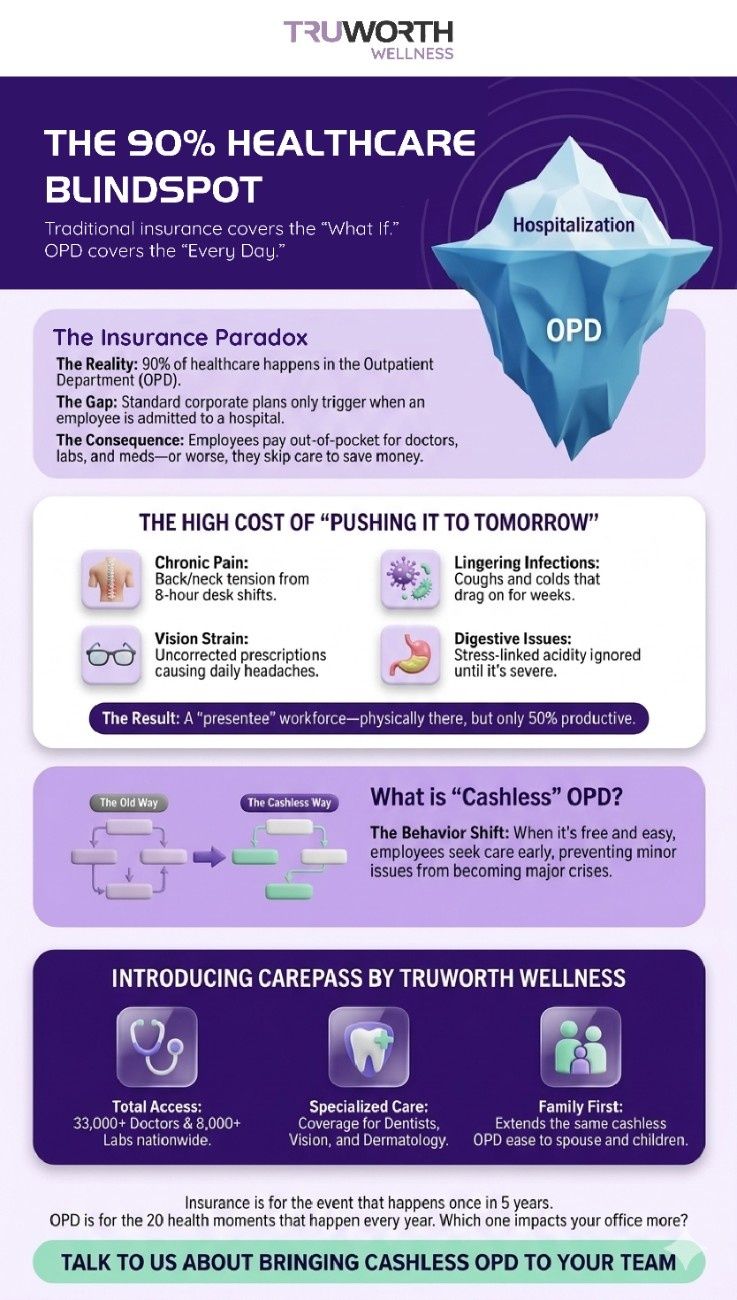
And yet OPD, which stands for Outpatient Department, covers the healthcare that employees actually use. Not the hospitalisation that happens once in five years. The doctor visit that happens five times a year. The blood test. The prescription. The dentist. The eye check. The physiotherapy session for the back that has been hurting since the last office chair broke.
This is the healthcare that happens in real life, on ordinary weekdays, without a hospital admission or an insurance claim form.
And for most Indian corporate employees, it comes entirely out of their own pocket.
What OPD Actually Covers?
OPD is every healthcare interaction that does not involve being admitted to a hospital. In practical terms, that means:
- Doctor consultations, both in-clinic and online
- Diagnostic tests and lab work
- Medicines and pharmacy
- Specialist visits like dentists, eye doctors and dermatologists
- Physiotherapy and rehabilitation
- Mental health consultations
- Preventive health check-ups
- Maternity and women's health consultations
This is the majority of healthcare that a person needs across their lifetime. And it is almost entirely absent from traditional corporate health insurance, which kicks in only when something serious enough to require hospitalisation occurs.
The gap between what insurance covers and what healthcare actually costs in day-to-day life is significant. For many employees, particularly those in mid-level roles managing EMIs, family obligations and rising living costs, that gap is a genuine barrier to seeking care.
The result is a workforce that defers consultations, skips follow-ups, does not fill prescriptions, and quietly manages conditions that would be straightforward to treat, because the cost and inconvenience add up to a decision they keep pushing to tomorrow.
Must Read: OPD For Families: Why Covering Dependents Reduces Employee Stress?
The Everyday Health Problems Getting Ignored
Before understanding why OPD benefits matter so much, it helps to see what employees are currently managing without proper medical attention.
Here is what a typical Indian corporate employee deals with in a given year without seeing a doctor:
1) Pain that becomes chronic
- Lower back pain from sitting eight hours a day
- Neck and shoulder tension from screen posture
- Persistent headaches written off as stress
2) Infections that drag on
- Recurring cold and cough managed with chemist-counter medicines
- Sinus infections that linger for weeks
- Throat infections that keep returning
3) Digestive issues that affect every day
- Acidity and reflux from irregular meals
- Bloating and discomfort that become normal
- Gut symptoms linked to stress that never get properly assessed
4) Vision that has changed but never been rechecked
- Uncorrected prescriptions causing eye strain and headaches
- Dry eyes from air-conditioned offices
- No eye examination in two or three years because it involves cost and time
5) Mental health concerns with nowhere to go
- Anxiety that could be managed with early counselling
- Sleep problems that a doctor could help with
- Low mood that stays just below the threshold of feeling worth addressing
Every single one of these is treatable. Most are inexpensive to address when caught early. All of them affect how that employee thinks, feels and performs at work every single day they go unaddressed.
Also Read: Summer Infections On Rise! Take Care! Smart Tips For Employees & Companies
Why Employees Do Not Seek Care?
The question is not whether employees need OPD care. They clearly do. The question is what stops them from accessing it.
The answer is almost always one of two things:
- Cost: A GP consultation in a decent clinic costs anywhere between five hundred and fifteen hundred rupees. Add a blood test, a prescription and a follow-up and the total quickly crosses two to three thousand rupees. For an employee already stretched financially, that is a decision, not a convenience.
- Inconvenience: Finding a clinic. Checking if it is in the insurance network. Realising it is not covered. Paying out of pocket. Filing a reimbursement claim. Waiting six weeks for it to come through. Many employees decide the process is not worth it for something that might resolve on its own.
The result is deferred care, prolonged symptoms, reduced performance and occasionally a minor condition that becomes a major one because nobody addressed it early.
Must Check: Preventive Measures Every Corporate Must Take To Minimize Illness At Work
What Cashless OPD Changes?
Cashless OPD removes both barriers simultaneously.
No upfront payment. No reimbursement forms. No claims process. The employee books a consultation, walks in or logs on, receives care, and leaves. That is the entire experience.
The internal calculation shifts from:
"It is probably nothing. It will cost me money and time. I will wait and see."
To:
"I can book a consultation today. It costs me nothing. I will just find out what this is."
That shift in behaviour is where the real value of cashless OPD lives. It changes when employees seek care, which changes how quickly conditions are addressed, which changes how long employees spend functioning below their potential.
Introducing CarePass by Truworth Wellness
This is exactly the gap that CarePass is designed to close.
CarePass is a unified digital healthcare membership that gives employees cashless access to the full spectrum of everyday healthcare through a single card and a single platform. No switching between providers. No paperwork. No waiting periods. Activate and use.
Think of it the way you think of a multipurpose card that simplifies everyday transactions. CarePass does the same for healthcare. One membership. Everything covered. Immediately accessible.
And it is backed by partnerships with India's most trusted healthcare names: Apollo, Fortis, Max, Tata 1mg, PharmEasy, Clove Dental, Lenskart and more.
Must Read: Why CarePass Is A Strategic Win For Your Business?
What CarePass Actually Gives Employees Access To?
The numbers behind the network are significant:
- 35,000+ pharmacies for easy access to medicines
- 25,000+ doctors for in-clinic consultations
- 8,000+ doctors for online teleconsultations
- 8,000+ diagnostic centres with home sample collection
- 5,500+ gyms for fitness and wellness
- 5,000+ dentists for comprehensive dental care
- 300+ vision care stores for eye health
- Coverage across 400+ cities across India
This is not a metro-only benefit. It is a benefit designed to work where employees actually are, including Tier 2 and Tier 3 cities where the alternative to CarePass is often no structured healthcare access at all.
Four Plans Designed for Different Needs
CarePass is not one-size-fits-all. It is built on the understanding that different employees have different healthcare needs and different levels of existing coverage.
1) CarePass Base: The Digital Essential
The starting point. Simple, reliable access to essential healthcare services. Diagnostics and lab tests at privileged pricing through Tata 1mg, Healthians and Redcliffe. OPD consultations at Apollo, Fortis and Max. Medicines through Apollo Pharmacy, Tata 1mg and PharmEasy. Assisted support for finding providers and coordinating visits.
For employees who need a starting point for organised, cashless healthcare access without complexity.
2) CarePass Prime: The Lifestyle Specialist
Everything in Base, plus specialist access. Dental care through Clove Dental. Eye care through Lenskart. Dermatology services. Women's wellness including maternity support, pregnancy care, fertility treatments and IVF services through partner hospitals. Lifestyle health memberships including Apollo Circle and Tata 1mg for extended benefits.
For employees who want more than basic care and need access to specialist and lifestyle health services.
3) CarePass Essential: The Always There For You Guardian
Everything in Prime, plus unlimited GP teleconsultations throughout the year. Immediate medical advice available whenever it is needed, without booking, without waiting, without leaving the desk. Priority helpdesk with prescription and consultation support.
For employees who want ongoing, continuous access to medical guidance without the friction of booking in-clinic appointments for every concern.
4) CarePass Advantage: The Ultimate Wellness Shield
Everything in Essential, plus one annual comprehensive health check-up for early risk detection and health tracking. Preventive care integrated with ongoing management. End-to-end appointment booking, coordination and guided healthcare navigation.
For employees and organisations that want proactive, preventive, fully managed healthcare rather than reactive care after symptoms appear.
| Feature | CarePass (Base) | CarePass Prime | CarePass Essential | CarePass Advantage |
|---|---|---|---|---|
| Healthcare Discounts | Yes | Yes | Yes | Yes |
| Labs & Diagnostics Discounts | Yes | Yes | Yes | Yes |
| Hospital OPD Discounts | Yes | Yes | Yes | Yes |
| Pharmacy Discounts | Yes | Yes | Yes | Yes |
| Dental Care Discounts | — | Yes | Yes | Yes |
| Eye Care Discounts | — | Yes | Yes | Yes |
| Dermatology Discounts | — | Yes | Yes | Yes |
| Women’s Wellness Benefits | — | Yes | Yes | Yes |
| Lifestyle Memberships | — | Yes | Yes | Yes |
| Unlimited Teleconsultation | — | — | Yes | Yes |
| Annual Health Check-Up | — | — | — | Yes |
| Service Support | Yes | Yes | Yes | Yes |
Extended to the People Who Matter Most
Every CarePass plan extends coverage beyond the individual employee to include:
- The employee themselves
- Their spouse
- Up to two children
This matters enormously for employee experience. The healthcare anxiety that most employees carry is not just about themselves. It is about the family member whose follow-up appointment they are worried about. The child who keeps getting sick. The spouse managing a chronic condition.
A benefit that covers the employee's family is a benefit that addresses the whole human, not just the person who shows up to the office.
How To Manage Chronic Conditions At A Lower Cost?
What This Means for Organisations?
CarePass is not just a health benefit. It is a productivity investment, a retention tool and a cultural signal rolled into one.
- Productivity: Employees who can access healthcare easily and without cost get better faster. Minor conditions do not drag on for weeks. Chronic conditions get managed consistently. The presenteeism that quietly costs organisations significant output every day is reduced directly by removing the barriers to everyday care.
- Retention: Tangible, immediately useful benefits that employees feel every time they see a doctor or fill a prescription are far more valued than abstract insurance policies that only matter in a crisis. CarePass is something employees notice, use and appreciate in their ordinary lives. That daily relevance builds loyalty in a way that hospitalisation-only coverage never can.
- Cultural signal: Offering CarePass tells employees that the organisation thinks about their health in the full, daily, human sense of the word. Not just in the catastrophic sense. That signal is received and it matters.
- Attraction: In a talent market where compensation packages are increasingly comparable across organisations, a benefit that visibly and practically improves everyday life stands out. CarePass is the kind of benefit that gets mentioned in offer acceptance conversations.
The Gap It Fills That Nothing Else Does
Traditional health insurance covers hospitalisation. The annual health camp covers one morning a year. The wellness app covers nudges and step counts.
None of these cover the GP consultation at 6 PM on a Wednesday. None of these cover the blood test the doctor recommended three months ago that the employee has been putting off because of the cost. None of these cover the dental pain that has been building for two weeks or the prescription that is sitting unfilled on the kitchen counter.
CarePass covers all of it. Cashlessly. Digitally. Immediately.
That is the gap it fills. And it is a bigger gap than most organisations have ever stopped to measure.
A Simple Way to Think About It
Here is the clearest way to understand what CarePass does.
Your employees have health insurance for the one serious event that might happen every five years.
CarePass gives them healthcare for the twenty ordinary health moments that happen every single year.
Both matter. But only one of them affects how your employees feel, perform and show up every single week.
CarePass by Truworth Wellness is available for corporates, NBFCs and business partners looking to offer a genuinely comprehensive, immediately usable healthcare benefit to their workforce. From the Base plan that covers everyday essentials to the Advantage plan that builds a complete preventive health ecosystem, CarePass meets employees where their healthcare actually happens. Talk to us about bringing CarePass to your organisation.