Last-Minute Roster Changes: Is Your Retail Wellness Strategy Missing A Basic Health Barrier?


Short Answer (Blog Briefing)
Picture a store associate who finishes a late closing shift, reaches home after 11 p.m., and gets a message at 9 a.m.: the roster has changed, and tomorrow is now an opening shift. No yoga session, health camp or wellness webinar can undo that. Yet many retail employee wellness initiatives focus on activities and benefits, and leave the roster itself untouched.
This article explains how last-minute schedule changes affect health, why they matter for retail employee wellness in India and elsewhere, and what HR and operations teams can do about it.
Also Read: Employee Wellness Program Strategies For Organizations By Budget
How Do Last-Minute Schedule Changes Affect Employee Health?
Shift scheduling and employee health are closely linked, because the roster decides when people sleep, eat, travel and see their families. When it changes at short notice, none of that can be planned.
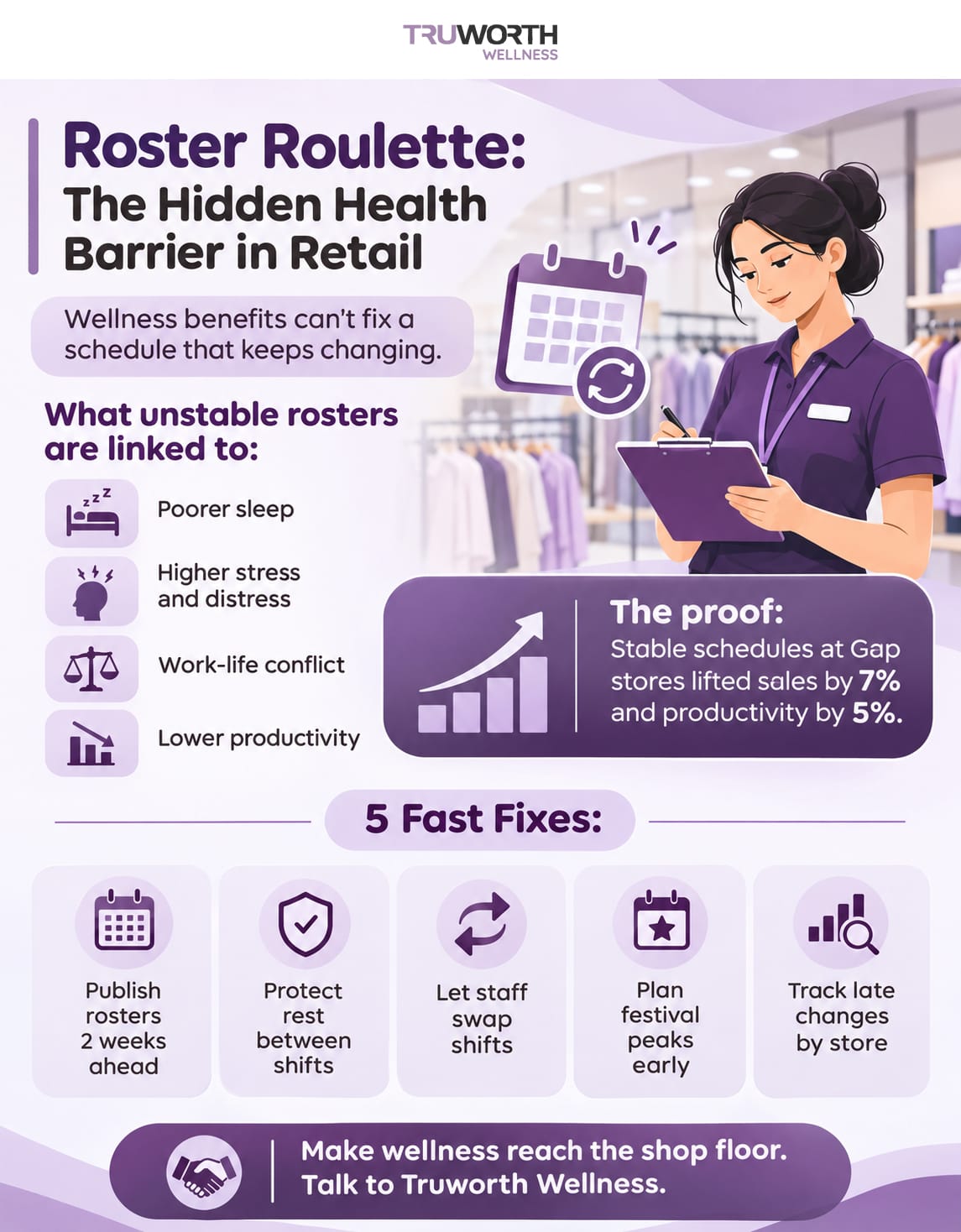
The Shift Project, a long-running US survey of hourly retail and food service workers, found that unpredictable schedules are associated with psychological distress, poor sleep quality and unhappiness. The link was stronger for schedule instability than for low wages, and work-life conflict explained much of it. In the same research, 43% of workers who had a shift cancelled reported feeling unhappy, compared with 26% of those who had not.
Three pathways link scheduling to retail employee wellness:
- Sleep: swinging between closing and opening shifts disrupts the body clock.
- Stress: not knowing next week's hours creates constant low-level worry, a major driver of retail employee stress.
- Work-life balance for retail employees: cancelled plans, missed family time and trouble arranging childcare, studies or a second job.
One caution: most of this research comes from the US. Indian retail differs in laws, wages and shift patterns, and rigorous local data is limited. But the mechanisms, which are lost sleep, stress and lost control over time, are human, not national.

From Stress to Burnout: Why It Matters for Retail Workforce Wellbeing
Retail work already carries demanding conditions: long hours on your feet, customer pressure, sales targets and peak seasons such as festivals and sale periods. Add unpredictable schedules, and retail employee burnout becomes more likely.
The World Health Organization describes burn-out as an occupational phenomenon that results from chronic workplace stress that has not been successfully managed. Its signs are exhaustion, mental distance or cynicism toward the job, and reduced effectiveness. It is not formally recognised as a medical diagnosis.
That definition matters for HR because it points to the workplace as part of the cause. Improving retail employee wellness and retail workforce wellbeing cannot rest on individual resilience alone. For frontline employee wellness, the roster has to be treated as a health factor, just like insurance, canteens and counselling.
Also Read: Employee Burnout Is Costing Companies More Than Ever
Warning Signs Your Roster Is Hurting Retail Employee Wellness
- Frequent shift swaps, late changes or cancelled shifts
- Rising absenteeism or sudden resignations after busy periods
- Staff who say they are always tired or cannot plan their week
- Complaints about back-to-back closing and opening shifts
- Low use of wellness benefits because employees cannot get away from the floor
The Business Case: Stable Schedules Help Sales Too
It is easy to assume stable schedules are unaffordable when footfall is unpredictable. A randomised controlled experiment at 28 Gap stores in the San Francisco and Chicago areas tested that assumption. Stores that introduced more stable scheduling saw median sales rise by 7% and labour productivity by 5%, or roughly an extra $6.20 of revenue per labour hour.
Sleep improved as well. Related research from the same team found that nearly half of the workers surveyed (47%) said their schedule interfered with their sleep, and the move to stable schedules was linked to an average 6 to 8 percent improvement in sleep quality.
The researchers also found that customer demand explained only part of the variation in schedules, and that inaccurate information about the size and timing of stock deliveries was a key obstacle to predictability. In other words, many last-minute changes are avoidable.
These are US results from one retailer, so do not expect identical numbers in India. But they show that predictable rosters and strong retail employee wellness are not opposing goals.
7 Ways to Improve Retail Rostering for Employee Wellbeing
These fair scheduling practices for retail employees are a practical starting point for improving retail employee wellness.
- Publish rosters early. Aim for at least two weeks' notice, and treat changes inside 72 hours as exceptions that need a reason.
- Protect rest between shifts. Avoid "clopening", where someone closes late and opens early the next day. Set a minimum rest gap.
- Give staff a voice. Collect availability and shift preferences, and offer a simple swap system so employees can trade shifts.
- Anchor fixed days or hours. Where possible, give each person a predictable core pattern and a fixed weekly off.
- Plan peaks early. Build festival, sale and stock-delivery rosters weeks ahead, and get accurate delivery information from the supply team.
- Create a backup pool. Keep trained floating or part-time staff for absences, so the first response is not to recall someone on their day off.
- Make it a manager KPI. Track notice time and late changes by store, and coach managers who rely on last-minute fixes.
Also Read: The Role Of Community In Employee Wellbeing For Accelerated Healing
Retail Employee Wellness Program Ideas That Support the Roster Fix
Better rostering works best inside a broader retail wellness program. Ideas to consider:
- Employee assistance program for retail workers: confidential counselling by phone or app, in local languages and outside store hours, because staff cannot always step away during a shift.
- Health check-ups for retail store employees in India: simple screening camps or vouchers with confidential results and follow-up support. Long hours on your feet, irregular meals and broken sleep make early checks valuable.
- Break and rest design: proper seating, drinking water, rest areas and protected breaks during peak hours.
- Shift-friendly nutrition and sleep tips: short, practical guidance in place of generic webinars held at fixed times.
- Manager sensitisation: training store managers to spot signs of stress and burnout and to respond with support.
- Easy access to outpatient (OPD) care, so staff can see a doctor without losing a day's pay.

How Retail Employers Can Support Frontline Staff Wellbeing in India?
Working hours, overtime and weekly rest are regulated by state Shops and Establishments Acts and the national labour codes, so check the rules that apply to your stores and states with your compliance team. Compliance is the floor, not the goal.
Beyond that, design retail employee wellness for the shop floor, not the head office: short sessions, mobile access, local languages and timings that fit shift patterns. Retail employee wellness India programmes work when frontline staff can actually use them.
Store managers are the link between policy and practice. If they are measured only on labour cost and sales, they will keep making last-minute changes. Give them clear roster rules, forecasting support and training, and make wellbeing part of how store performance is reviewed.
How to Measure Whether It Is Working?
To measure retail employee wellness, track a few simple numbers by store, before and after the changes: average notice period for roster changes, share of shifts changed within 72 hours, absenteeism, attrition, uptake of EAP and health check-ups, and a short pulse survey on sleep, stress and schedule satisfaction. Review them every quarter and share results with store managers.
Also Read - Annual Health Checkup : Significance And Benefits
Final Thoughts
A retail employee wellness strategy that ignores the roster is treating symptoms while leaving a root cause in place. Counselling, check-ups and benefits matter, but they work best when employees can also sleep, plan their week and trust their schedule. Start with one change, such as earlier rosters or a minimum rest gap, measure the effect and build from there. Small, visible improvements to the roster also show frontline teams that wellness is not just a poster in the break room.
Is your wellness strategy reaching your store floor? Truworth Wellness helps employers support frontline teams with Employee Assistance Programs, OPD health benefits and outcomes-based reporting, so wellbeing reaches every shift, not just head office.
Sources and Further Reading
- The Shift Project (Harvard / UC Berkeley): Service workers with unstable schedules experience negative health outcomes
- Stable Scheduling Study report (Williams, Lambert, Kesavan and Gap Inc.)
- Aspen Institute: Schedule stability, a win for retail businesses and their workers
- World Health Organization: Burn-out an occupational phenomenon (ICD-11)
Disclaimer: This article is for general information and is not medical or legal advice. Employers should check applicable state and national labour laws with their compliance team.
Frequently Asked Questions About Retail Employee Wellness
How do last-minute schedule changes affect employee health?
Research links unpredictable schedules to poorer sleep, higher psychological distress and work-life conflict. Short-notice changes make it hard to plan rest, meals and family time, so stress builds up over weeks.
How to reduce stress for retail staff with changing rosters?
Give notice as early as possible, set a minimum rest gap between shifts and let staff swap shifts. Add confidential counselling support and train managers to respond when employees say they are struggling. Even small signals of fairness, such as advance notice of festival-season shifts, help staff feel in control.
What are fair scheduling practices for retail employees?
They include advance notice of rosters, limits on late changes, rest between shifts, a say in preferred hours, and predictable weekly offs. Always check state and national rules on hours and overtime.
How to improve retail rostering for employee wellbeing?
Plan peak seasons early, use a backup pool for absences, avoid closing-then-opening shifts and track late changes by store. Treat schedule stability as a manager KPI, not an afterthought.
What are some retail employee wellness program ideas?
Consider an employee assistance program, health check-ups, better rest areas, shift-friendly nutrition and sleep guidance, manager training and easy access to doctor consultations. Combine them with fair rostering.
How can retail employers support frontline staff wellbeing?
Start with the basics: predictable rosters, proper breaks and safe, comfortable stores. Then add accessible support such as counselling and health screening that frontline employees can use during their own time.
Is an employee assistance program useful for retail workers?
Yes, if staff can reach it. Retail employees often cannot step away from the floor, so a phone or app-based EAP in local languages, available outside store hours, removes the biggest barrier to using it.
Why are health check-ups important for retail store employees in India?
Long hours on your feet, irregular meals and disrupted sleep can raise health risks over time. Regular check-ups can help spot problems early, provided results stay confidential and employees get follow-up support.
How does scheduling affect employee turnover in retail?
Evidence is suggestive, not conclusive. In the Gap experiment, more stable schedules appeared to help people stay longer, but turnover also depends on pay, growth and managers. Stable rosters are one lever.