When Should A Company Introduce An EAP?

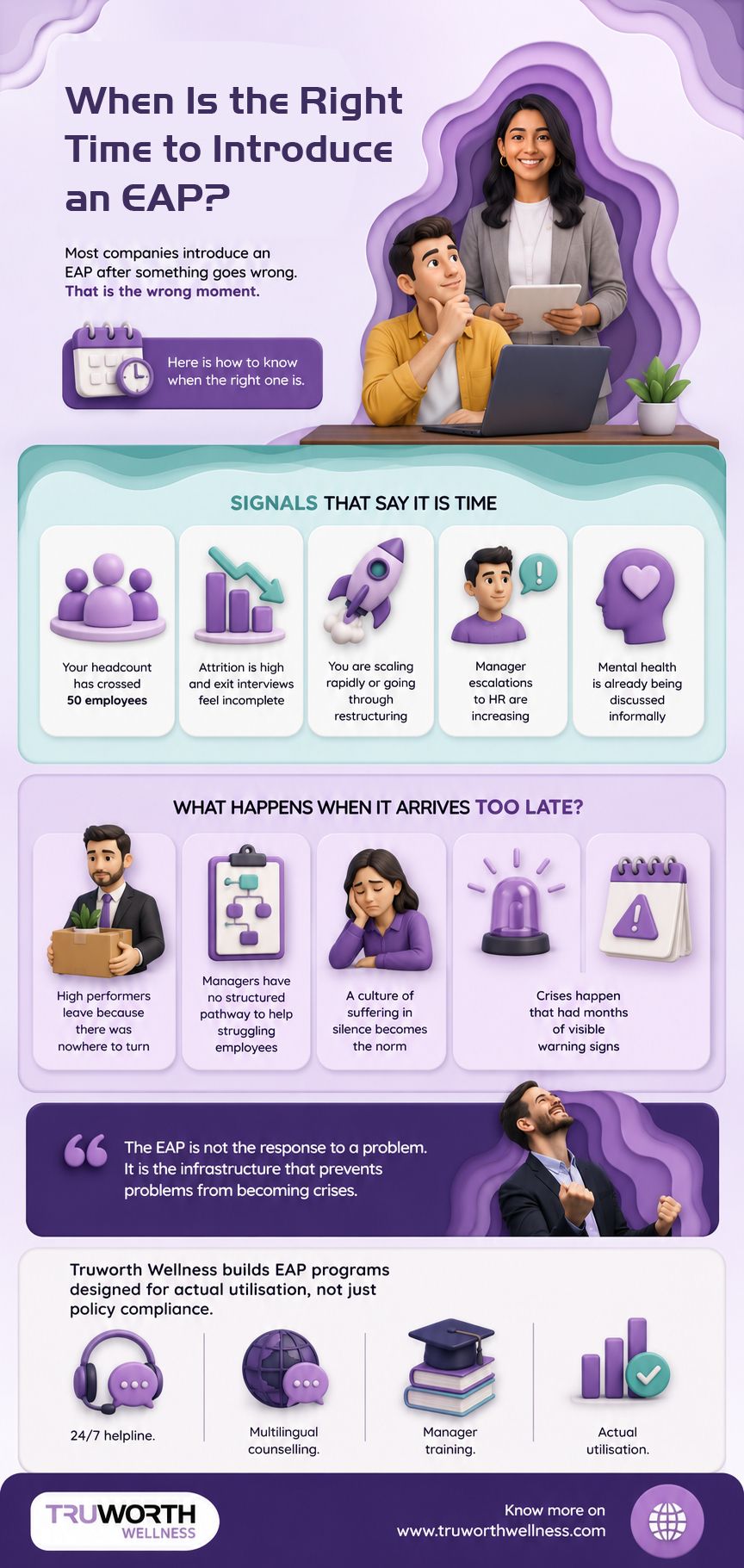
Most companies introduce an EAP after something goes wrong. Here is why that timing is exactly backwards and what the right moment actually looks like.
There is a pattern that repeats itself in Indian corporate wellness conversations with uncomfortable regularity.
A senior employee has a breakdown. Or someone resigns citing mental health. Or an incident happens that HR has no framework to respond to. Or a leadership team reads a report about burnout statistics and suddenly feels the urgency they did not feel the previous quarter.
And then the EAP conversation begins.
The problem is not that these companies are introducing an EAP. The problem is that they are introducing it in response to a crisis rather than in anticipation of one. And an EAP introduced reactively, without the cultural groundwork, the manager training, the employee communication and the genuine leadership commitment that makes it work, is an EAP that will sit unused while the next crisis builds quietly in the background.
The right time to introduce an EAP is almost certainly earlier than your organisation thinks. Here is how to know when that moment actually is.
What an EAP Is and What It Is Not?
Before discussing timing, it helps to be clear about what an EAP actually is. Because the most common reason companies delay introducing one is a misunderstanding of its purpose.
An Employee Assistance Program is not:
- A crisis hotline for employees in psychiatric emergencies
- A benefit for people who are seriously mentally ill
- A replacement for health insurance or clinical treatment
- A service that most employees will never need
An EAP is:
- A confidential, early-intervention support system for everyday mental health challenges
- A resource for stress, anxiety, relationship difficulties, financial worries and work-related emotional challenges
- A preventive tool that catches problems early before they become clinical crises
- A signal to employees that the organisation takes their whole health seriously
- A structured pathway for managers who notice a struggling employee and do not know what to do
When understood this way, the question of when to introduce an EAP answers itself much more quickly. If your employees experience stress, which they do, if they face personal and professional challenges, which they do, and if you want a structured, confidential, professional support system available to them before those challenges become crises, which you should, then the right time to introduce an EAP is now.
 Truworth Wellness
The Signals That Say It Is Time
While the honest answer is that most organisations should have introduced an EAP earlier than they did, there are specific signals that make the case with particular clarity.
1) Your headcount has crossed fifty employees
Below a certain size, founders and senior leaders often have direct, personal relationships with every team member. They notice when someone is struggling. They can have an informal conversation. The informal care infrastructure that small teams naturally develop can partially substitute for formal EAP support.
Once a company crosses fifty to one hundred employees, that informal visibility disappears. Teams are larger. Managers are more removed. Individual struggles become invisible more easily. The organisation is now large enough that some employees are almost certainly struggling with no one aware of it. This is the inflection point where an EAP stops being a nice-to-have and starts being a genuine operational necessity.
2) Attrition is higher than it should be and exit interviews are not telling the full story
High attrition almost always has a mental health and wellbeing dimension that exit interviews do not capture. Employees do not say in exit interviews that they left because they were burning out, because they felt invisible, because the stress was unsustainable or because they had nowhere to turn when things got difficult. They say growth, opportunity, compensation.
If attrition is elevated and the stated reasons do not feel like the complete picture, the unstated reasons are often exactly what an EAP is designed to address. Introducing one before the next wave of resignations rather than after is the appropriate response.
3) You are scaling rapidly
Fast growth is exciting. It is also one of the most psychologically demanding environments for employees. Roles change quickly. Structures shift. New people arrive faster than culture can absorb them. Ambiguity is high. The psychological safety that stable, well-understood environments provide is frequently absent in fast-scaling companies.
Employees in rapidly scaling organisations are carrying significant uncertainty alongside their regular workloads. An EAP introduced during a growth phase provides the psychological safety net that the organisational environment cannot yet provide naturally.
4) You have gone through or are planning a restructuring
Layoffs, restructurings and significant organisational changes create well-documented mental health impacts on the employees who remain. Survivor guilt, anxiety about job security, grief for departed colleagues, increased workloads and reduced trust in the organisation are all predictable consequences of restructuring events.
Introducing an EAP immediately before or after a restructuring is not too late. It is one of the most appropriate moments, because the need is documented, the timing is visible and leadership has a natural communication hook for why the benefit is being introduced.
5) Manager escalations to HR are increasing
When managers are increasingly bringing HR into conversations about struggling employees, it is a signal that the informal support systems within the organisation are at capacity. Managers are noticing problems but do not have the tools or the frameworks to respond effectively. HR is being asked to fill a gap it is not always resourced to fill.
An EAP addresses this directly by giving managers a structured, professional pathway to point struggling employees toward rather than attempting to provide the support themselves.
6) Mental health conversations are starting to happen informally
When employees are beginning to talk about stress, burnout, anxiety or mental health challenges informally, in Slack channels, in corridor conversations, in anonymous feedback, it is a strong signal that the need exists and is not being formally acknowledged or met. This informal conversation is an opportunity, not a warning sign. It means employees are ready to engage with mental health support if it is provided. The EAP is the formal response to an informal signal that has already arrived.
The Wrong Reasons Companies Delay
Understanding the most common reasons organisations delay introducing an EAP helps address the objections that frequently come up in the decision-making process.
"Our employees seem fine."
This is the most common and most dangerous reason for delay. Employees who are not fine are almost never visibly not fine until the situation has reached a point where the consequences are already significant. The nature of mental health challenges in corporate environments is that they are hidden until they are not. Seeming fine is not the same as being fine, and an organisation cannot assess its employees' mental health without a mechanism designed to surface it.
"We are too small for an EAP."
There is no meaningful minimum size threshold for employee mental health need. A ten-person startup has employees managing stress, personal challenges and work-related mental health difficulties just as a five-hundred-person corporate does. The difference is scale, not existence. Appropriately designed and scaled EAP solutions exist for organisations of all sizes.
"It will send the wrong signal, like we think our employees are struggling."
This reflects a misunderstanding of how EAP communication works and how employees respond to it. Introducing an EAP does not signal that the organisation thinks its employees are unwell. It signals that the organisation takes its employees' whole health seriously, provides a resource proactively rather than reactively and trusts its employees to use it if and when they need it. The signal it sends is one of care, not concern.
"We will introduce it after we sort out the more immediate priorities."
The immediate priorities almost always include some version of the problems an EAP is designed to address. Attrition, performance issues, manager capability gaps, engagement challenges. Positioning the EAP as something for after the urgent problems are solved misses that the EAP is part of how the urgent problems get solved.
What Happens When the EAP Arrives Too Late?
The cost of delayed EAP introduction is not always visible on a dashboard. But it is real.
- The employee who left because there was nowhere to turn: High performers who develop mental health challenges in unsupported environments do not always stay. The attrition that follows a burnout episode that was not caught early is a talent cost that is rarely attributed to its true cause.
- The manager who did not know what to do:When a manager has a struggling employee and no structured pathway to offer support, they either over-involve themselves in a way that breaches appropriate boundaries or do nothing. Neither outcome serves the employee or the organisation. The EAP is the resource that gives the manager something to do that is both helpful and appropriate.
- The culture that developed around suffering in silence: Organisations without formal mental health support develop informal norms around managing difficulty privately. Those norms become cultural. The expectation that struggling should be invisible embeds itself. Introducing an EAP into a culture that has been built around silence requires significantly more work than introducing one before that culture has solidified.
· The crisis that was entirely predictable:Most significant mental health events in corporate environments are not sudden. They are the end point of a trajectory that had visible signals for months. An EAP with proactive outreach and accessible early intervention catches people at the beginning of that trajectory, not at the end.
Exploring The Power Of EAP Helplines For Corporates
The Right Way to Introduce an EAP
Timing matters. So does execution. An EAP introduced without the following elements will underperform regardless of when it arrives.
- Leadership endorsement that is visible and genuine: The single most powerful driver of EAP utilisation is whether senior leaders talk about mental health openly and reference the EAP as a resource they value. A leadership team that introduces the EAP and never mentions it again has not introduced it in any meaningful sense.
- Manager training before the launch: Managers are the primary referral pathway into the EAP. Without training on how to notice a struggling employee, how to have a supportive conversation and how to make an EAP referral naturally and appropriately, the most important access pathway remains closed.
- Simple, clear employee communication:Employees need to know three things. What the EAP is. What it covers. How to access it. That information needs to be communicated in plain language, through multiple channels and repeated regularly, not announced once at launch and never mentioned again.
- Genuine confidentiality that employees believe: The stated confidentiality of an EAP is meaningless if the culture does not support the belief that using it is genuinely safe. Building that belief requires consistent cultural signals over time, not just a promise in the introductory email.
- Measurement and review: Utilisation rates, most common presenting issues, peak usage periods and employee feedback are all data points that should be reviewed regularly and used to improve both the EAP design and the broader organisational response to employee mental health.
The Bottom Line
The right time to introduce an EAP is before you feel like you urgently need one. Because by the time the urgency is visible, the cost has already accumulated, the culture has already adapted around the absence of support and the employees who most needed it have already made decisions based on its absence.
If your organisation has people, those people have mental health. And mental health, like physical health, is best supported proactively rather than reactively.
The EAP is not the response to a problem. It is the infrastructure that prevents problems from becoming crises.
Build the infrastructure before the crisis. That is when to introduce an EAP.
Truworth Wellness helps organisations design and implement EAP programs that are built for actual utilisation, not just policy compliance. From 24/7 helpline access and multilingual counselling to manager training and leadership engagement, our EAP is designed to reach the employees who need it before they reach a breaking point. Talk to us about introducing an EAP that works from day one.