Screen Lock Fatigue: Why Your Eyes, Brain & Body Are Paying The Price For Your Work?

You are not just tired. You are screen tired. And there is a difference.
Close your eyes for a moment.
Go on. Actually do it.
Notice what that feels like. The immediate relief. The quiet. The sense of the world pulling back slightly. The muscles around your eyes loosening in a way you did not even realise they were tight.
Now think about how many times you did that today at work.
Probably not many. Because the screen needed you. The emails kept coming. The messages kept pinging. The presentations kept demanding. And so you kept looking. Hour after hour, without realising that what you were asking your eyes, your brain and your nervous system to do across an eight to ten hour workday is genuinely extraordinary, and that the exhaustion you feel by evening is not a character flaw or a sign of low fitness.
It is a physiological response to a very specific and very modern kind of demand.
It is called screen fatigue. And it is quietly becoming one of the most widespread and least addressed health issues in the Indian corporate workforce.
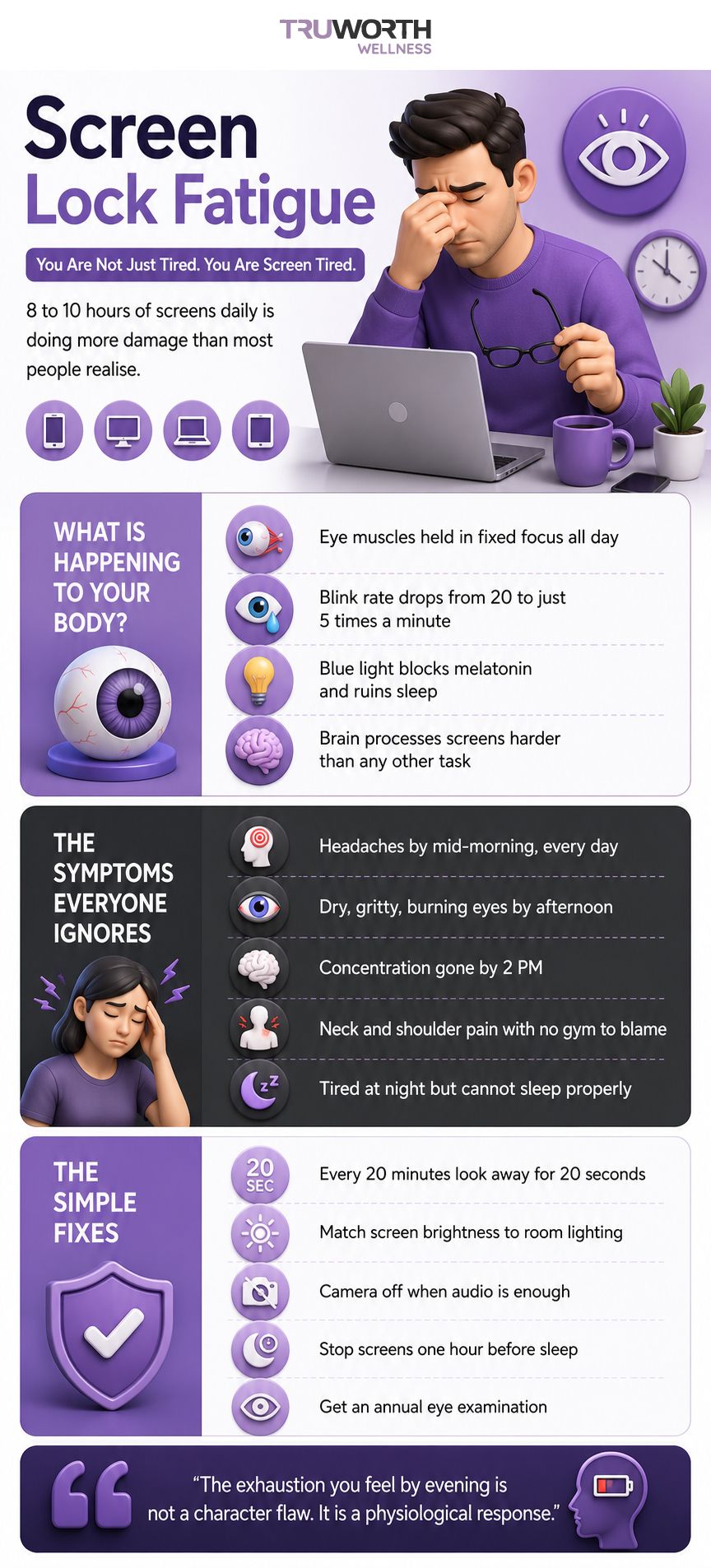
What Screen Fatigue Actually Is?
Screen fatigue, sometimes called digital eye strain or computer vision syndrome, is not simply tiredness from a long day. It is a cluster of physical, cognitive and neurological symptoms that develop from sustained, uninterrupted screen exposure.
It affects the eyes, obviously. But it goes much further than that.
Here is what is actually happening in the body during a typical corporate screen day:
The eyes are doing something they were never designed for.
Human eyes evolved for variety, not fixation. Here is what sustained screen use demands instead:
- Looking at a fixed, backlit screen at a consistent distance for hours at a time
- Performing thousands of tiny focus adjustments called accommodation every hour
- Holding eye muscles in sustained contraction, like holding your arm straight out all day
- Doing all of this in artificial light with almost zero variation in focal distance
The muscles fatigue. The focus becomes less sharp. The eyes begin to ache. None of this is surprising once you understand what the visual system is actually being asked to do.
Blinking drops dramatically.
- Normal blink rate: 15 to 20 blinks per minute
- During screen use: as few as 5 to 7 blinks per minute
- Result: the tear film on the eye surface evaporates faster than it is replenished
- Outcome: dry, irritated, gritty eyes that get progressively worse through the day, especially in air-conditioned offices where humidity is already low
Blue light affects the brain's timing system.
- Blue wavelength light from screens directly suppresses melatonin production
- Melatonin is the hormone that tells the body it is time to sleep
- Evening screen use pushes the biological clock later
- Result: difficulty falling asleep, lighter sleep quality and next-day fatigue that compounds over weeks
The brain is working harder than it appears.
Reading on a screen demands more from the brain than most people realise:
- Lower contrast and self-luminance of displays increase cognitive processing load
- Subtle screen flicker invisible to conscious awareness adds to neural strain
- Constant background processing of notifications and dynamic content never fully stops
- The result is genuine cognitive fatigue by mid-afternoon that goes far beyond ordinary tiredness
 Truworth Wellness
The Symptoms Nobody Is Connecting to Their Screen
This is where screen fatigue becomes an organisational issue rather than just a personal one.
The symptoms are common, widely experienced and almost universally misattributed to other causes.
1) Headaches that arrive by mid-morning and stay
A dull, persistent pressure around the temples or behind the eyes that builds across the day. Gets blamed on dehydration, poor sleep or tension. Frequently caused by sustained ocular muscle strain and the cognitive load of continuous screen processing.
2) Eyes that feel gritty, dry or burning by afternoon
Most employees experience this daily and manage it by rubbing their eyes or simply enduring it. It is dry eye from reduced blink rate and it is progressive. Unaddressed, it becomes a chronic condition.
3) Blurred vision that comes and goes
Particularly noticeable when looking up from the screen to something across the room. The eye muscles have been held in fixed-focus contraction so long that they temporarily cannot adjust smoothly. This is called accommodation spasm and it is a direct indicator of significant ocular fatigue.
4) Neck, shoulder and upper back pain.
Screen fatigue is not only an eye condition. It creates a chain of physical effects:
- Forward head posture during screen use creates sustained neck muscle tension
- Shoulder and upper back muscles compensate and tighten across the day
- This tension contributes directly to headaches and end-of-day physical exhaustion
- It is why a screen-heavy day can feel like physical work even without leaving the desk
5) Difficulty concentrating after lunch
The afternoon concentration collapse is partly metabolic and partly neurological. The brain, having processed screens for four to five hours continuously, is genuinely fatigued in a measurable neurological sense. The inability to focus is not laziness. It is cognitive exhaustion from sustained digital processing.
6) Poor sleep despite genuine tiredness
The evening screen-sleep cycle is one of the most damaging patterns in corporate health:
- A day of constant digital stimulation leaves the brain in a state of neurological arousal
- Evening screen use suppresses melatonin further, pushing sleep onset later
- Sleep is lighter and less restorative even when duration appears adequate
- The next day starts with a deficit and the cycle compounds week after week
7) Irritability and reduced emotional tolerance
Neurological fatigue from sustained screen exposure directly reduces the brain's capacity to regulate emotional responses. The short temper and reduced patience by late afternoon is not a personality issue. It is a fatigued nervous system with depleted regulatory capacity.
The Scale of the Problem in Indian Corporate Life
Screen time in Indian corporate environments has increased dramatically over the past five years. Remote and hybrid work, the proliferation of communication platforms, video calls that replaced walk-to-desk conversations, and the migration of almost every work process to digital interfaces have created a situation where many employees are looking at screens for ten to twelve hours a day, including evenings.
Add personal screen time and the total daily screen exposure for many Indian corporate employees reaches fourteen to sixteen hours.
The eyes, brain and nervous system were not designed for this.
What makes this particularly significant is the compounding effect with other prevalent health issues:
- Employees already metabolically compromised absorb screen fatigue faster
- Those sleeping poorly have less neurological recovery capacity
- Employees managing chronic stress have a depleted nervous system before the screen day even begins
- Sedentary employees compound ocular and cognitive strain with physical postural strain
When one system is under strain, the others have less reserve. Screen fatigue does not exist in isolation. It sits on top of everything else.
What Most Companies Are Doing About It?
Almost nothing.
The occasional email about the 20-20-20 rule. A poster in the break room about taking screen breaks. A wellness webinar that forty people attended and nobody changed behaviour after.
The structural factors that actually drive screen fatigue remain entirely unaddressed:
- Meeting culture that demands camera-on video calls all day
- Notification norms that make being offline feel professionally dangerous
- Performance culture that equates screen presence with productivity
- Office lighting and screen setups that are never properly optimised
Screen fatigue is being treated as a personal management problem when it is fundamentally an organisational design problem.
What Actually Helps?
The good news is that screen fatigue is highly responsive to relatively simple interventions. The barrier is not knowledge. It is the organisational will to implement changes that challenge some deeply embedded assumptions about how work should look.
1) The 20-20-20 rule, but actually followed
Every twenty minutes, look at something twenty feet away for twenty seconds. This gives the eye muscles a chance to release their sustained contraction and partially recover. A wellness platform that delivers timed eye break nudges throughout the workday builds this into the routine rather than leaving it to individual willpower.
2) Blink reminders sound trivial. They are not
A simple, periodic reminder to blink consciously during screen work has a measurable effect on tear film health and ocular comfort across the day. It takes no time, costs nothing and makes a genuine difference to afternoon eye symptoms.
3) Screen and lighting setup matters enormously
Small physical changes with significant daily impact:
- Screen brightness matched to ambient light, not set to maximum
- Screen positioned at arm's length and slightly below eye level
- Matte screen protector to reduce glare
- Warm-toned ambient lighting rather than harsh overhead fluorescent
4) Blue light management in the evening
- Night mode or warm display settings on all devices after 7 PM
- Blue light filtering glasses for employees who work on screens in the evening
- A hard stop on work screens at least an hour before sleep
5) Async communication as a health intervention
Every video call replaced with a written update or voice message is a period of reduced ocular and cognitive demand. Async communication norms are not just a productivity preference. They are a direct screen fatigue reduction strategy.
6) Camera optional as a genuine cultural norm
The requirement to be visually present on video for hours every day significantly increases ocular and cognitive fatigue. Organisations that make camera-off genuinely acceptable, culturally rather than just in writing, meaningfully reduce daily screen load.
7) Movement breaks that move the eyes as well as the body
Physical movement breaks that include distance gazing, looking out of a window, focusing on a far object, address ocular fatigue specifically in ways that a walk to the coffee machine does not.
8) Annual eye examinations as a workplace health standard
A significant proportion of screen-related fatigue is worsened by uncorrected or incorrectly corrected vision. Workplace health programs that include vision screening and annual eye examination access address a root cause rather than just the symptoms.
Must Check: How Digital Detox Can Boost Productivity?
The Mental Health Dimension Nobody Is Talking About
Screen fatigue has a mental health dimension that is rarely discussed but clinically significant.
Constant connectivity creates a state of sustained low-level alertness in the nervous system. This state is metabolically and neurologically expensive.
Over time, this contributes to what researchers describe as attention residue:
- Even during moments away from the screen, part of the brain remains in the digital environment
- The mental rest needed to consolidate memory and regulate emotion never fully happens
- The result is a baseline of anxiety, irritability and cognitive depletion that feels chronic
This contributes directly to the anxiety, the irritability, the sense of never quite switching off, and the feeling of being constantly behind that many corporate employees experience as background noise. It is not a personality trait. It is a neurological consequence of an always-on digital life.
An EAP that supports employees with stress, anxiety and sleep issues is addressing the mental health symptoms of screen fatigue even when it does not name it as such. The connection between digital overload, nervous system dysregulation and mental health outcomes is real and the support for it belongs inside a comprehensive wellness program.
Must Check: Signs Your Brain Is Overstimulated And Why The Workplace Is Often The Cause?
A Simple Experiment Worth Trying
Tomorrow at work, set a timer for twenty minutes. When it goes off, look away from your screen for twenty seconds. Look out of a window if possible. Focus on something far away. Blink deliberately several times.
Do this every twenty minutes for one day.
Notice how your eyes feel at 5 PM compared to a typical day. Notice whether your headache arrived or did not. Notice whether your concentration held longer into the afternoon.
One day of following the 20-20-20 rule consistently will not reverse months of screen fatigue. But it will give you a reference point for what less ocular strain feels like. And that reference point is the beginning of taking this seriously.
What Organisations Need to Do?
Screen fatigue is not going away. Screens are central to how modern work happens and will remain so.
But these are entirely within organisational control:
- The norms created around camera use and async communication
- The physical setups and lighting provided to employees
- The eye health screening included in wellness programs
- The mental health support available for anxiety and sleep issues screen fatigue drives
- The meeting culture that determines how many hours of video calls fill a day
An employee whose eyes ache every afternoon, whose headaches are chronic, whose sleep is poor and whose concentration collapses by 3 PM is not performing at their potential. The productivity cost of widespread screen fatigue in a large organisation is enormous and almost entirely unmeasured.
Measuring it would be a start. Addressing it would be better.
Truworth Wellness builds corporate wellness programs that address the full spectrum of modern workplace health challenges, including the digital health issues that most programs have never caught up with. From eye health support and sleep coaching to EAP access for the anxiety and cognitive fatigue that screen overload drives, we help organisations protect the health of a workforce that lives on screens. Talk to us about building a wellness program that reflects how your people actually work.