The Hidden Costs Procurement Teams Often Miss During Vendor Selection
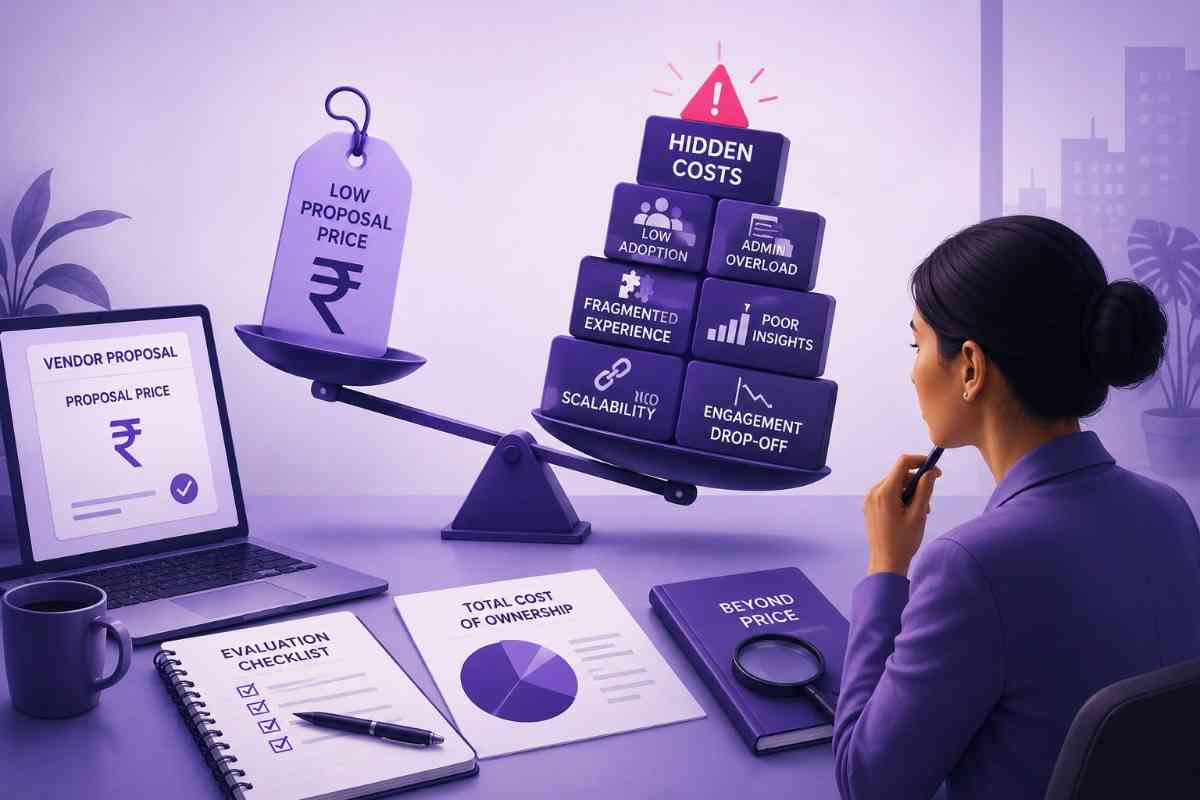
When organizations evaluate vendors, the process often begins with a simple question:
Which option offers the best value for the budget?
It is a reasonable place to start. Procurement teams are expected to manage costs, negotiate effectively, and ensure every investment delivers measurable returns.
But when it comes to employee wellbeing solutions, the lowest-cost option on paper is not always the most cost-effective choice in practice.
A wellness platform may fit the budget. The proposal may look impressive. The feature list may check every box.
Yet a few months after implementation, reality often tells a different story.
Employees are not engaging with the platform. HR teams are spending extra time managing vendor requests. Reporting lacks meaningful insights. Participation declines after the initial launch. The promised impact never fully materializes.
At that point, the organization is no longer paying only for the vendor. It is paying for missed opportunities, lost engagement, administrative effort, and unrealized outcomes.
The truth is that some of the most significant costs of vendor selection never appear in the proposal document.
Looking Beyond the Price Tag
Procurement teams have become increasingly sophisticated in evaluating technology, services, and workplace solutions. Yet wellness programs are sometimes assessed primarily through features, pricing, and contractual terms.
While these factors matter, they only tell part of the story.
A wellness solution succeeds when employees actually use it, find value in it, and continue engaging with it over time. If that does not happen, even the most affordable solution can become an expensive investment.
The challenge is not simply choosing a vendor. It is choosing a partner capable of creating long-term value.
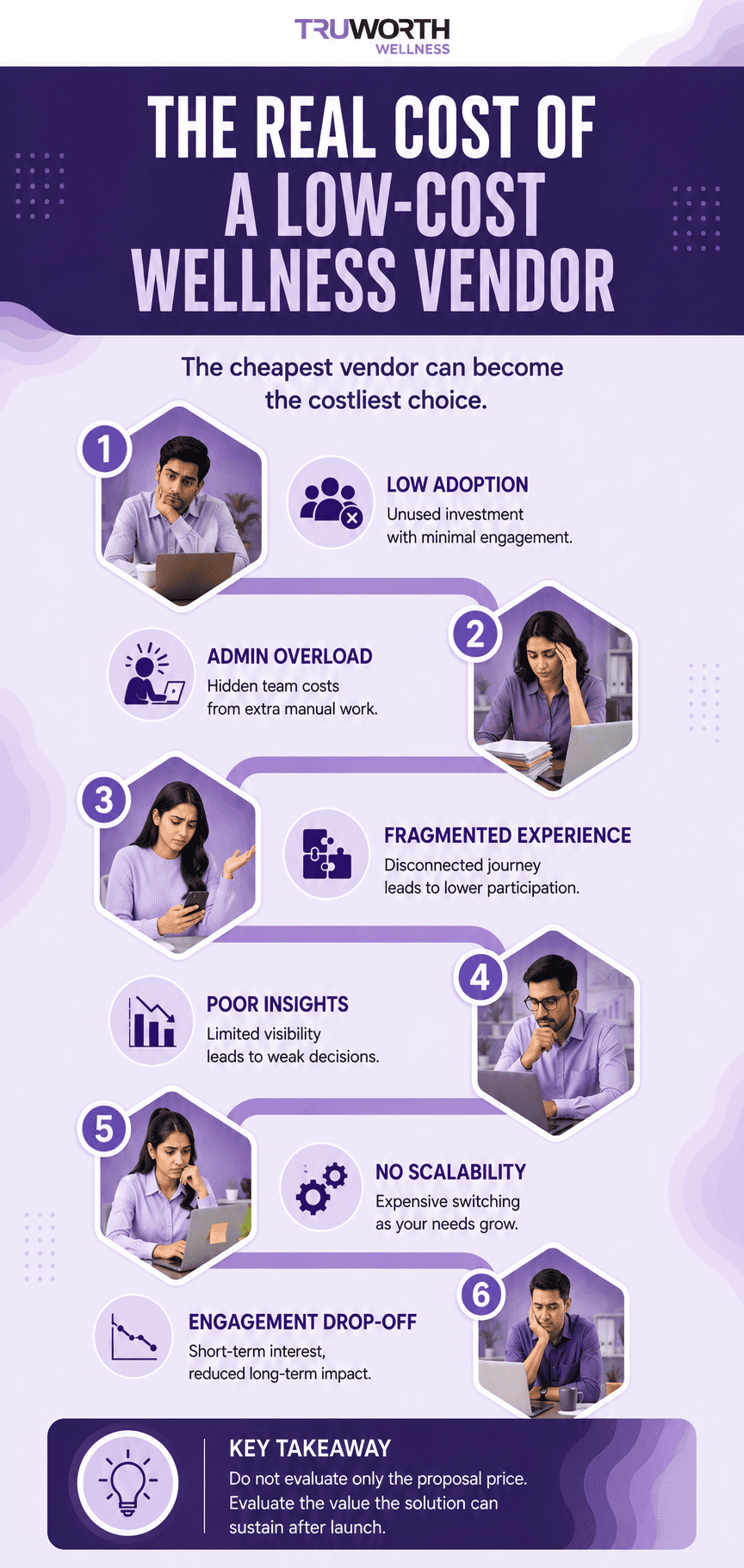
Hidden Cost #1: Low Employee Adoption
Imagine purchasing a wellness platform packed with features.
It offers health assessments, fitness resources, mental health content, nutrition guidance, and wellness challenges.
On paper, it looks comprehensive.
But if employees rarely log in after the first few weeks, those features become largely irrelevant.
One of the biggest hidden costs in wellness investments is low adoption.
When participation remains low:
- Employee wellbeing goals are harder to achieve
- Program outcomes become difficult to measure
- Return on investment suffers
- Future wellness initiatives may face greater skepticism
Before selecting a vendor, it is worth asking:
- How does the platform encourage participation?
- What strategies support ongoing engagement?
- What does employee usage typically look like after six months or one year?
A platform that employees actively use often creates more value than one with a longer feature list but lower engagement.
Hidden Cost #2: The Administrative Burden Nobody Planned For
A vendor may appear cost-effective until implementation begins.
Suddenly, HR teams find themselves spending time on:
- Manual employee onboarding
- Campaign coordination
- Follow-ups with vendor teams
- Data consolidation
- Report generation
These tasks consume valuable hours that could otherwise be spent on strategic people initiatives.
This hidden operational cost is often overlooked during vendor evaluation.
The question should not only be, "How much does the platform cost?"
It should also be, "How much work will it create for our internal teams?"
The best partnerships simplify wellness management rather than adding another layer of complexity.
Hidden Cost #3: A Fragmented Employee Experience
Many organizations build their wellbeing ecosystem one solution at a time.
One vendor for fitness. Another for mental wellbeing. Another for health assessments. Another for rewards and engagement.
While each solution may serve a purpose, the employee experience can quickly become fragmented.
Employees may have to navigate multiple platforms, remember different logins, and engage with disconnected experiences.
Over time, this complexity often leads to lower participation.
People are far more likely to engage with wellbeing programs when the experience feels simple, seamless, and easy to access.
Convenience is not just a nice-to-have. It directly influences engagement.
Hidden Cost #4: Data That Does Not Drive Action
Most vendors offer dashboards.
But dashboards alone do not create value.
Organizations need insights that help answer meaningful questions:
- What wellbeing challenges are employees facing?
- Which programs are generating engagement?
- Where should future investments be focused?
- What trends are emerging across the workforce?
Without actionable insights, wellness programs become difficult to evaluate and even harder to improve.
Good data should not just describe activity. It should support better decision-making.
Hidden Cost #5: Outgrowing the Solution Too Quickly
A vendor may meet today's needs perfectly.
But what happens as the organization grows?
Can the platform support:
- A larger workforce?
- Multiple office locations?
- Different employee demographics?
- Evolving wellbeing priorities?
Switching vendors later can be disruptive and expensive.
It often involves:
- New implementation costs
- Employee retraining
- Data migration challenges
- Reduced engagement during transition periods
Choosing a scalable solution from the beginning can prevent significant costs in the future.
Hidden Cost #6: The Engagement Drop-Off Effect
This may be the most common challenge of all. Many wellness initiatives begin with excitement.
Launch communications generate interest. Employees explore the platform. Participation spikes.
Then, gradually, engagement starts to fade. Months later, only a small percentage of employees remain active.
This is not necessarily a platform problem. It is often an engagement problem. Sustained wellbeing outcomes require sustained participation.
That is why organizations should look beyond launch plans and ask:
- How does the vendor keep employees engaged throughout the year?
- What mechanisms encourage repeat participation?
- How does the platform make wellbeing feel relevant over time?
Because the true value of a wellness solution is not measured during launch week. It is measured in the months and years that follow.
What Great Vendor Selection Really Looks Like?
The most successful procurement decisions balance cost with long-term value.
Instead of focusing exclusively on pricing, organizations can broaden the conversation to include:
- Employee adoption
- Ease of use
- Ongoing engagement
- Administrative efficiency
- Quality of insights
- Scalability
- Employee experience
- Long-term outcomes
These factors often determine whether a wellness investment delivers meaningful impact or quietly fades into the background.
The goal is not simply to purchase a solution.
The goal is to create healthier, more engaged employees while making the process manageable for the teams responsible for delivering it.
Choosing a Partner, Not Just a Platform
As workplace wellbeing continues to evolve, organizations are beginning to ask different questions during vendor selection.
They are looking beyond features and pricing. They are evaluating how effectively a solution supports engagement, simplifies administration, creates meaningful employee experiences, and delivers measurable outcomes over time.
At Truworth Wellness, we have seen firsthand how these factors influence the success of wellness programs. Sustainable wellbeing is rarely achieved through technology alone. It requires thoughtful design, continuous engagement, and experiences that employees genuinely want to participate in.
The organizations seeing the strongest results are often those that view wellness vendors not as service providers, but as long-term partners in employee wellbeing.
The Best Procurement Decisions Create Value Long After the Contract Is Signed
A contract may define the beginning of a vendor relationship, but it does not determine its success.
Success is reflected in healthier employees. Stronger engagement. Better participation. Easier administration. More informed decision-making.
Those outcomes rarely depend on price alone.
The next time your organization evaluates a wellness vendor, consider looking beyond what appears in the proposal.
- Ask how the solution will perform six months from now.
- Ask how employees will experience it.
- Ask how much value it will create over time.
Because the most expensive wellness investment is often not the one that costs the most.
It is the one that nobody uses.
Frequently Asked Questions
1. Why should procurement teams look beyond vendor pricing?
Because the lowest price does not always reflect the true cost. Low adoption, extra administration, poor reporting, and weak engagement can reduce the overall value of the investment.
2. What is the biggest hidden cost in wellness vendor selection?
Low employee adoption is often the biggest hidden cost. If employees do not use the platform consistently, even a feature-rich solution delivers limited impact.
3. How can organizations reduce administrative burden?
They can choose vendors that offer smooth implementation, automated workflows, clear reporting, and strong support for HR or benefits teams.
4. What should be evaluated before finalizing a wellness vendor?
Procurement teams should assess adoption strategy, employee experience, engagement methods, scalability, reporting quality, and long-term partnership support.
5. What is the simplest rule for better vendor selection?
Do not choose the vendor that only looks affordable today. Choose the partner that can create measurable value over time.