The Quick Fix Trap: What People Get Wrong About Supplements?

Walk into any office conversation today and you will hear it.
“I started magnesium for stress.”
“I’m taking vitamin D for energy.”
“I added protein powder because I feel tired.”
“My friend said probiotics helped her gut.”
Supplements have quietly become part of the modern employee routine. Not because companies are pushing them. But because employees are trying to fix how they feel, on their own, without much guidance.
Low energy. Poor sleep. Stress. Weight gain. Brain fog.
Instead of asking what in their daily routine is driving these symptoms, many employees reach for capsules, powders, and quick fixes. Social media advice, influencer recommendations, and peer suggestions often replace clinical evaluation and lifestyle reflection.
This is where corporate wellness has a critical opportunity.
Most workplace health concerns are not rooted in deficiency. They are rooted in patterns. Long sitting hours. Irregular meals. Chronic stress. Screen overload. Inconsistent sleep.
When supplements become the first step instead of the last step, the real drivers of poor health remain untouched.
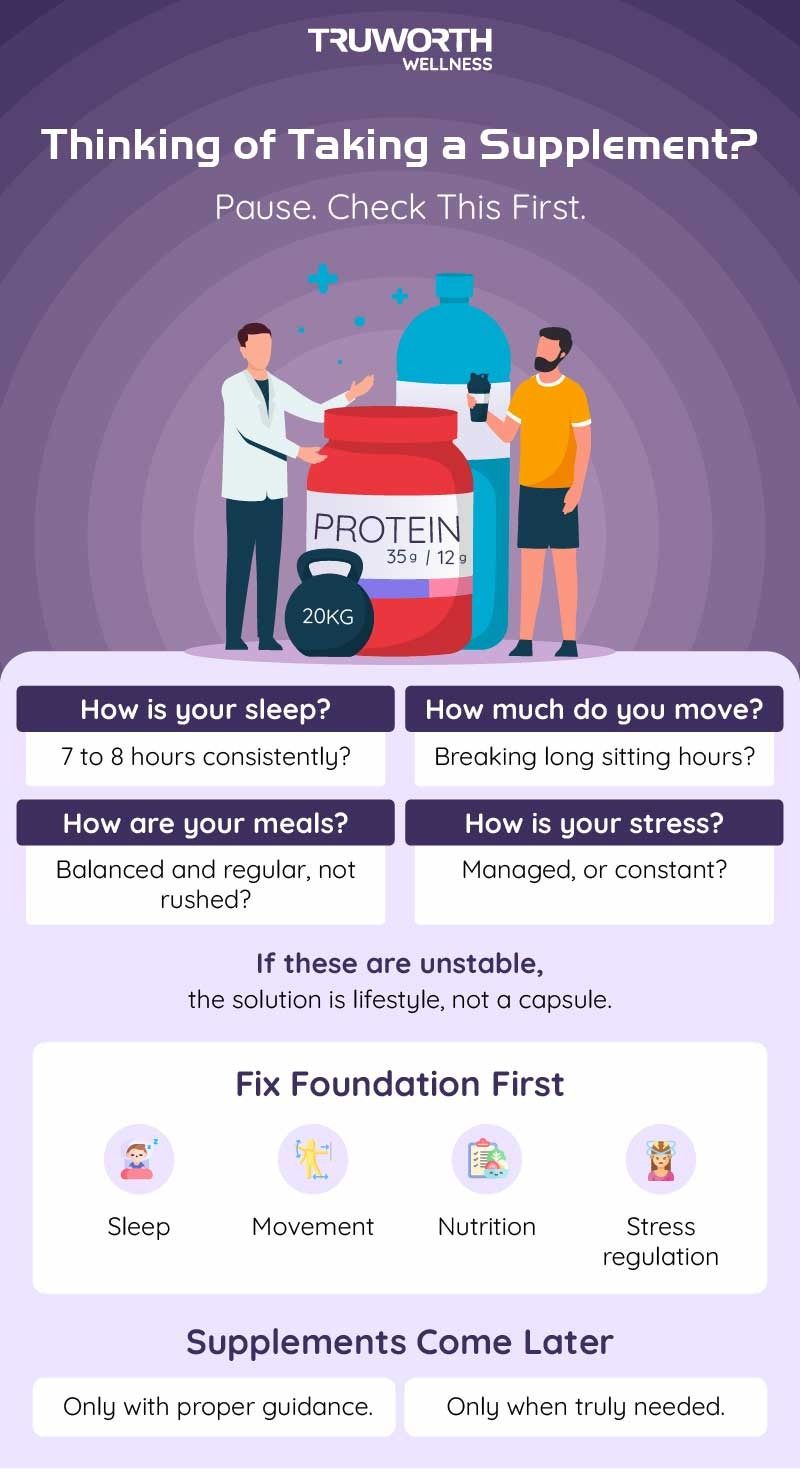
Before any tablet, there must be a habit check. Before any powder, a pattern audit. Before any supplement, a lifestyle correction.
Because sustainable health at work is built on behavior, not bottles.
Also Read: How Do You Know If Social Media Is Affecting You Negatively (Even If You May Not Realize It)?
The Supplement Culture At Work
The global supplement market is expanding rapidly, influenced by trends amplified through platforms like Instagram and YouTube, where influencers promote magnesium for stress, protein powders for energy, and probiotics for gut health.
In corporate settings, this translates into:
- Employees self prescribing based on trends
- HR teams distributing generic wellness kits
- Leaders equating supplementation with “doing something for health”
But supplementation without behavioral change does not correct the root causes of fatigue, burnout, weight gain, or metabolic risk.
If someone sleeps five hours, sits ten hours, eats processed food, and experiences chronic stress, no supplement will override biology.
The Corporate Blind Spot: Symptoms vs Systems
In many organizations, wellness conversations revolve around:
- Low energy
- Brain fog
- Stress overload
- Weight fluctuations
- Frequent sick leaves
Also Read - Energy Management: The Simple Shift That Changes How You Work!
Supplements are often positioned as a solution because they are easy to implement and measurable as a benefit.
However, most corporate health challenges are behavioral and environmental, not nutritional deficiencies.
For example:
Low energy is often linked to poor sleep hygiene, screen exposure, and lack of movement, not a vitamin shortage.
Digestive issues are commonly related to rushed eating, stress, and irregular meals.
Stress resilience is built through nervous system regulation, not capsules.
When companies skip lifestyle assessment and move straight to supplementation, they normalize dependency rather than empowerment.
Why Lifestyle Must Come First?
Physiology Follows Patterns
Human biology responds to daily behaviors:
- Sleep quality regulates hormones
- Movement improves insulin sensitivity
- Balanced meals stabilize energy
- Stress regulation lowers inflammation
Supplements may support these processes, but they cannot replace them.
From a corporate wellness lens, this means designing environments that enable healthy patterns during work hours, not outsourcing wellbeing to pills.
Psychological Impact Of “Quick Fix” Culture
There is also a subtle psychological cost.
When employees believe health requires products, they disconnect from personal agency. Wellness becomes transactional.
Over time, this creates:
- Low intrinsic motivation
- Reduced accountability
- Increased reliance on external solutions
Organizations that promote lifestyle-first approaches cultivate self regulation and resilience instead of product dependency.
Financial Sustainability For Organizations
From a benefits perspective, distributing supplements at scale can be costly. More importantly, it does not always correlate with long term health outcomes.
Investing in:
- Sleep education
- Movement programs
- Stress management workshops
- Nutritious cafeteria policies
- Flexible work models
Often produces higher ROI than bulk supplementation.
Wellness budgets work best when directed toward systems change, not symptom management.
Also Read: Flexible Work Isn’t Just For Parents Of Toddlers Anymore!
When Are Supplements Appropriate?
This is not an anti supplement argument. Supplements have a role when:
- A clinically diagnosed deficiency exists
- A healthcare provider prescribes them
- Specific life stages require support
- Medical conditions demand supplementation
However, even in these cases, lifestyle remains foundational.
For example:
Iron deficiency requires iron supplementation. But sleep, diet diversity, and stress levels still influence recovery.
Vitamin D may be necessary in deficient populations. But outdoor exposure and movement remain relevant.
Corporate wellness frameworks should encourage evidence based use, not trend based consumption.
A Lifestyle First Corporate Model
Organizations can structure wellness initiatives around five foundational pillars before considering supplementation.
Sleep As A Performance Metric
Encourage realistic workloads, meeting boundaries, and digital sunset practices.
Promote 7 to 8 hours of sleep as a leadership norm, not a luxury.
Movement Built Into The Workday
Design micro breaks, walking meetings, posture resets, and stretch routines.
Sedentary behavior is one of the strongest predictors of metabolic dysfunction in corporate populations.
Stress Regulation Tools
Offer nervous system literacy sessions.
Teach breathwork, attention resets, and emotional regulation practices.
These build internal resilience more effectively than “anti stress supplements.”
Food Environment Improvements
Cafeterias and pantry offerings should prioritize whole foods over ultra processed snacks.
Nutrition education should focus on balanced meals, not superfood fads.
Also Read: Can Your Cafeteria Pass A Wellness Test? Why Food Audits Are No Longer Optional
Emotional Fitness And Recovery
As you have explored in previous corporate wellness discussions, emotional fitness is emerging as a critical KPI beyond engagement metrics. Employees in survival mode do not need supplements first. They need psychological safety, clarity, and recovery spaces.
The Risk Of Skipping Foundations
When companies promote supplements before lifestyle correction, several risks emerge:
- Masked burnout
- Delayed diagnosis of real issues
- Escalating healthcare costs
- Culture of performance over health
In high pressure environments, supplements may temporarily enhance output, but without systemic change, breakdown is inevitable.
Also Read: Are Wellness Programs The Answer To Combating Employee Burnout?
The Role Of HR And Leadership
HR teams have a critical responsibility.
Instead of asking, “What supplement package should we offer?”
The better question is, “What unhealthy patterns are we normalizing at work?”
- Are employees skipping meals due to meetings?
- Are they responding to emails at midnight?
- Are they sitting for nine hours without movement?
If yes, the intervention is organizational, not nutritional.
Leadership modeling matters deeply here. When leaders prioritize rest, movement, and boundaries, it signals permission across the organization.
Reframing Wellness Metrics
True wellness success should be measured by:
- Consistent energy across the day
- Emotional regulation under pressure
- Reduced absenteeism
- Stable metabolic markers
- Improved life satisfaction
Not by supplement distribution numbers.
As corporate wellness evolves, especially in the Indian context where trend adoption often outpaces regulation, organizations must stay grounded in science and sustainability.
A Practical Corporate Action Plan
Before adding supplements to your wellness program, conduct:
- A sleep and fatigue audit
- A sedentary time assessment
- A stress load survey
- A food environment review
- A psychological safety check
If lifestyle gaps are evident, address those first.
Supplements can support a healthy system. They cannot fix a dysfunctional one.
Final Thought
In corporate wellness, maturity lies in choosing long term change over short term optics.
Always lifestyle changes before supplement use.
Because habits scale. Capsules do not.
At Truworth Wellness, we design workplace wellbeing programs that prioritize behavioral foundations, emotional fitness, and sustainable performance. Supplements may have a role, but only after the ecosystem supports health.
If organizations want resilient, high performing teams, the starting point is not a bottle. It is culture.