A Simple 7-Day Practice That Can Quietly Transform Your Mental Wellbeing At Work

Complaining has become so normal that we rarely notice it.
A delayed meeting. A colleague who does not respond. The weather. The workload. The system. The coffee machine.
None of these complaints feel dramatic on their own. Most sound harmless, even justified.
Yet when complaining becomes a default response, it slowly shapes how we think, feel, and show up at work.
The No-Complaining Challenge is not about forced positivity or suppressing real concerns. It is about building awareness around our habitual reactions and gently shifting from automatic negativity to conscious response.
In corporate wellness conversations, this small practice is gaining attention because it requires no apps, no equipment, and no extra time. Just intention.
Also Read: Signs That You Lack Self-Awareness: Understanding Yourself For Personal Growth
Why Complaining Feels Natural But Drains Us Over Time?
Complaining often begins as a coping mechanism. It gives momentary relief. It creates bonding through shared frustration. It makes us feel heard.
But repeated complaining has unintended consequences.
From a psychological standpoint, the brain strengthens what it repeatedly focuses on. When we complain often, we train the mind to scan for what is wrong rather than what is workable.
Over time, this can lead to:
- Increased stress perception
- Lower emotional resilience
- Reduced sense of control
- Workplace cynicism and disengagement
- Emotional fatigue without clear cause
Many employees report feeling constantly tired or irritated, even when nothing major is going wrong. Often, it is not the workload but the mental narrative running alongside it.
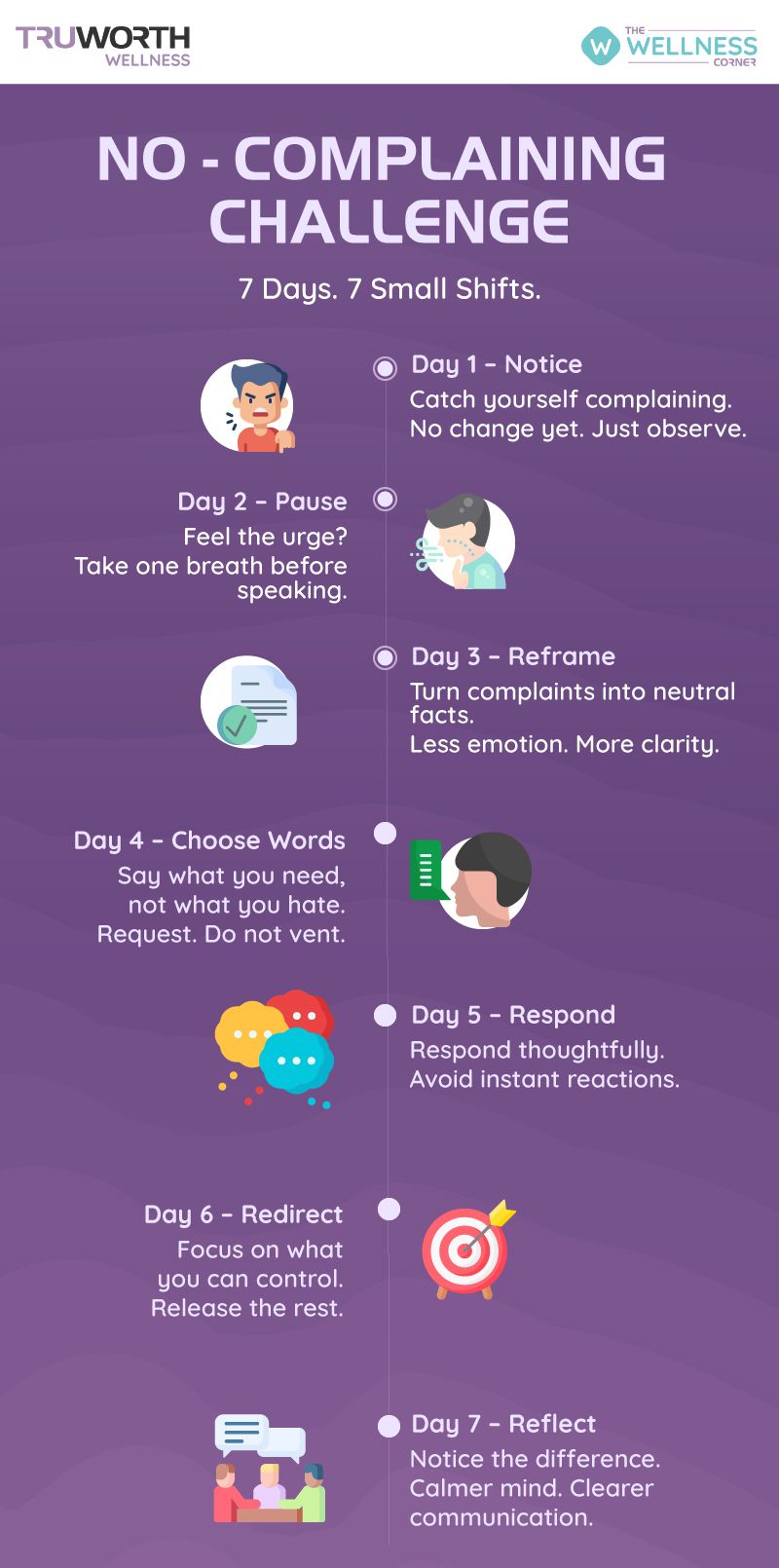
What Is the No-Complaining Challenge?
The No-Complaining Challenge is a 7-day awareness practice.
For seven days, you consciously avoid verbal complaining. This includes:
- Speaking negatively about situations without intent to solve
- Habitual venting that goes in circles
- Repeating the same frustration without action
Important distinction:
This challenge does not mean staying silent about real issues, boundaries, or unfairness.
The difference lies in intention.
- Complaining focuses on what is wrong without moving forward.
- Communication focuses on clarity, solutions, or support.
Also Read: Setting Healthy Boundaries With Clients & Customers In Corporate Relationships
Why Seven Days Is Enough To Notice A Shift?
Seven days may sound short, but it is long enough to interrupt patterns.
Most complaints are automatic. We do not decide to complain. It just happens. When you consciously pause for even a week, the brain begins to notice triggers.
Employees often report:
- Increased self-awareness
- Fewer emotional reactions
- More thoughtful conversations
- Better listening skills
- Reduced mental clutter
This is not about becoming cheerful. It is about becoming intentional.
How to Practice the No-Complaining Challenge at Work?
Step 1: Define What Complaining Means for You
Complaining can look different for everyone.
For some, it is vocal frustration.
For others, it is subtle sarcasm or repetitive sighing.
Some complain internally, replaying the same thought loop.
Start by observing, not judging.
Step 2: Pause Before You Speak
When you feel the urge to complain, pause for a moment and ask:
- Is this helping me or anyone else?
- Am I looking for support or just release?
- Can I reframe this into a request or observation?
- Often, the pause alone changes the response.
Step 3: Replace Complaints With Conscious Choices
You do not need to suppress emotions. You can redirect them.
Instead of: “This meeting is such a waste of time.”
Try:“I need clarity on the objective of this meeting.”
Instead of: “This workload is impossible.”
Try: “I need to prioritise or ask for support.”
Language shapes experience.
Step 4: Allow Safe Expression Without Negativity
The challenge does not require emotional suppression.
If something genuinely bothers you:
- Speak to the right person
- Focus on facts rather than blame
- Express impact rather than accusation
- This builds emotional maturity, not silence.
What Happens When Teams Try This Together?
When organisations introduce this challenge as a wellness initiative, subtle but powerful shifts occur.
- Meetings become more solution-oriented
- Gossip reduces naturally
- Psychological safety improves
- Employees feel less emotionally drained
- Conversations gain clarity and purpose
The absence of habitual complaining creates space for reflection, creativity, and empathy.
Importantly, it does not eliminate difficult conversations. It improves the quality of them.
The Neuroscience Behind Why This Works
Complaining activates the brain’s stress response repeatedly. Each complaint reinforces neural pathways associated with threat and dissatisfaction.
When we consciously interrupt this cycle:
- The prefrontal cortex engages, improving decision-making
- Emotional regulation improves
- Stress hormones reduce over time
- Mental resilience strengthens
This is why small daily practices often create bigger impact than large, infrequent interventions.
Common Misconceptions About the No-Complaining Challenge
“It promotes toxic positivity.”
It does not. The challenge encourages honest communication without repetitive negativity.
“It silences real problems.”
It actually improves how problems are voiced and addressed.
“It is unrealistic in high-pressure workplaces.”
High-pressure environments benefit the most because mental bandwidth is limited.
Making It a Sustainable Habit, Not a One-Time Challenge
After seven days, most people do not stop complaining entirely. That is not the goal.
The real outcome is awareness.
You begin to catch yourself sooner. You choose your words more carefully. You respond instead of reacting.
Over time, this becomes emotional fitness.
Where Workplace Wellness Can Support This Shift?
Mental habits do not change in isolation. They change in environments that support reflection, safety, and self-regulation.
At Truworth Wellness, emotional awareness practices like the No-Complaining Challenge are integrated into broader workplace wellbeing programs that focus on:
- Emotional intelligence
- Stress resilience
- Communication health
- Psychological safety
These programs do not aim to fix people. They help people understand themselves better, which naturally improves behaviour, relationships, and performance.
Final Thought
Complaining is not a flaw. It is a signal.
But when we learn to listen to the signal without amplifying it, we regain control over our mental space.
The No-Complaining Challenge is not about being quieter.
It is about being clearer.
And clarity is one of the most underrated wellness skills in today’s workplace.