Heart Health At 35: Why Indian Corporate Employees Cannot Afford To Wait Until 40?

India has one of the youngest average ages for first heart attacks in the world. Most corporate employees are not thinking about their heart until it is too late. Here is why that needs to change right now.
He was thirty-seven years old.
Senior manager at a growing tech company. No dramatic symptoms. No family history anyone had flagged. No reason, by any conventional measure, to be worried about his heart.
He collapsed at his desk on a Wednesday afternoon.
His colleagues called it sudden. His doctor called it predictable.
The signs had been there for years. The chronic stress. The six hours of broken sleep every night. The desk job with almost no movement. The blood pressure reading from last year's health check that was slightly high and then never followed up on.
Nobody connected the dots. Not his company. Not his wellness program. Not even his own doctor.
This is not a rare story in India anymore. It is becoming a common one.
The Number Every HR Leader Should Know?
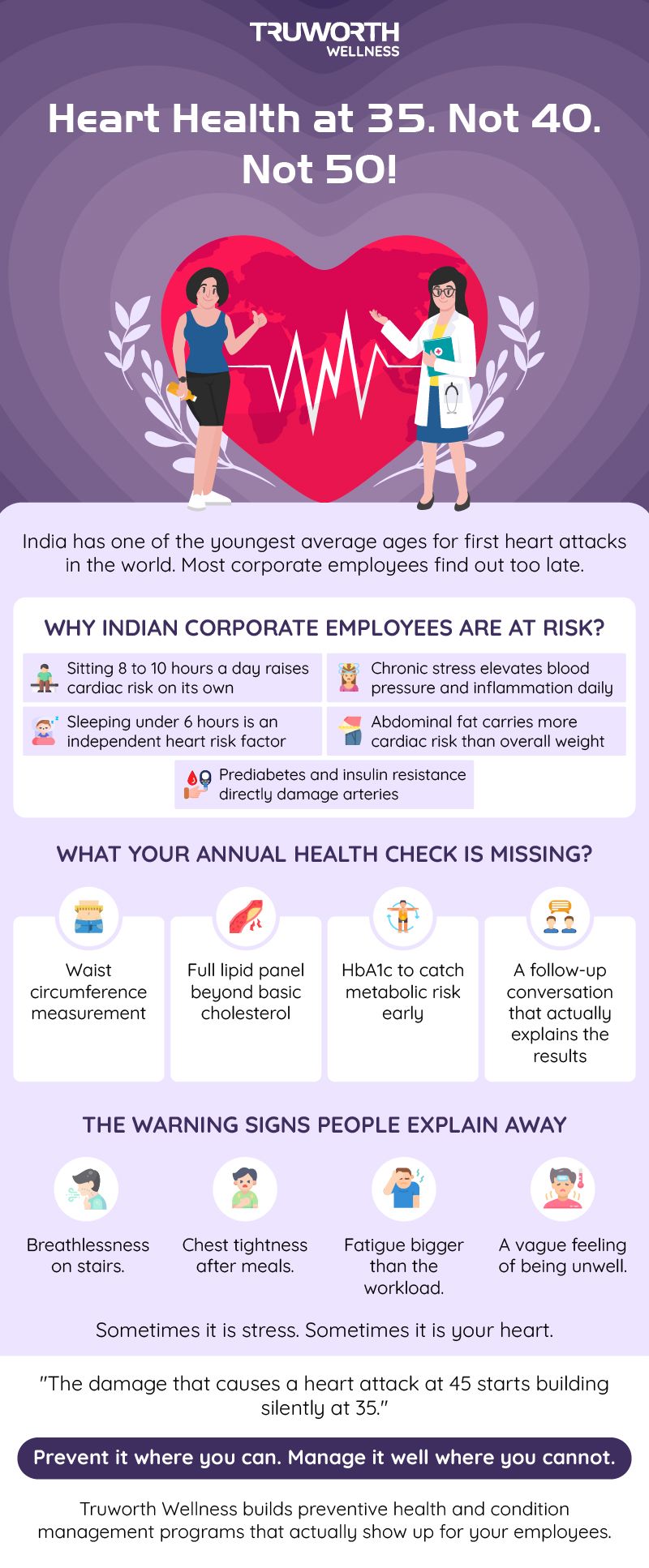
India has one of the youngest average ages for first heart attacks in the world.
While the global average age for a first heart attack is around sixty-five, Indian patients are experiencing them nearly a decade earlier. Research in leading cardiology journals consistently shows that Indian men face significantly higher cardiovascular risk at younger ages than most other populations in the world.
The reasons are not a mystery. They include:
- A genetic predisposition to certain metabolic risk factors
- Diets high in refined carbohydrates and unhealthy fats
- Rapidly rising rates of diabetes and prediabetes in working-age adults
- Lifestyle factors that corporate environments make significantly worse
The Indian corporate employee sits at the intersection of every single one of these risk factors. And most corporate wellness programs are designed as though heart disease is a concern for people who are about to retire.
It is not. It is a concern for people who are about to be promoted.
Must Check: Truworth Wellness Study Shows Rising Heart Health Concerns Among Corporate India
Why Thirty-Five Is the Age That Actually Matters?
Most people think heart disease is something that happens at sixty. Or maybe fifty if they are unlucky.
For Indian corporate employees, that assumption is genuinely dangerous.
Here is what the science says:
The Damage Starts Long Before the Event
A heart attack does not happen because of what someone ate last Tuesday. It is the result of a process that has been building quietly for ten, fifteen, sometimes twenty years. Arterial damage, chronic inflammation, insulin resistance. These processes begin in the twenties and thirties and become dangerous by the forties and fifties.
By the time a forty-five year old is sitting in a cardiologist's office being told their arteries are in trouble, most of the damage was done between thirty and forty-two. That is the window where intervention works best. And it is the window most people completely ignore.
Corporate Life Accelerates the Risk
Chronic stress, sitting all day, sleeping less than seven hours, eating high-carbohydrate office meals and carrying weight around the abdomen do not just add up. They interact and amplify each other in ways that move the cardiovascular timeline forward significantly.
A thirty-five year old with all of these factors is not on a fifty-year-old's heart health timeline. They are on a much shorter one.
The warning signs are easy to explain away.
- Breathlessness climbing two flights of stairs
- Fatigue that feels bigger than the workload
- Occasional chest tightness written off as acidity
- A vague, persistent feeling of being unwell
These symptoms get explained away every day. Too busy to investigate. Probably just stress. Probably the food. Probably need better sleep.
Sometimes that is all it is. Sometimes it is not.
The Risk Factors Sitting Quietly in Your Office
Understanding why Indian corporate employees are so vulnerable requires looking at the specific combination of factors that make this population uniquely at risk.
1) Abdominal fat, not just overall weight : In South Asian populations, fat stored around the abdomen carries far more cardiovascular risk than fat stored elsewhere, even at a completely normal body weight. An Indian employee with a normal BMI but a waist measurement above eighty centimetres for women or ninety centimetres for men is carrying significant cardiac risk.
Most corporate health checks measure BMI. For Indian employees, waist circumference is a more accurate and more alarming number.
2) Insulin resistance: Indian populations have a genetic predisposition to insulin resistance that is made significantly worse by sedentary lifestyles and high-carbohydrate diets. Insulin resistance is not just a diabetes risk. It is a direct cardiovascular risk factor that drives inflammation and arterial damage independently of blood sugar levels.
The employee whose HbA1c is in the prediabetic range is not just at risk of diabetes. They are already on a cardiovascular risk trajectory.
3) Cholesterol that looks normal but is not: Here is the part that surprises most people. A standard cholesterol test can come back completely normal while hiding a cardiovascular risk profile that is anything but.
Indian populations frequently show:
- Low good cholesterol (HDL)
- High triglycerides
- Elevated small dense LDL particles that damage arteries
A basic cholesterol reading says fine. A full lipid panel tells a very different story.
4) Chronic stress every single day: Sustained stress raises blood pressure, promotes inflammation, disrupts sleep, worsens insulin resistance and drives behaviours like poor eating and physical inactivity. Every one of these independently increases cardiac risk.
The average Indian corporate employee's stress levels are not just a productivity concern. Their cardiovascular system is paying for it quietly, every single day.
5) Sleeping less than seven hours: Short sleep duration is an independent cardiovascular risk factor. Adults sleeping fewer than six hours a night have significantly higher rates of high blood pressure, coronary artery disease and stroke than those sleeping seven to eight hours.
Sleeping five to six hours and calling it fine is not a personality trait. It is a cardiac risk factor.
What the Corporate Health Check Is Missing?
Most annual health checks include a basic blood test, blood pressure reading and weight measurement. For catching cardiovascular risk in Indian employees, this is not enough.
Here is what is typically missing:
- Waist circumference: Simple, free, takes thirty seconds. More predictive of cardiac risk in Indian populations than BMI. Almost never included.
- Full lipid panel: Total cholesterol alone is not sufficient. HDL, LDL and triglycerides together give a far more accurate picture.
- HbA1c: One of the most important cardiovascular risk markers available. Routinely absent from basic corporate screenings.
- A follow-up conversation: A health check that hands over a report with no explanation, no context and no next steps is not a health assessment. It is a data collection exercise.
What Good Cardiovascular Screening Looks Like?
The good news is that cardiovascular risk is measurable, predictable and very often preventable when caught early.
Here is what a genuine cardiac wellness program in a workplace looks like:
- Comprehensive screening that goes beyond the basics: Full lipid panel, HbA1c, waist circumference, resting heart rate, accurate blood pressure and a lifestyle questionnaire covering stress, sleep, diet and physical activity.
- A personalised risk score: Every employee gets a clear, simple picture of their ten-year cardiovascular risk, what is driving it, and what changes would make the biggest difference for them specifically.
- A clear path for high-risk employees: Not just a recommendation to see a doctor. An actual, facilitated connection to a physician or cardiologist for employees who need clinical follow-up.
Lifestyle support that targets the real drivers.
- Nutrition coaching focused on heart-healthy eating in the Indian food context
- Movement guidance designed around cardiovascular benefit
- Stress management that addresses cortisol and blood pressure
- Sleep improvement support
- Smoke cessation for employees who smoke
Annual repeat screening: A single assessment is useful. Annual repeat assessments that show whether risk is improving or worsening are transformative. Seeing your cardiovascular risk score go down over twelve months is one of the most powerful motivators for continuing healthy behaviour.
How Truworth Wellness Approaches Heart Health?
Truworth Wellness treats cardiovascular health as part of a comprehensive metabolic and lifestyle risk framework, not a standalone screening event.
Through the Health Risk Assessment, cardiovascular risk factors are identified as part of a whole-person health picture. The HRA captures not just clinical markers but the lifestyle, stress, sleep and dietary patterns that drive cardiac risk specifically in the Indian corporate context.
Employees identified with elevated cardiovascular risk are connected to personalised support:
- Nutrition coaching for heart-healthy eating in Indian dietary patterns
- EAP-based stress management targeting cortisol and blood pressure
- Sleep coaching to address one of the most commonly ignored cardiac risk factors
- Physical activity guidance calibrated to cardiovascular benefit
- Facilitated medical consultations for employees who need clinical follow-up
At the organisational level, anonymised HRA data gives HR leaders a population cardiovascular risk picture. This allows targeted, intelligent program design rather than generic wellness initiatives that reach everyone and change nothing.
If You Are Thirty-Five and Reading This?
You do not need to be sick to read this as a message for you.
If you have never had a comprehensive cardiovascular risk assessment, the risk factors that lead to a heart attack at forty-five may be building right now, quietly, in the background of your daily life.
You will not feel them. That is the point.
The health check you had last year that came back normal told you about one moment in time. It told you nothing about the direction things are heading.
Finding out at thirty-five gives you a decade to change the trajectory. That decade is the most valuable health asset you have right now.
Do not wait until forty to start using it.
What Organisations Need to Do Differently?
The conversation about heart health in Indian companies needs to start at thirty-five, not fifty.
That means:
- Upgrading health checks to include measurements that actually predict cardiac risk in Indian populations
- Using HRA data to find employees on a cardiovascular risk trajectory before anything happens
- Building lifestyle programs that address the real, modifiable drivers of India's cardiac crisis
- Making heart health screening as routine and normalised as any other annual health benefit
- Treating cardiovascular wellness as a business continuity decision, not just a health perk
The employee who collapsed on a Wednesday was not unlucky. He was unscreened, unsupported and working in an environment that made his risk worse without ever once drawing his attention to it.
That is a preventable outcome. It just requires the decision to prevent it.
Truworth Wellness builds comprehensive health risk assessment programs that identify cardiovascular risk in Indian corporate employees before it becomes a crisis. From full metabolic screening and personalised risk scores to nutrition coaching, stress management and medical follow-up pathways, our programs are designed to protect the people your organisation depends on most. Talk to us about bringing cardiovascular wellness to your workforce.