Rising Group Insurance Premiums & Medical Inflation In India: How Corporate Wellness Programs Can Help?

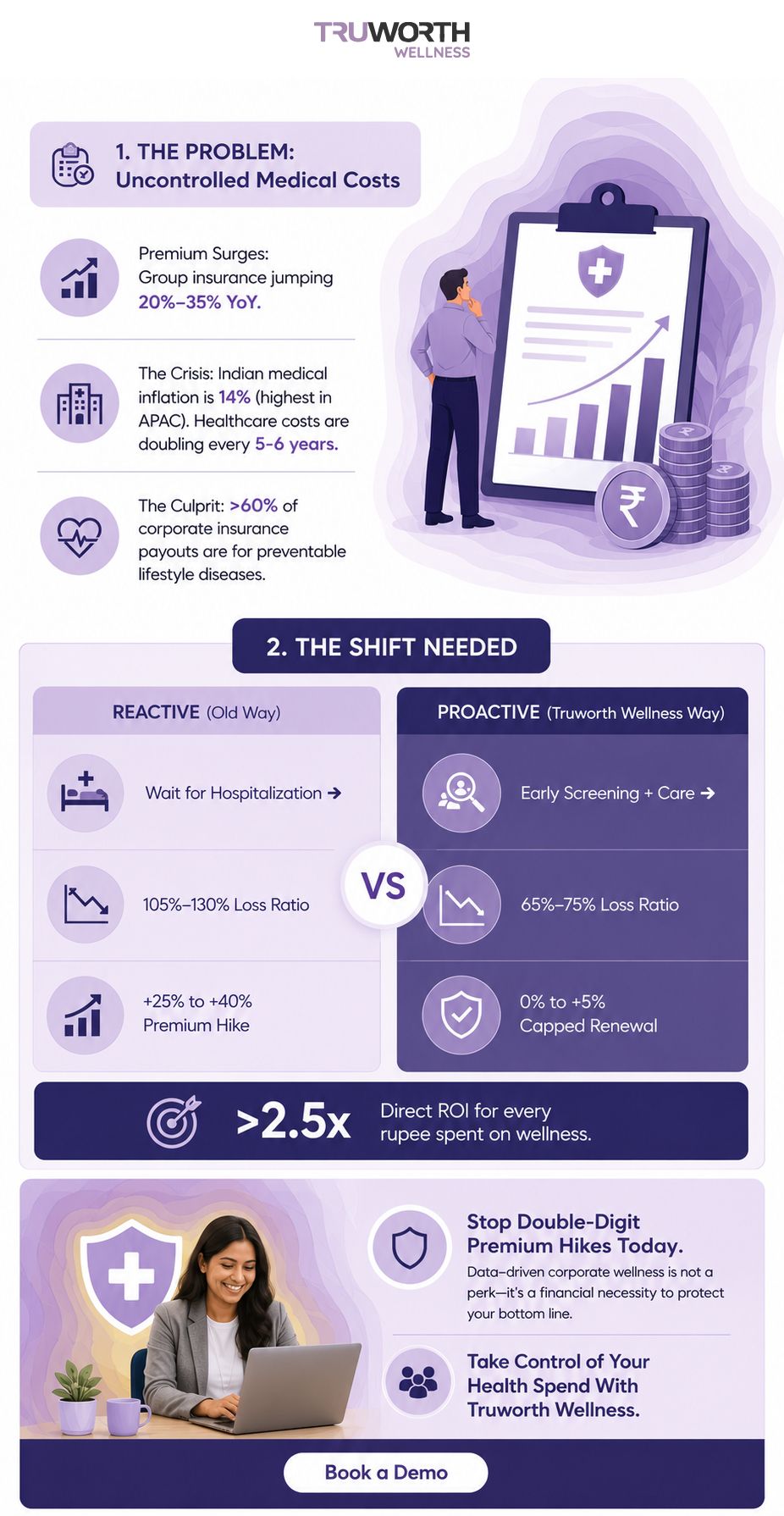
During annual policy renewal cycles, Indian Human Resources leaders and Benefits Managers consistently face a harsh financial reality: Group Medical Coverage (GMC) insurance premiums surging by 20% to 35% year-on-year.
For Enterprise CFOs and HR Heads in IT/ITeS hubs like Bengaluru and NCR, BFSI centers in Mumbai, and industrial clusters in Pune and Chennai, employee health benefits are no longer a static line item. They have morphed into one of the fastest-growing operational expenses.
At the center of this budget crunch is a structural mismatch: while traditional corporate benefits remain reactive (paying for hospitalizations after an acute event occurs), the modern Indian workforce is experiencing an unprecedented, quiet surge in preventable chronic metabolic and cardiac diseases.
To arrest skyrocketing group insurance premiums in India and protect corporate bottom lines, organizations must pivot from reactive claims management to proactive, data-driven corporate wellness programs in India.
The Crisis of Double-Digit Medical Inflation in Corporate India
Medical inflation in India has climbed to approximately 14%, marking the highest rate in the Asia-Pacific (APAC) region. This far outpaces general CPI inflation (which hovers around 5% to 6%), meaning healthcare costs double nearly every five to six years.
📊 INFLATION RATE COMPARISON SUMMARY
- General CPI Inflation: ~5% - 6% (Standard baseline economic growth)
- Medical Inflation in India (APAC Peak): ~14% (Healthcare costs double every 5 to 6 years)
Key Macroeconomic & Clinical Drivers of Medical Inflation in Corporate India
The sharp escalation in healthcare delivery costs and corporate insurance premiums across India is driven by several compounding clinical, supply chain, and market factors:
- Advancements in Medical Technology: Rapid deployment of cutting-edge treatments (particularly in oncology, cardiology, and robotic surgery) aims to boost precision and patient outcomes. However, developing, procuring, and maintaining imported machinery requires high capital expenditure and specialized clinical training. These prolonged development timelines and high import reliance drive up baseline healthcare delivery costs significantly.
- Rise in Medical Tourism: India’s reputation for world-class specialized care at competitive pricing attracts a steady surge of international patients for complex interventions (e.g., organ transplants, joint replacements, cancer therapies). This heightened global demand puts capacity pressure on top Tier-1 and Tier-2 private hospital chains, exerting upward pressure on domestic treatment fees.
- High Demand for Specialized Healthcare Services: Breakthroughs in medical science have heightened patient awareness and expectation for advanced treatments. Increased willingness among corporate employees and urban populations to pay for high-end care empowers healthcare providers to command higher service fees and procedure costs.
- Lingering Supply Shocks & Post-COVID Claims: The COVID-19 pandemic caused lasting structural shifts across India's healthcare system. Emergency surges in demand for critical infrastructure (ventilators, oxygen units) created price shocks. Furthermore, an unprecedented surge in post-pandemic claim frequency led insurers to hike health insurance rates by 10% to 20% across corporate books.
- Surging Raw Material & Import Costs: Active Pharmaceutical Ingredients (APIs) and raw materials used in equipment manufacturing have seen steep global price increases. Coupled with higher import tariffs, international freight costs, warehousing fees, and emergency logistics, total medical supply chain costs have risen.
- Escalating Baseline Treatment Cost Per Person: Core line items within hospital procedures (such as surgical consumables, specialist consultation fees, trained nursing care, utility tariffs, commercial real estate rents, and facility upkeep) continue to experience double-digit annual cost growth.
Why GMC Loss Ratios Are Hurting Corporate Budgets in Metro Hubs?
Insurance underwriters evaluate a company’s risk using a core financial metric: the Claim Loss Ratio.

When an enterprise’s GMC Loss Ratio crosses the safe benchmark of 80% to 85%, the insurance carrier operates at a loss once administrative and broker margins are factored in. To rebalance their risk portfolio during renewal season, insurers apply heavy loaded premiums or demand restrictive corporate sub-limits (e.g., capping room rent, daily ICU allowances, or maternity coverages).
|
Corporate Scenario |
Average GMC Loss Ratio |
Annual Premium Increase at Renewal |
Impact on Employee Experience |
|
Reactive Enterprise
(No Wellness Interventions) |
105% – 130% |
+25% to +40% Surge |
Scaled-back coverage, higher co-pays, reduced employee
trust. |
|
Proactive Enterprise
(Truworth Wellness Integrated) |
65% – 75% |
0% to +5% (Capped/Negotiated) |
Enhanced coverage limits, low co-pays, high workforce
morale. |
In major metro hubs, where talent attraction and retention hinge heavily on broad, zero-copay family health coverages, scaling back benefits is rarely an option for HR. The only sustainable path to reduce GMC loss ratios is addressing the root cause of claims: workforce health deterioration.
The Silent Driver: Chronic Lifestyle Diseases in the Indian Workforce
The primary driver behind escalating loss ratios isn't rare genetic disorders; it is the silent, pervasive spread of early-onset non-communicable diseases (NCDs) among corporate professionals.
THE METABOLIC DANGER ZONE IN CORPORATE INDIA
- 101 Million Indian Adults Living with Type 2 Diabetes
- 136 Million Indian Adults Currently Pre-Diabetic
- 35.5% Urban Indians Suffering from Hypertension
Source: ICMR-INDIAB Study published in The Lancet & PIB Press Release
Early-Onset Diabetes, HbA1c Trajectories, and Urban Stress
Modern corporate work environments (characterized by 10-hour desk shifts, high screen time, hybrid isolation, late-night meal deliveries, and high-cortisol deadlines) create an ideal storm for metabolic decay:
- Undetected Pre-Diabetes: A vast majority of employees living with elevated blood glucose levels (HbA1c between 5.7% and 6.4%) remain completely asymptomatic. Without routine biometric screenings, these employees transition into full-blown Type 2 Diabetes within 24 to 36 months.
- Unmanaged Hypertension & Dyslipidemia: Elevated blood pressure and abnormal lipid profiles silently damage vascular health, dramatically elevating the risk of early-onset cardiac events among young tech and financial professionals.
- Workplace Burnout & Mental Fatigue: Studies by ASSOCHAM reveal that over 42.5% of corporate employees in Indian private sectors suffer from chronic anxiety or lifestyle-induced depression. High stress triggers chronic systemic inflammation, poor sleep architecture, emotional eating, and alcohol dependency, further accelerating metabolic degradation.
(Source: ASSOCHAM Preventive Healthcare & Corporate Sector Report)
Key Takeaway: Tertiary hospitalizations stemming from unmanaged chronic metabolic conditions account for over 60% of corporate GMC claim payouts. Crucially, up to 80% of these critical events are entirely preventable through early detection, lifestyle modifications, and ongoing health risk monitoring.
How Preventive Corporate Wellness Reduces Insurance Claims and Loss Ratios?
To lower your organization's claim loss ratio, corporate health strategy must shift from reactive claim processing to proactive health risk management.
OPERATIONAL PARADIGM SHIFT:
Reactive Model (High Cost, High Loss Ratio)
Asymptomatic Employee ➔ Ignored Vitals ➔Acute Cardiac Event ➔ ₹5–8 Lakh GMC Claim
Proactive Model (Optimized Cost, Low Loss Ratio)
Targeted Screening ➔ Early Risk Identified ➔Truworth Lifestyle Coaching ➔ Vitals Normalized / Zero Hospitalization
Preventive healthcare reduces high-cost insurance claims through three direct operational mechanisms:
- Intercepting Risk Before Hospitalization: Catching metabolic anomalies (such as hypercholesterolemia or pre-diabetes) through routine screenings allows employees to manage their condition via targeted nutrition and lifestyle changes, preventing expensive emergency hospital stays.
- Shifting the Workforce Health Curve: Corporate wellness initiatives move employees out of high-risk categories. Transitioning even 15% of your high-risk workforce into moderate or low-risk brackets reduces emergency room visits and chronic care complications across your organization.
- Data-Backed Insurance Premium Negotiations: When HR leaders demonstrate high wellness engagement rates, measurable vitals improvements, and active risk mitigation protocols, underwriters can offer:
- Lower baseline premium increases during annual renewals.
- Removal of restrictive policy clauses and co-pays.
- Premium rebates or wellness credits built directly into the policy contract.
Core Pillars of an ROI-Driven Corporate Health Program in India
A successful corporate wellness program in Indiarequires a comprehensive strategy tailored to the lifestyle and cultural dynamics of the Indian workforce. Truworth Wellness builds corporate health frameworks around four integrated pillars:
TRUWORTH WELLNESS ENTERPRISE PILLARS
- Comprehensive Diagnostic Screenings: Onsite & virtual biometrics (HbA1c, Lipids, BP, BMI) & Digital HRAs.
- Digital Health Portal & App: Gamified challenges, continuous wearable sync, and personalized Indian meal coaching.
- Employee Assistance Programs (EAP): 24/7 multi-lingual confidential counseling & managerial sensitivity training.
- Targeted Chronic Care Management: 12-to-24 week pre-diabetes reversal and cardiovascular risk mitigation protocols.
Building a Business Case for the C-Suite: Calculating Wellness ROI
To secure executive approval and budget allocation, HR leaders must present corporate wellness not as a "perk," but as a strategic financial investment that protects capital and mitigates risk.
TOTAL CORPORATE WELLNESS ROI FRAMEWORK
Direct Financial ROI (Insurance Impact)
- GMC Premium Inflation Mitigation (Slowing hikes from 25% to 5%)
- Lower Claim Loss Ratios (<75%)
- Reduced Employee Out-of-Pocket Medical Expenses
Indirect Operational ROI (Workforce Productivity)
- Decreased Sick Leave Absenteeism
- Reduced Presenteeism Productivity Losses (costs 3x to 4x more than direct absenteeism)
- Enhanced Talent Attraction & Employee Retention
Business Case Example: 2,000-Employee IT Enterprise
- Annual GMC Premium (Baseline): ₹2.0 Crore
- Projected Renewal Hike (Without Wellness @ +25%): +₹50 Lakhs
- Actual Renewal Hike (With Truworth Wellness Program @ +5%): +₹10 Lakhs
- Direct Insurance Savings Realized: ₹40 Lakhs
- Investment in Truworth Enterprise Wellness: ~₹12–15 Lakhs
- Net Direct ROI Ratio: > 2.5x Return on Investment (excluding additional gains from reduced absenteeism and higher productivity)
Take Action: Protect Your Workforce and Optimize Healthcare Budgets
Rising medical inflation and double-digit GMC premium increases do not have to disrupt your annual corporate budget. By addressing root causes (early-onset lifestyle diseases, unmanaged stress, and undetected metabolic risks), HR leaders can regain control over corporate insurance spend while building a healthier, more productive workforce.
Truworth Wellness brings over a decade of corporate health experience, partnering with leading Indian enterprises to build data-driven, scalable, and high-engagement employee wellness programs.
Ready to Curb Rising Insurance Premiums & Reduce Your Loss Ratio?
Discover how Truworth Wellness can help lower claim costs, optimize your GMC loss ratio, and launch a tailored employee wellness program for your organization.
For visual context on the ICMR INDIAB study findings regarding non-communicable diseases in India, watch Over 100 million Diabetic Cases in India.
This video summarizes the key findings of the ICMR-INDIAB epidemiological study on the surge of metabolic disorders across urban and rural populations.