What Nobody Tells You About Coming Back From Maternity Leave?

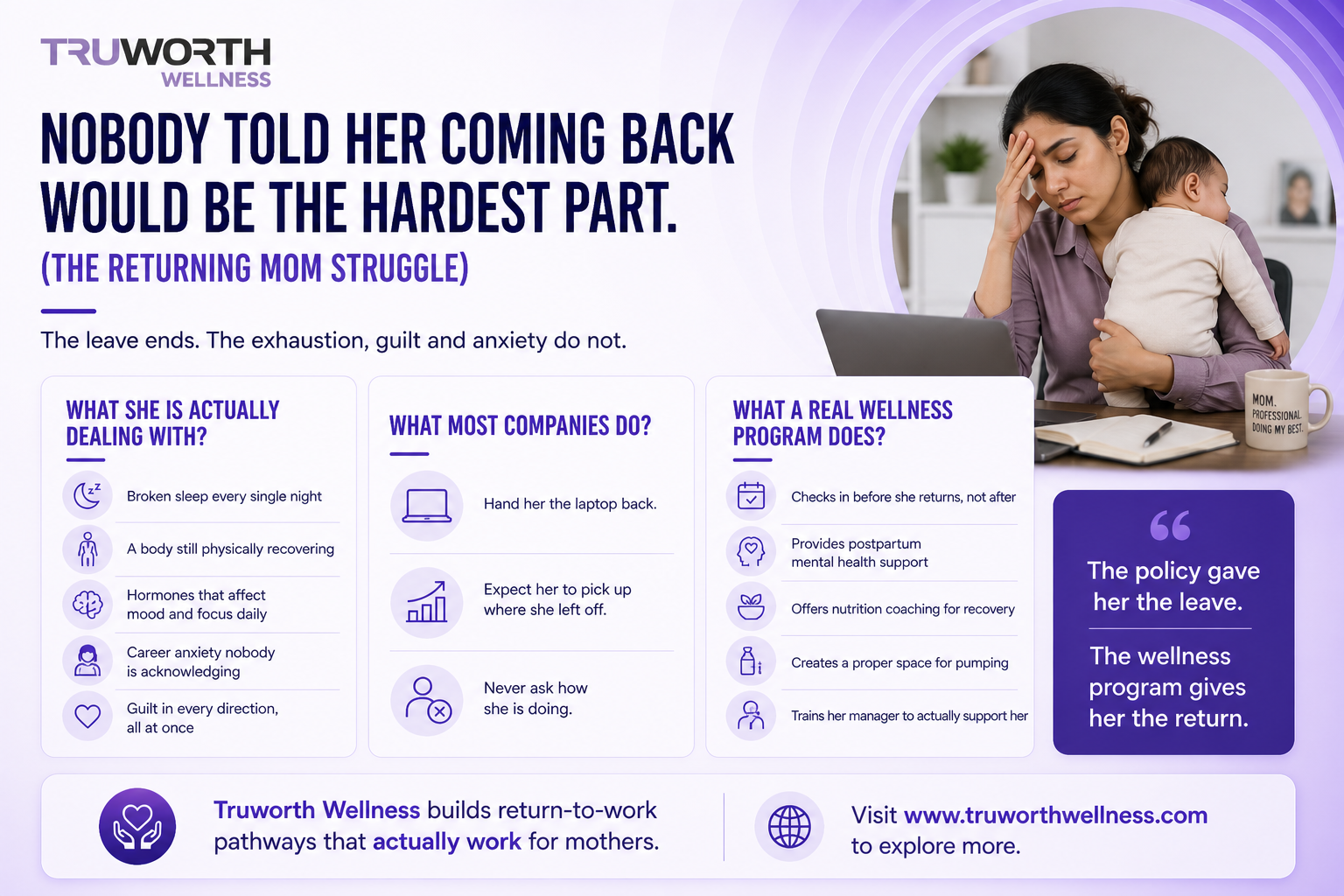
The leave ends. The support ends. But the exhaustion, the guilt, the anxiety and the identity confusion do not. Here is what Indian companies are getting completely wrong about returning mothers.
She has been back at her desk for three weeks.
From the outside, everything looks fine. She is in meetings. She is replying to emails. She is hitting her deadlines.
From the inside, this is what is actually happening:
- She is running on four hours of broken sleep
- She cried in the bathroom this morning
- She cannot remember the last time she felt like herself
- She loves her baby completely and also misses her old life in a way she cannot explain to anyone
She is not struggling because she is weak. She is struggling because she just went through one of the biggest physical and emotional experiences of her life. And her company gave her twenty-six weeks of leave and then expected her back at full capacity on a Monday morning.
Nobody warned her it would feel like this. And nobody at work is asking.
The Big Gap Nobody Talks About
India's maternity leave laws are fairly progressive on paper:
- Twenty-six weeks of paid leave for the first two children
- Creche facilities for larger organisations
- Work from home options where possible
These protections matter. But they only cover one thing: the time away.
Nobody has designed anything for what happens when she comes back.
Most companies think the job is done once the leave is given. It is not. The return is actually where the real support is needed. And in most Indian workplaces, that support simply does not exist.
What Is Really Happening in Her Body?
This is the part most workplaces never talk about. Because talking about it means admitting that the person who walked back in is not the same person who left. And she is not. Not physically, not hormonally, not emotionally.
Here is what she is actually dealing with:
1) Physical recovery that takes longer than anyone admits
Whether she had a natural birth or a caesarean, her body is still healing. Many women return to work while still in physical recovery. They do not mention it because they are afraid of being seen as less capable.
If she is breastfeeding, add to that:
- Hormonal changes that affect mood and energy every single day
- The need to pump during work hours in an office not designed for it
- Physical discomfort that she manages quietly and alone
Must Check: How Can Working Mothers Benefit From Wellness Programs?
2) Sleep deprivation that affects her brain
New mothers average far less sleep than what the body needs. And the sleep they do get is broken, not restful.
What chronic sleep deprivation actually does to a person:
- Weakens memory and concentration
- Slows down decision making
- Makes emotions harder to regulate
- Reduces the ability to handle pressure
She is sitting in strategy meetings on a brain running on empty. Not because she is less capable. Because she has not slept properly in months.
3) Hormonal changes that affect her mood and mind
After birth, the body goes through a dramatic hormonal shift. This is not something she can control or push through with willpower.
The result can include:
- Higher levels of anxiety than she has ever felt before
- Low mood that does not lift even on good days
- Difficulty concentrating
- Feeling emotionally flat or overwhelmed without a clear reason
Postpartum depression affects roughly one in five new mothers in India. Postpartum anxiety is even more common and almost never diagnosed.
These are not personal failings. They are medical realities. And they do not disappear because the leave period ended.
 Truworth Wellness
What She Is Carrying That Nobody At Work Can See?
Beyond the physical, there is a whole other set of pressures she is managing quietly while appearing to be completely fine.
1) Career anxiety
She is worried about what she missed while she was away. She is wondering:
- Was she quietly passed over for anything?
- Do her colleagues see her differently now?
- Is her commitment being questioned?
- Will the promotion she was on track for still happen?
This is not paranoia. Research consistently shows that mothers face career penalties after having children. She is aware of this, even if nobody has said it directly.
2) Relationship pressure at home
A new baby puts enormous strain on relationships. She and her partner are both exhausted, both adjusting, both trying to figure out a new version of their life together. The division of household and childcare work in most Indian families falls heavily on the mother. She is carrying that weight on top of everything else.
Do Read: Family-Friendly Wellness Programs (Incentives For Dependants)
3) Childcare guilt and worry
Every day she is at work, a part of her mind is with her child. Is the baby okay? Did the creche call? Is the nanny reliable? This is not distraction. It is the reality of being a working mother. It takes up real mental energy that nobody accounts for.
4) The pressure to seem fine
Perhaps the hardest part of all. She cannot admit she is struggling because she is afraid of what it will cost her professionally. So she performs. She smiles. She says everything is fine.
Until it is not.
What Most Indian Companies Get Wrong?
The standard corporate assumption is this: the leave was the support. Now it is over. Back to normal.
This is wrong in almost every way.
Here is what most companies do when a mother returns:
- Hand her back her laptop
- Expect her to pick up where she left off
- Never ask how she is doing
- Never adjust her workload for the first few weeks
- Never check if she has a private space to pump
- Never train her manager to have a proper return-to-work conversation
And when she struggles, the story that gets told is that motherhood changed her priorities. That she is not as committed as she used to be.
The problem is never described as the environment. It is always described as her.
How a Good Wellness Program Changes Everything?
This is where a genuinely designed wellness program makes a difference that a maternity policy simply cannot.
Not through a welcome-back gift or a single webinar. Through real, sustained, practical support that starts before she even walks back through the door.
Here is what that actually looks like:
1) A proper return-to-work pathway
Before she returns:
- A conversation about what she needs
- A realistic picture of what her first month will look like
- Clear information about what support is available to her
This one conversation changes everything. It tells her that her return has been thought about, not just administratively processed.
2) Mental health support that understands new motherhood
Not generic stress management. Specific support from counsellors who understand:
- Postpartum depression and anxiety
- Birth trauma
- The emotional complexity of new motherhood
- The difference between ordinary tiredness and something that needs clinical attention
3) Nutrition and recovery support
A breastfeeding, sleep-deprived, physically recovering mother has very specific nutritional needs. A nutrition coach who understands this can help with:
- Managing energy on broken sleep
- Foods that support hormonal recovery
- Blood sugar stability throughout the working day
- Immune support during a period of high physical demand
4) A lactation-friendly workplace that actually works
Not a bathroom. Not a storage cupboard. A proper, private, comfortable space with:
- Somewhere to sit comfortably
- A refrigerator for milk storage
- A schedule that accommodates pumping without requiring an awkward conversation
Truworth Wellness
5) A community of other working mothers
Connection with other women inside the organisation who have been through the same experience is one of the most powerful forms of support available. A wellness program that creates this community provides something no policy can replicate.
6) Manager training that goes beyond policy awareness
The most important person in her experience is her direct manager. A manager who knows:
- How to have a genuine return-to-work conversation
- What reasonable accommodations look like
- How to create safety for her to be honest about what she needs
is worth more than any app or platform.
7) Flexible working that is real, not just stated
Flexibility that exists on paper but disappears under the pressure of meeting culture and visibility norms is not flexibility. A wellness program that advocates for genuine flexible working as a health intervention and gives managers tools to make it real serves returning mothers in a way that a written policy never will.
Why This Is Also Good for Business?
Companies spend years hiring, training and developing talented women. The maternity return period is one of the highest-risk moments for losing that investment.
What happens when support is poor:
- Many women quietly disengage and never return to their previous trajectory
- Some leave within a year or two
- The talent, the experience, and the potential senior leadership walk out with them
What happens when support is good:
- Women return to full capacity faster
- Loyalty to the organisation increases significantly
- Other women in the workforce take note and feel more secure about their own futures
- The organisation builds a genuine reputation as a place where women can grow
The cost of getting this right is a fraction of the cost of getting it wrong.
If You Are a Returning Mother Reading This
What you are experiencing is not weakness.
It is not a sign that you are less capable than before. It is the completely normal outcome of a huge life event that your body and mind are still working through.
You do not need to be fully back immediately. You do not need to perform normalcy while your reality is anything but. And you do not need to do this without support.
If your organisation is not providing that support, that is a gap in the organisation. Not in you.
What Needs to Change?
The maternity conversation in Indian companies needs to go further than the leave policy. It needs to cover what return actually involves and what genuine support looks like.
That means:
- A structured return pathway, not just a start date
- Mental health support that understands postpartum reality
- Practical lactation facilities that actually function
- Manager training on return-to-work conversations
- A peer community for working mothers
- Flexible working that is culturally real, not just written down
- Nutrition support that is specific to her situation
- A wellness program that treats returning mothers as a group with specific needs
The policy gave her the leave. The wellness program gives her the return.
Truworth Wellness builds wellness programs that support employees through every major life stage, including the return from maternity leave. From postpartum mental health support and nutrition coaching to manager training and peer communities, we help companies create the conditions where returning mothers can genuinely thrive. Talk to us about building a return-to-work wellness pathway for your organisation.