Why Purpose-Driven People Are Healthier, And How Wellness Is Changing Around That?

Let's start with a quick reality check for companies
Do employees know why they should care about their health? Or are they just being told what to do?
Why Purpose-Driven People Are Healthier, And How Wellness Is Changing Around That?
What if your wellness program is not underperforming because employees lack discipline, but because it lacks meaning?
For years, corporate wellness has been engineered like a compliance system.
- Track steps.
- Log meals.
- Attend sessions.
- Reward participation.
- Measure outputs.
The assumption is simple: if you create enough structure, behavior will follow.
It does. Briefly.
Then engagement drops. Participation flattens. Outcomes plateau.
Not because employees do not care about their health, but because the system is asking for effort without offering relevance.
Purpose changes that equation.
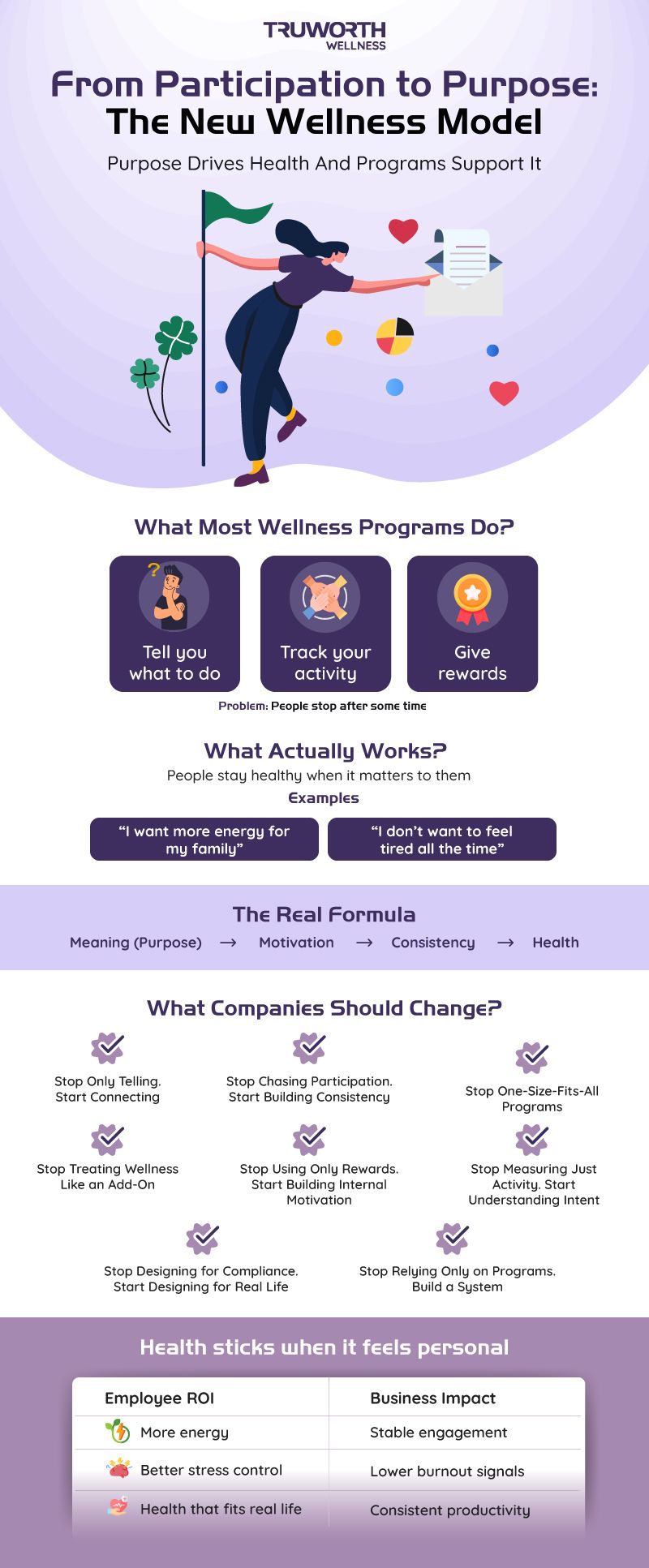
Purpose Is Not Soft. It Is a Biological Advantage.
Purpose is often misclassified as a motivational concept. It is not. It is a physiological and behavioral stabilizer.
Individuals with a strong sense of purpose show:
- Lower baseline stress responses
- Greater consistency in health behaviors
- Higher resilience during disruption
- Better long-term adherence to routines
From a behavioral economics lens, purpose reduces “decision fatigue.” When actions are tied to a meaningful identity or outcome, they require less cognitive negotiation. The brain stops debating and starts defaulting.
Think of it like load-bearing architecture.
- In a poorly designed structure, every beam carries excess strain.
- In a well-designed system, load is distributed intelligently.
Purpose works the same way. It redistributes the effort required to maintain healthy behaviors.
Without it, every action feels like a choice. With it, actions become automatic extensions of identity.
That is where wellness programs often fail. They optimize for activity, not alignment.
Must Check: Health Coaching To Enhance Workplace Wellness Strategy
Corporate Micro-Action
Ask employees one question in your next pulse survey:
“What is one thing in your life that your health directly supports?”
Do not analyze it yet. Just collect it. You are mapping meaning, not metrics.
The Engagement Problem Is Actually a Relevance Problem
Most wellness dashboards show the same pattern. High initial participation. Gradual decline. Sporadic spikes during campaigns.
The instinctive response is to add more incentives, more nudges, more communication.
This is equivalent to increasing voltage in a system with faulty wiring.
The issue is not intensity. It is connection.
- When an employee sees a step challenge as a corporate task, it competes with work deadlines, family responsibilities, and mental fatigue. It loses.
- When that same activity connects to something personal, energy for their child, stamina for travel, mental clarity for decision-making, it moves up in priority.
Purpose acts as a ranking system for behavior.
Without it, wellness sits at the bottom of the list. With it, wellness becomes foundational.
This is where the idea of Employee ROI shifts.
Traditional ROI asks: “What did the company gain from this program?”
A purpose-aligned model asks: “What did the employee gain that made the program worth continuing?”
That second question determines sustainability.
Corporate Micro-Action
Rewrite one wellness communication this week.
- Instead of: “Join the 10,000 steps challenge.”
- Try: “What would more energy at the end of your day change for you?”
Then connect the challenge to that outcome.
From Participation to Identity: The Real Behavior Shift
Most programs are built around participation metrics. Logins. Activity counts. Completion rates.
But behavior does not sustain through participation. It sustains through identity.
- A person who sees themselves as “someone trying to be healthy” negotiates constantly.
- A person who sees themselves as “someone who takes care of their health” behaves differently without prompting.
This is not semantics. It is cognitive framing.
High-performance engineering systems rely on stable states. Once a system reaches equilibrium, it resists disruption. Identity creates that equilibrium in human behavior.
Purpose accelerates identity formation.
When employees connect health to something deeply personal, they stop borrowing motivation from the program. They generate it internally.
This is where wellness begins to scale without increasing cost.
Corporate Micro-Action
Add a single reflective prompt to your platform or communication:
“Complete this sentence: I take care of my health because ______.”
Let employees fill it privately. No tracking. No scoring. Just reflection.
Culture of Care Is Not Built Through Benefits. It Is Built Through Signals.
Organizations often equate wellness with offerings. More sessions. More experts. More resources.
Employees interpret something else entirely.
They look for signals.
- Is it acceptable to log off on time?
- Do managers model healthy behavior?
- Are breaks normalized or subtly discouraged?
Purpose-driven wellness programs extend beyond the individual. They shape collective norms.
In engineering terms, this is not about adding components. It is about calibrating the system.
A culture of care exists when healthy behavior is not an exception. It is the default.
Purpose strengthens this culture because it moves wellness from a program to a shared value.
When employees see that their wellbeing is connected to their ability to contribute, perform, and sustain their personal lives, the narrative shifts from “optional” to “essential.”
Corporate Micro-Action
In your next leadership meeting, ask each manager to share one visible behavior they will model this month, such as leaving on time twice a week or taking walking meetings.
Visibility builds culture faster than policy.
Data Without Context Is Noise. Purpose Gives It Meaning.
Most organizations are not short on data. They are short on interpretation.
You can track sleep, activity, nutrition, stress markers. But without context, these metrics remain isolated.
Purpose provides that context.
- If an employee’s goal is to have more energy for caregiving responsibilities, their sleep data becomes actionable.
- If their goal is career performance, stress and focus metrics gain relevance.
This is where technology must evolve.
Wellness platforms need to move beyond generic dashboards to contextual intelligence, systems that understand why an individual engages, not just how often.
This is also where a strategic partner becomes critical.
Platforms like Truworth Wellness are increasingly positioned not as program providers, but as infrastructure for data-driven, purpose-aligned health ecosystems. The value is not in content delivery, but in connecting behavioral data with personal context and organizational insight.
That is the shift from reporting to reasoning.
Corporate Micro-Action
Segment your existing wellness data by intent, not just activity. For example, group employees based on stated goals like “energy,” “stress reduction,” or “fitness,” and observe patterns. Even a basic segmentation will reveal more than aggregate dashboards.
The Economics of Purpose: Why This Matters to the Business
A purpose-driven approach is not philosophical. It is economically sound.
Consider the cost structure of disengagement:
- Low utilization of wellness investments
- Increased absenteeism and presenteeism
- Higher attrition linked to burnout
- Reduced productivity due to fragmented energy
Now consider what purpose changes:
- Higher adherence without additional incentives
- More stable behavior patterns
- Improved mental resilience
- Stronger alignment between personal and organizational goals
This is Employee ROI in its most practical form.
When employees see value in maintaining their health, the organization benefits from sustained performance. Not through enforcement, but through alignment.
It is similar to designing a high-efficiency engine. You do not force output. You reduce friction.
Purpose reduces friction in human behavior.
Corporate Micro-Action
Calculate one simple metric:
Percentage of employees who return to a wellness activity after 30 days.
This is a proxy for meaning, not just participation. Track it monthly.
Wellness Is Shifting From Programs to Systems
The future of corporate wellness will not be defined by more initiatives. It will be defined by better integration.
Purpose sits at the center of this integration.
- It connects individual motivation with organizational outcomes
- It aligns data with decision-making
- It transforms culture from policy-driven to behavior-driven
In architectural terms, purpose is not an add-on. It is the foundation. Everything else, technology, communication, incentives, builds on top of it.
Organizations that recognize this are already moving away from fragmented wellness efforts toward cohesive ecosystems, where data, behavior, and meaning interact continuously.
This is where structured platforms, thoughtful design, and strategic partners converge.
Not to push employees toward health, but to make health the most logical choice they can make.
Corporate Micro-Action
Map your current wellness initiatives on a single page.
For each one, ask:
“What personal outcome does this connect to?”
If the answer is unclear, that is your redesign starting point.
Conclusion
Wellness programs don’t fail because employees don’t care. They fail because they don’t connect.
Purpose changes that.
When health supports something that matters, energy, family, performance, it stops feeling like an extra task. It becomes a default. That is where consistency comes from.
For organizations, the shift is simple but structural:
- Less pushing, more alignment
- Less activity tracking, more meaning
- Less programs, more systems
This is where Employee ROI meets Culture of Care. Employees sustain their health because it serves their life. Organizations benefit from steady performance, not forced participation.
The next phase of wellness will not be about offering more. It will be about connecting better.
And that requires infrastructure that links intent, behavior, and data, something ecosystems like Truworth Wellness are steadily enabling.
Summary
Purpose does not make wellness easier. It makes it relevant.
And relevance is what sustains behavior when motivation runs out, calendars fill up, and priorities compete.
The organizations that understand this are not just building healthier employees. They are building systems where health supports performance, and performance sustains health.
That is not a program. It is infrastructure.