Survivor Guilt In The Office. What Is It And How Does It Affect An Employee?

When colleagues lose their jobs and you keep yours, the relief you expect does not always come. Sometimes what comes instead is something much harder to name.
The announcement came on a Tuesday.
Fifteen percent of the workforce. Restructuring. Effective immediately.
By Wednesday morning, some desks were empty. The people who sat there had been colleagues, friends, lunch companions, people whose coffee orders everyone knew. And now they were gone.
The people left behind still had their jobs. Their salaries were intact. Their access cards still worked. On paper, they were the lucky ones.
But lucky is not what many of them felt.
What many of them felt was something closer to confusion. A heaviness they could not quite explain. A guilt that did not make logical sense but showed up anyway, quiet and persistent, in the back of every workday.
That feeling has a name. It is called survivor guilt. And it is one of the most common and least talked about experiences in the modern workplace.
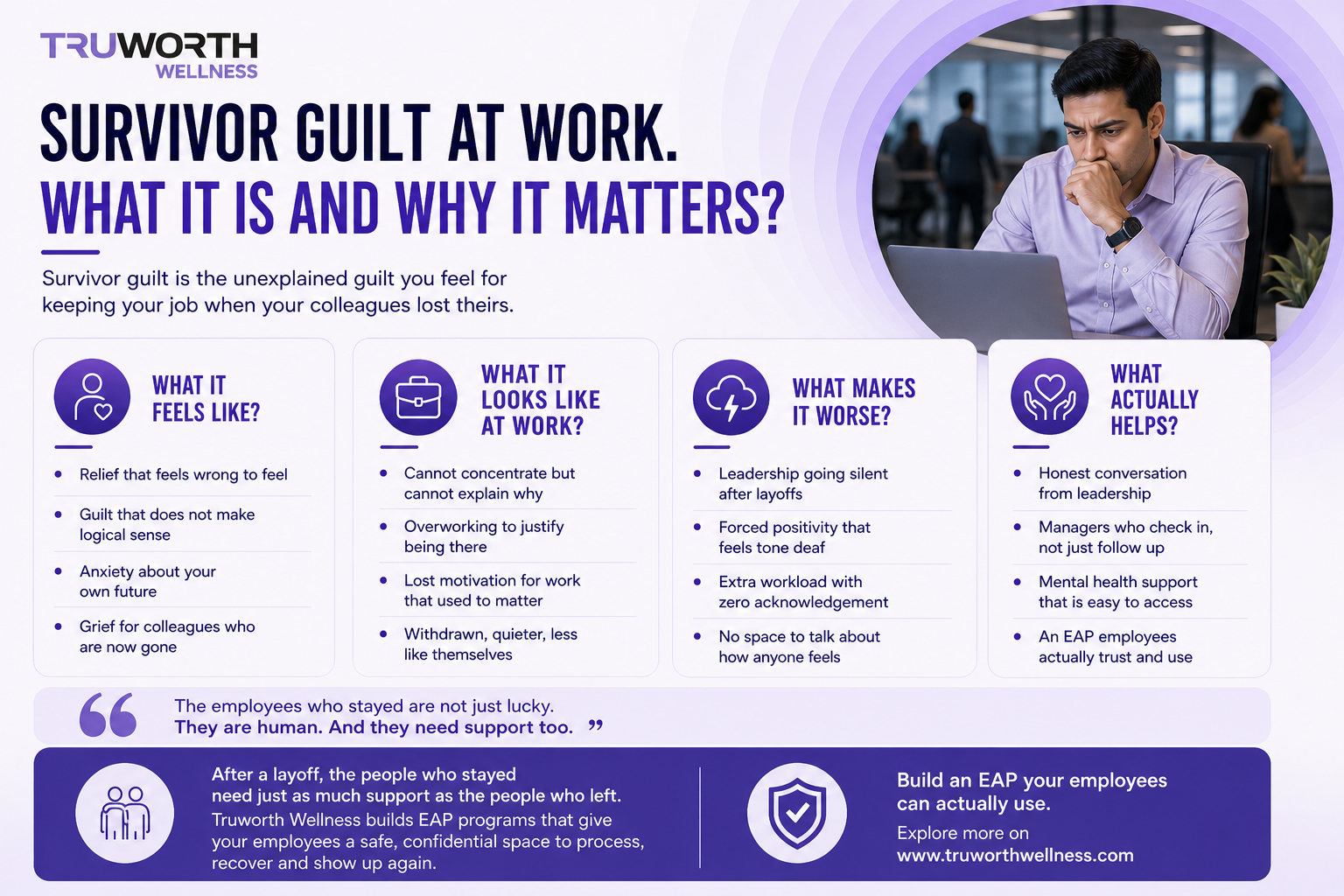
So What Exactly Is Survivor Guilt?
Survivor guilt is the uncomfortable feeling that comes when you escape something difficult that others did not.
It was first studied in people who survived major disasters, wars and accidents while others around them did not. But over time, researchers and psychologists recognised that the same pattern shows up in workplaces, particularly after layoffs, restructuring or any situation where some employees lose their jobs and others keep theirs.
In simple terms, it sounds like this inside someone's head:
- "Why did I keep my job when my colleague who worked just as hard did not?"
- "Did I deserve to stay more than they did?"
- "Should I feel relieved? Because I do not feel relieved."
- "Is it wrong that I still have a salary when they are struggling to find their next one?"
These thoughts are not logical. The person asking them had no control over who was let go. They made no decision. They held no power in that process. But the guilt comes anyway, because that is what guilt does. It does not wait for logic.
Why Does It Happen?
Understanding why survivor guilt happens makes it easier to recognise and address.
- We are wired to care about fairness: Human beings have a deep, built-in sense of fairness. When something happens that feels unfair, like a colleague losing a job they worked hard for, it creates discomfort even in the people it did not directly affect. The person who kept their job did not create the unfairness. But they are close enough to it to feel it.
- We form real bonds at work: Colleagues are not just professional contacts. For many people, especially those who spend eight to ten hours a day together, they are genuine relationships. When those relationships are suddenly cut off by circumstances outside anyone's control, it creates a real sense of loss. Grief, even. And grief and guilt often travel together.
- We question our own worth: When the people who were let go were talented, hardworking and well-liked, it naturally raises a question in the minds of those who stayed. Why them and not me? That question, left unanswered, can quietly chip away at a person's confidence and sense of self-worth.
- The relief feels wrong: It is natural to feel relief when your job is safe. But in the context of colleagues losing theirs, that relief can feel inappropriate or even shameful. So the person suppresses the relief and ends up carrying a complicated mix of emotions they do not know what to do with.
What Does Survivor Guilt Actually Look Like at Work?
This is important because survivor guilt does not always announce itself clearly. It often disguises itself as other things.
Here are the most common signs:
- Difficulty concentrating: The person is physically at their desk but mentally somewhere else. They are thinking about their former colleagues, worrying about the future, or processing emotions they have not had space to properly acknowledge.
- Overworking to justify their place: Many survivors respond to guilt by working harder than ever. They arrive early, leave late, take on extra projects and never say no to anything. On the surface this looks like dedication. Underneath it is an attempt to prove they deserve to be there.
- Withdrawal from the team: Some people pull back. They become quieter in meetings, less social, less willing to participate in team activities. The lightness has gone out of their relationship with work.
- Anxiety about their own job security: Even though they kept their job, they now feel less certain about the future. The layoffs proved that no one is completely safe. This anxiety can become a constant background hum that affects everything from how they write an email to how they present in front of leadership.
- Loss of motivation and engagement: The work that used to feel meaningful feels hollow. The culture that felt positive feels fragile. The organisation that felt trustworthy now feels uncertain. It is hard to be fully invested in a place that just showed how quickly things can change.
- Physical symptoms: Headaches, trouble sleeping, stomach issues, persistent tiredness. When emotions are not processed, the body often starts carrying them instead.
How It Affects the Organisation?
Survivor guilt is not just a personal experience. It has a direct impact on the organisation as a whole.
- Productivity drops: Employees who are emotionally preoccupied cannot perform at their best. The cognitive bandwidth taken up by unprocessed guilt, anxiety and grief is bandwidth unavailable for actual work.
- Engagement collapses: People who once felt connected to their organisation's purpose and culture find it harder to care in the same way after a round of layoffs. The trust has been shaken. Rebuilding it takes time and intention.
- The best people start looking elsewhere: High performers who have options often start quietly exploring them after a round of layoffs, regardless of whether their own job is at risk. The uncertainty and the changed culture make them reconsider their commitment. Organisations that do not actively address the aftermath of layoffs often find themselves losing exactly the people they most wanted to keep.
- Team dynamics shift: The team that remains is smaller, often carrying a heavier workload, and emotionally disrupted. Without acknowledgement and support, resentment can build. Relationships can become strained. Collaboration can deteriorate.
What Makes It Worse?
There are specific things organisations do after layoffs that make survivor guilt significantly worse, often without realising it.
- Silence: When leadership does not acknowledge what happened, does not address how people are feeling, and moves straight back into business as usual, it sends a message that the human cost of the decision does not matter. Employees notice this. And it deepens the disconnect.
- Excessive positivity: On the other end of the spectrum, organisations that immediately pivot to messages about exciting opportunities, fresh starts and looking forward can feel deeply tone-deaf to employees who are still processing the loss of people they cared about. Forced optimism after a painful event does not inspire. It alienates.
- Increased workload with no acknowledgement: When the work of the people who left is quietly absorbed by those who remain, without any conversation about it, without any recognition of the additional pressure, it adds practical stress to emotional stress. The survivor is now working harder in an environment that is already emotionally difficult.
- No space to talk about it: When there is no outlet, no forum, no permission to name what people are feeling, the emotions go underground. They do not disappear. They surface later in the form of disengagement, attrition and health problems.
What Good Organisations Do Differently?
The organisations that come through restructuring with their culture and their people intact do things differently. Not because they have a magic formula. Because they treat the human experience of their employees as something worth taking seriously.
- They acknowledge what happened honestly: Leadership addresses the layoffs directly. They do not pretend everything is fine. They name the difficulty. They express genuine care for the people who left. They give remaining employees permission to feel whatever they are feeling without judgement.
- They create space for real conversations: Town halls where questions can be asked honestly. Team meetings where managers check in on people genuinely, not just professionally. One-on-one conversations that go beyond task updates. The space to talk is itself a form of support.
- They watch for the signs: Managers are trained to recognise the symptoms of survivor guilt. They know what to look for and they know how to respond. They do not wait for an employee to come to them. They go first.
- They make mental health support visible and accessible: This is where a well-designed Employee Assistance Program becomes essential. Not as a crisis resource but as an everyday, normalised, genuinely accessible support system. An EAP that employees trust and know how to use gives people somewhere to take the emotions they are not ready to bring to a manager or a colleague.
- They address the workload honestly: If the remaining team is being asked to absorb more work, that conversation happens openly. Timelines are adjusted where possible. Priorities are reset. The ask is acknowledged rather than silently assumed.
- They invest in rebuilding trust deliberately: Through consistent, honest communication. Through following through on what they say. Through showing employees that the people who remained matter and that their wellbeing is a genuine organisational priority rather than a stated value that disappeared under financial pressure.
How a Wellness Program Specifically Helps?
A strong corporate wellness program is one of the most practical tools available to an organisation navigating the aftermath of a layoff. Here is specifically why.
- It gives employees somewhere safe to go: Many employees will not talk to their manager about survivor guilt. They may not even talk to their partner. But they might talk to a counsellor through a confidential EAP. Having that option available, and knowing it is genuinely confidential, matters enormously.
- It normalises the conversation: When a wellness program addresses survivor guilt directly through content, nudges, webinars or manager guidance, it gives the experience a name and makes it acceptable to acknowledge. That alone reduces the burden.
- It catches people early: Survivor guilt, left unaddressed, can develop into clinical anxiety or depression. A wellness program with proactive outreach and accessible mental health support catches people at the earlier, more manageable stage before it becomes a longer-term health issue.
- It supports physical health too: The sleep disruption, the stress-related physical symptoms, the appetite changes that come with survivor guilt all have physical health dimensions. Nutrition support, sleep guidance and stress management tools within a wellness program address these practical physical impacts alongside the emotional ones.
- It helps managers help their teams: A wellness program that includes manager training equips leaders to have the conversations that matter. To check in meaningfully. To recognise the signs. To make referrals without making it awkward. The manager is often the most important variable in how a team comes through a difficult period and giving them the tools to play that role well is one of the highest-value investments an organisation can make.
If You Are Going Through This Right Now
If you are reading this and recognising yourself in it, here is what is important to understand.
What you are feeling is real. It is not irrational. It is not ungrateful. It is not a sign that something is wrong with you.
It is a human response to a difficult situation. And it deserves to be taken seriously rather than pushed down and ignored.
You are allowed to feel relieved that you kept your job and sad that your colleague did not. Both of those things can be true at the same time. You are allowed to need time to adjust. You are allowed to talk to someone about it.
If your organisation has an EAP, this is exactly what it is there for. You do not need to be in crisis to use it. You just need to be human, which you are.
What Needs to Change?
Layoffs and restructuring are sometimes unavoidable business decisions. But the way organisations handle what comes after is entirely within their control.
The employees who remain are not just workforce units that survived a reduction. They are people who just watched colleagues they cared about lose their livelihoods, who are now processing complicated emotions while trying to do their jobs, and who are quietly deciding whether this is still an organisation they want to invest themselves in.
How that question gets answered depends almost entirely on what the organisation does next.
Silence is a choice. Acknowledgement is also a choice. Investment in the wellbeing of the people who stayed is a choice.
The organisations that make the right choices in the weeks and months after a layoff come out the other side with stronger cultures, more loyal teams and better health outcomes than those that simply move on and expect everyone else to do the same.
Truworth Wellness helps organisations support their people through difficult moments, including the aftermath of restructuring. From confidential counselling through our EAP to manager training and proactive wellbeing outreach, we help companies take care of the employees who stayed with the same intention they used to make the difficult decisions. Talk to us about building that support for your organisation.