How To Maintain Emotional Resilience In A High-Trigger Workplace?

In simple words, "How to Train Your Mind to Not Get Offended at Work?"
A passing comment in a meeting.
A message that feels cold.
Feedback that sounds harsher than intended.
At work, offence rarely arrives loudly. It shows up quietly and then lingers.
For many professionals, being offended is not about ego or fragility. It is about effort. When people work hard, care deeply, and tie identity to performance, even small remarks can feel personal.
But in fast-paced workplaces, emotional reactions can quietly impact confidence, relationships, and decision-making. Learning not to get offended is not about suppressing emotions or tolerating disrespect. It is about training the mind to respond with clarity instead of reactivity.
This is a skill. And like any skill, it can be developed.
Also Read: Common Work Triggers & How To Deal With Them?
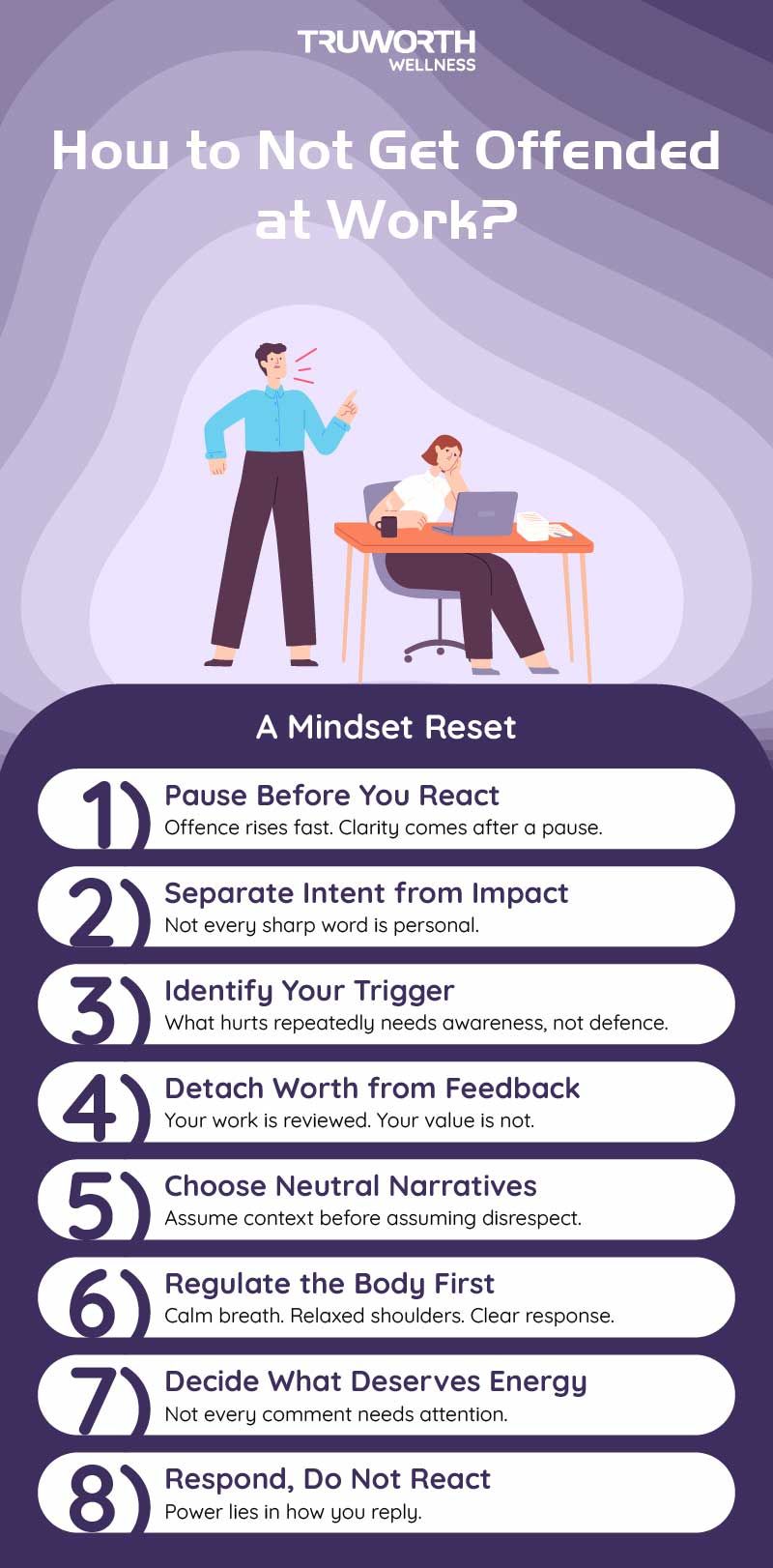
Why We Get Offended At Work More Than We Expect?
Work environments combine three sensitive factors.
- Identity: For many people, work is not just a role. It is proof of capability, worth, and growth. When feedback feels dismissive, the mind reads it as a personal attack.
- Hierarchy: Power dynamics amplify emotions. A comment from a manager, client, or senior colleague carries more psychological weight than the same comment from a peer.
- Unspoken Pressure: Deadlines, expectations, competition, and performance metrics keep the nervous system on edge. In this state, even neutral words can feel sharp.
Offence is often less about what was said and more about the internal state of the listener.
The Cost Of Getting Offended Too Easily
Being frequently offended does not make someone weak. But it does make work heavier than it needs to be.
Over time, it can lead to:
- Reduced participation in meetings
- Overthinking conversations long after they end
- Strained team relationships
- Loss of confidence and emotional fatigue
- Passive resistance or withdrawal from collaboration
For leaders, this cost multiplies. Emotional reactivity at the top shapes culture at every level.
Alos Read: How To Go From Nervous To Confident During Meetings?
Reframing The Goal: It Is Not About Being Thick-Skinned
A common misconception is that not getting offended means becoming emotionally numb or indifferent.
In reality, emotional resilience is about:
- Understanding what is yours to take personally and what is not
- Responding thoughtfully instead of reacting instantly
- Protecting self-respect without needing constant validation
The goal is not to stop feeling. The goal is to feel without losing balance.
Step 1: Separate Intent From Impact
At work, impact matters. But assuming intent can be emotionally expensive.
Before reacting, train the mind to ask:
- Was this comment intentionally disrespectful
- Could this be poor wording, stress, or urgency speaking
- Is this about me, or about the task and outcome
Most workplace remarks are clumsy, rushed, or poorly framed, not malicious.
This mental pause alone can reduce emotional charge significantly.
Step 2: Notice Your Inner Trigger Pattern
Offence is rarely random. It follows patterns.
Some people are triggered by:
- Being interrupted
- Public feedback
- Tone of voice
- Comparison with peers
- Silence or lack of acknowledgement
Awareness is power.
Once you identify your recurring trigger, the mind becomes less surprised and less reactive when it appears again.
Instead of thinking, “Why did this hurt,” the inner dialogue shifts to, “This is my trigger. I know this feeling.”
That shift creates distance.
Step 3: Do Not Attach Your Worth To Every Interaction
At work, feedback is often about output, speed, alignment, or priorities. It is rarely a verdict on personal value.
Train the mind to hold this distinction:
- My work can be evaluated
- My worth is not under review
This does not mean ignoring feedback. It means receiving it without letting it redefine self-image.
High performers struggle most with this because excellence often becomes identity. Learning to separate the two is emotional maturity, not detachment.
Step 4: Replace Mental Narratives With Neutral Language
The mind fills gaps quickly, often negatively.
- A short message becomes:
“They are unhappy with me.” - A blunt comment becomes:
“They do not respect me.”
Instead, practice neutral interpretations:
- “I do not have full context yet.”
- “This may be about urgency, not tone.”
- “I can seek clarity before concluding.”
Neutral language calms the nervous system and prevents emotional escalation.
Also Read: How To Gain Mental Clarity: Psychological Tricks And Activities
Step 5: Pause The Body Before Responding
Offence is not just mental. It is physiological.
Tight chest. Fast breathing. Heat in the face.
Training the mind also means regulating the body.
Simple practices that help:
- Slowing the breath for 60 seconds before responding
- Placing both feet firmly on the ground
- Relaxing the jaw and shoulders consciously
A regulated body supports a regulated response. Without this pause, even well-intentioned words can come out sharp.
Step 6: Learn The Difference Between Feedback And Disrespect
Not all discomfort is offence.
Feedback that challenges habits, assumptions, or performance can feel uncomfortable without being disrespectful.
Ask yourself:
- Is the message about improvement?
- Is there personal insult involved?
- Is this a pattern or a one-time interaction?
If it is feedback, engage with it.
If it is disrespect, address it calmly and clearly.
Emotional resilience includes self-advocacy.
Step 7: Choose When To Engage And When To Let Go
Not every comment deserves mental real estate.
Ask:
- Will this matter in one week?
- Does responding add value?
- Is silence a wiser choice here?
Letting go is not avoidance. It is discernment.
Professionals who thrive long-term are selective about where they invest emotional energy.
Also Read: The Power Of Quiet Spaces: Why Some Employees Thrive Only In Silence?
Step 8: Build Inner Stability Outside Work
Workplace resilience is supported by life outside work.
Poor sleep, unresolved stress, emotional exhaustion, and lack of recovery time make the mind more sensitive.
Organizations often focus on productivity without addressing emotional capacity.
Practices that strengthen inner stability include:
- Regular breath awareness or calming practices
- Reflection or journaling to process emotions
- Physical movement that releases stored tension
- Learning emotional regulation techniques
A calmer baseline means fewer triggers during the day.
What Leaders Must Understand?
Leaders often unintentionally create emotional climates.
Tone, urgency, body language, and feedback style deeply affect teams.
Emotionally resilient leadership does not mean being soft. It means being conscious.
Organizations that invest in emotional intelligence training, stress regulation, and mindful leadership see:
- Better communication
- Reduced conflict
- Higher trust
- Sustainable performance
Emotional strength is not a personal issue. It is a cultural one.
Training The Mind Is A Long-Term Skill
Not getting offended does not happen overnight.
Some days will still sting. That is human.
Progress looks like:
- Faster recovery after emotional reactions
- Clearer thinking under pressure
- Reduced need for validation
- More grounded responses
This is growth.
How Truworth Wellness Supports Emotional Resilience At Work?
At Truworth Wellness, we work with individuals and organizations to build emotional strength that supports performance, leadership, and wellbeing.
Our programs focus on:
- Emotional regulation and stress resilience
- Leadership emotional intelligence
- Preventive mental wellbeing practices
- Creating psychologically safe workplace cultures
Because emotionally stable people build healthier teams. And healthier teams build stronger organizations.
Final Thought
The workplace will never be free of triggers. But your inner world does not have to be controlled by them.
Training the mind to not get offended is not about lowering standards or tolerating poor behaviour. It is about rising above emotional noise and responding from a place of clarity, confidence, and self-respect.
That is not just a professional skill. It is a life skill.