How Wellness Impacts Employee Retention And Productivity?

The connection between employee health and business performance is well established. Here is the evidence and what it means for how you build your wellness strategy.
The business case for corporate wellness is no longer theoretical. Both Indian and global corporate contexts makes the connection between employee health and organisational performance measurable, specific and actionable.
Many organisations still see employee wellness as a nice-to-have rather than a business priority. It's often treated as an HR expense that's hard to justify and one of the first things to be cut when budgets are tight.
This article takes a different approach. Instead of focusing on broad ideas like culture or values, it shows the clear business impact of employee wellness. It explains how investing in wellness improves the two outcomes that matter most to any organisation: keeping employees for longer and helping them perform at their best.
The Retention Connection
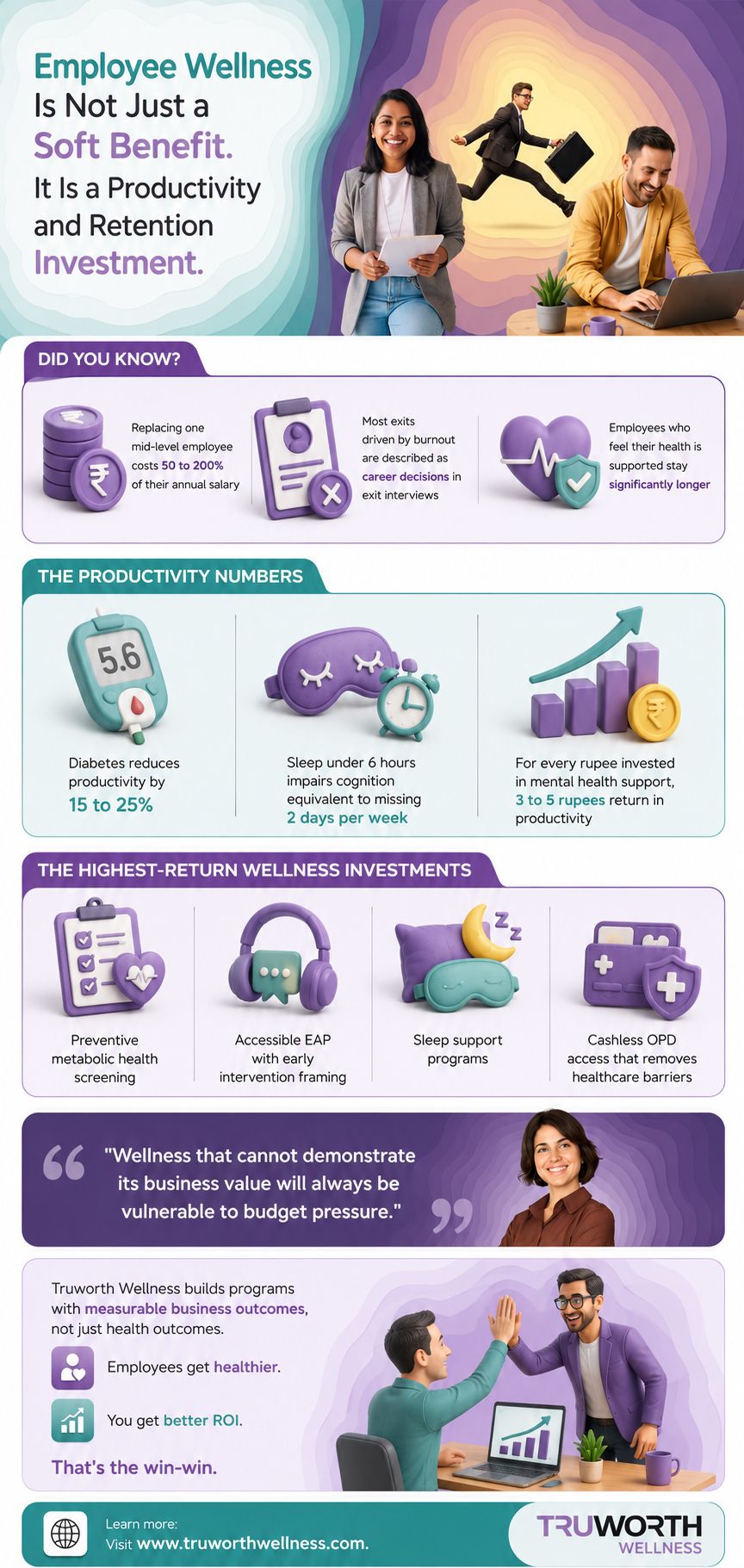
Employee retention is expensive when it fails. Replacing a mid-level employee typically costs between 50 and 200 percent of their annual salary when recruitment, training, onboarding and productivity loss during the transition are factored in.
The reasons employees leave are well documented in engagement research. Growth, compensation, management and culture are the most commonly cited. What is less documented is the frequency with which unaddressed health and wellbeing challenges are the underlying driver of these stated reasons.
Consider the most common hidden health drivers of voluntary exit:
- Burnout that has crossed the point of recovery within the role: An employee who has been operating at unsustainable intensity for an extended period, without support or acknowledgement from the organisation, reaches a point where leaving is the only way to recover. They do not cite burnout in their exit interview because it feels unprofessional or because they do not have the language for it. They cite growth or opportunity.
- A personal health or family health crisis that received no organisational support: An employee managing a serious personal health challenge or caring for an unwell family member while simultaneously expected to perform at full capacity with no acknowledgement or accommodation from the organisation develops a fundamental break in trust. When a recruiter offers a change, the untethering is easy.
- Mental health deterioration that was invisible until it became unsustainable: Anxiety, depression and burnout that were never addressed early enough to prevent significant deterioration eventually reach a level that makes the current role feel impossible. The exit is framed as a career decision. The underlying driver was a health one.
- Financial stress that wellness investment would have reduced: Financial anxiety is a significant, largely invisible driver of employee restlessness. An employee under significant financial pressure is perpetually susceptible to recruitment from organisations offering more. Financial wellness support that helps employees manage their financial situation more effectively reduces this vulnerability.
The retention impact of a well-designed wellness program is not captured in a single metric. It is accumulated across the prevented exits of employees who would have left if their health challenges had been allowed to progress without support.
The Productivity Connection
The relationship between employee health and individual productivity is one of the most robustly documented areas in occupational health research.
The mechanism is straightforward. Employees who are physically well, mentally well and financially stable have more cognitive and physical resources available for work. Employees who are managing unaddressed health challenges are using a portion of those resources to manage the challenge rather than to perform.
This is presenteeism. And it is significantly more costly than absenteeism in most research contexts.
Physical health and productivity:
Employees with unmanaged chronic conditions including diabetes, hypertension and metabolic syndrome demonstrate measurably lower productivity than their healthy counterparts:
- Diabetes reduces work productivity by an estimated fifteen to twenty-five percent through fatigue, cognitive impairment and physical limitations
- Unmanaged hypertension impairs cognitive function and reaction time
- Metabolic syndrome creates the afternoon energy crashes, brain fog and fatigue that are universally experienced in Indian corporate environments but rarely attributed to their clinical cause
Mental health and productivity:
The productivity cost of unaddressed mental health challenges is even more significant:
- Anxiety reduces working memory capacity and decision-making quality
- Depression significantly impairs concentration, motivation and the ability to initiate tasks
- Burnout reduces creative thinking, problem-solving capacity and interpersonal effectiveness
Research from the Centre for Mental Health estimates that depression and anxiety alone cost the global economy approximately one trillion dollars per year in lost productivity. In the Indian context, where mental health challenges are common and mental health support is rarely accessible without a formal program, the organisational cost is substantial.
Sleep and productivity:
The connection between sleep quality and cognitive performance is one of the clearest in occupational health research:
- Employees sleeping fewer than six hours per night show cognitive impairment equivalent to missing two full days of work per week
- Decision quality is measurably lower in sleep-deprived employees
- Emotional regulation is significantly compromised, affecting teamwork, communication and conflict management
Sleep improvement is one of the most impactful and most underinvested wellness interventions available because the productivity return is immediate and significant.
What the Research Says About Wellness ROI?
The return on investment from well-designed corporate wellness programs has been studied extensively and the findings are consistent.
The WHO estimates that for every dollar invested in mental health treatment and support, the return in improved productivity and reduced absenteeism is four dollars. For physical health interventions including chronic disease management, the return is lower but still positive and significant.
Johnson and Johnson's landmark study of their corporate wellness program found a return of approximately two-point-seventy-one dollars for every dollar invested, primarily through reduced healthcare costs, lower absenteeism and improved productivity.
In the Indian context, the ROI case is strengthened by:
- The high prevalence of metabolic risk factors in the corporate workforce that respond well to early intervention
- The significant underutilisation of mental health support that means EAP investment produces relatively large returns from a low base
- The high cost of attrition in knowledge-intensive industries where replacement is expensive and talent is scarce
The Specific Wellness Investments With the Highest Productivity and Retention Return
Not all wellness investments produce equal returns. The highest-return interventions are those that address the most common, most impactful and most undertreated health challenges in the specific workforce.
For most Indian corporate workforces, these are:
- Preventive metabolic health screening and support: The HRA-led identification of prediabetes, insulin resistance and cardiovascular risk factors, with personalised nutrition and lifestyle support, produces significant long-term reduction in chronic disease incidence, insurance claims and the productivity loss that chronic disease creates.
- Mental health support through a well-designed EAP: Early intervention in anxiety, depression and burnout through accessible, trusted EAP counselling prevents the productivity loss and retention risk of unmanaged mental health challenges escalating to clinical crises.
- Sleep support: Sleep coaching, shift management guidance and the cultural changes that reduce chronic sleep deprivation produce immediate and measurable productivity improvements.
- Accessible OPD care: Removing the financial and logistical barriers to everyday healthcare access reduces presenteeism from unmanaged acute conditions, reduces sick day rates from conditions that worsen without treatment and creates a healthcare-seeking culture that catches problems earlier.
How Truworth Wellness Connects Wellness to Business Outcomes?
Truworth Wellness designs wellness programs with business outcomes in mind, not just health outcomes in isolation. HRA-led preventive health programs reduce the chronic disease incidence that drives productivity loss and insurance cost. A 24/7 EAP reduces the retention risk and presenteeism cost of unmanaged mental health challenges. CarePass OPD access reduces the sick day and presenteeism costs of acute health conditions going unmanaged.
Utilisation data, health trend data and the connection between wellness investment and measurable business outcomes are all part of how we report program value to HR and leadership teams.
Because wellness that cannot demonstrate its business value will always be vulnerable to budget pressure. And wellness that can demonstrate it becomes a strategic investment rather than a cost.
Want to build a wellness program you can defend to the CFO? Talk to Truworth Wellness about measuring and communicating the business value of employee health investment.