Wellness Programs For Healthcare Workers Facing Hidden Burnout

Practical support for doctors nurses and hospital teams
Healthcare professionals are trained to notice distress in others, yet their own exhaustion can remain invisible. Doctors, nurses, technicians and support teams may continue functioning through irregular shifts, emotionally difficult cases and chronic sleep disruption while quietly losing the capacity to recover.
Effective wellness programs for healthcare workers must recognise that hidden burnout is both a people and care-continuity concern. Similarly, employee wellness programs for hospital staff should fit clinical schedules through confidential counselling, burnout assessments, preventive care, peer resources and flexible consultations—not expect already stretched employees to adapt to another fixed programme.
Quick Answer
How can hospitals support healthcare workers experiencing hidden burnout?
Hospitals should combine confidential mental-health care with healthier work practices. The most useful wellness programs for healthcare workers provide private counselling, burnout check-ins, peer support, preventive services and consultations that fit rotating shifts. Strong employee wellness programs for hospital staff also address workload, recovery time and psychological safety so employees can seek help without appearing weak or unreliable.
Why Healthcare Burnout Often Remains Hidden?
Burnout may look like endurance. A clinician can complete rounds, answer questions and document care while feeling emotionally depleted. A nurse may appear composed during a crisis and struggle after the shift ends. Support teams may absorb grief, frustration and aggression without their contribution being recognised as emotionally demanding.
1) Professional Identity Can Make Help Seeking Difficult
Healthcare workers are often expected to remain calm, capable and available. Some may worry that acknowledging distress will affect professional credibility, rostering, appraisal or relationships with colleagues. Others minimise their symptoms because patients appear to have more urgent needs.
This is why mental wellness support for medical professionals must be visibly confidential and separated from performance management. Wellness solutions for doctors and nurses should normalise early support rather than waiting for a crisis or extended absence.
2) Shift Work Disrupts Recovery
Night duty, rotating rosters, emergency calls and unpredictable handovers can interfere with sleep, meals, exercise and family routines. A generic daytime webinar may be inaccessible to the very employees carrying the highest fatigue burden.
The World Health Organization identifies long working hours, shift work, high workload and other psychosocial hazards as contributors to fatigue, occupational burnout and psychological distress among health workers. This makes wellness programs tailored for hospital shift patterns more than a convenience; timing is part of programme effectiveness.
3) Emotional Exposure Accumulates
Repeated contact with pain, death, uncertainty and distressed families can contribute to compassion fatigue. Employees may feel detached, irritable or guilty about no longer responding with the emotional energy they once had.
Useful wellness programs that address hidden burnout should distinguish compassion fatigue from a lack of empathy. The goal is to restore emotional capacity through recovery, peer connection and professional support—not shame employees for protecting themselves.
4) Violence and Aggression Add Another Layer
Healthcare employees may also face verbal threats or physical aggression. WHO reports that between 8% and 38% of health workers experience physical violence at some point in their careers, while many more face threats or verbal aggression. Review the WHO evidence.
EAP for hospitals and clinics in India should therefore include support after abusive or distressing incidents, while employers maintain security, reporting and violence-prevention systems.
How Burnout Affects Employees and Patient Care?
Burnout is not the same as ordinary tiredness after a difficult shift. It can involve persistent exhaustion, detachment from work and reduced professional efficacy. Individual experiences vary, and screening should support—not replace—qualified clinical assessment.
1) Burnout Can Affect Different Healthcare Roles
A recent pan-India survey reported personal, work-related and patient-related burnout prevalence of 47%, 31% and 35%, respectively, among the healthcare practitioners studied; 24.9% experienced all three forms. The cross-sectional design cannot establish cause and should not be treated as a national workforce estimate, but it highlights the need for early support across healthcare roles. View the PubMed study.
This evidence strengthens the case for wellness programs for healthcare workers that include nurses, doctors, technicians, administrative teams and support services rather than focusing on one visible professional group.
2) Exhaustion Can Affect Attention and Communication
Persistent fatigue may make concentration, decision-making and emotional regulation harder. In clinical environments, these effects can influence handovers, teamwork, documentation and how employees respond to patients and colleagues.
WHO’s policy brief on occupational health for health workers notes that poor and unsafe working conditions can jeopardise worker health, patient safety, quality of care and health-system resilience. Read the WHO policy brief.
Corporate wellness for healthcare organizations in India should therefore connect workforce wellbeing with patient-safety and quality systems without blaming individual employees for structural risks.
3) Burnout Can Weaken Retention
When employees see no sustainable way to recover, they may reduce hours, transfer, take repeated leave or exit the organisation. Remaining team members then absorb additional work, creating another cycle of strain.
Well-designed employee wellness programs for hospital staff can support retention when employees experience timely care, fair escalation and visible organisational action. Benefits alone will not solve chronic understaffing, but they can make earlier support and recovery more accessible.
What Wellness Programs for Healthcare Workers Should Include?
Healthcare wellbeing should combine individual care, peer resources and changes to the environment in which work happens.
1) Confidential Counselling With Flexible Access
Employees should be able to reach qualified professionals privately without explaining personal details to a supervisor. Access should accommodate early, late, rotating and overnight shifts through flexible appointments and digital options.
An EAP for hospitals and clinics in India should communicate confidentiality repeatedly and explain its limits, including emergency escalation. EAP support for frontline medical staff becomes more credible when employees know what remains private and how quickly help is available.
2) Burnout and Wellbeing Assessments
Short, voluntary assessments can help employees recognise exhaustion, detachment, sleep disruption and stress. Aggregated results may help organisations identify common pressure patterns without exposing individual answers.
For employee wellness programs for hospital staff, assessment must lead somewhere. Employees who indicate significant distress need a clear care pathway, while repeated team-level patterns should prompt workload and roster review.
3) Peer Support With Proper Boundaries
Peer supporters can provide listening, shared understanding and guidance towards professional resources. They should receive training, supervision and clear boundaries; they are not substitutes for counsellors or crisis services.
These resources strengthen mental wellness support for medical professionals, especially after difficult cases. However, participation should remain voluntary so peer support does not become another emotional duty assigned to already overloaded employees.
4) Preventive Healthcare That Staff Can Use
Healthcare workers can postpone their own health checks despite working near medical services. Privacy concerns, time constraints and reluctance to become a patient in their own workplace may create barriers.
Relevant wellness solutions for doctors and nurses can offer confidential screening, virtual consultations and referrals outside immediate reporting lines. Preventive care should also include other hospital employees whose roles are less visible but equally essential.
5) Short Recovery Support During the Shift
Brief breathing exercises, hydration prompts, mobility breaks and decompression after critical incidents can support recovery when operational conditions allow. These practices should not be used to justify unsafe workloads or missed statutory breaks.
Practical wellness programs for healthcare workers combine these micro-interventions with adequate staffing, fair rotations and access to rest. Personal resilience cannot compensate for a system that makes recovery impossible.
Employee Wellness Programs for Hospital Staff Must Fit Clinical Schedules
Hospitals operate continuously, so access designed around standard office hours will leave parts of the workforce behind.
Clinical reality | Common barrier | More usable support |
Rotating shifts | Fixed appointments are missed | Flexible virtual consultations and rotating onsite timings |
Critical incidents | Employees return directly to work | Optional debriefing and psychological first aid |
Busy wards | Long sessions feel impossible | Short check-ins and modular wellbeing activities |
Night duty | Preventive services are closed | Screenings and support windows across shifts |
Privacy concerns | Staff avoid care near colleagues | Confidential external or digital access routes |
These wellness programs tailored for hospital shift patterns should be adapted by department and role. Emergency, ICU, oncology, diagnostics, pharmacy and administrative teams do not experience the same pressures.
Corporate wellness for healthcare systems in India should also account for multiple facilities, varied workforce languages and differences between tertiary hospitals, smaller clinics and distributed care networks.
The Role of Managers and Clinical Leaders
Leaders influence whether employees feel safe admitting strain. They do not need to diagnose mental-health conditions, but they must know how to respond to visible distress and recurring workload problems.
1) Make It Safe to Speak Early
Managers should avoid dismissing exhaustion as part of the profession. Private check-ins, active listening and neutral referral language help employees seek mental wellness support for medical professionals without being labelled incapable.
2) Review Work Conditions Alongside Individual Support
WHO’s mental-health-at-work guidance recommends organisational interventions that address psychosocial risks, alongside manager training and worker support. For corporate wellness for healthcare organizations in India, this means reviewing rostering, staffing, role clarity, violence exposure and recovery—not offering counselling in isolation.
3) Respond After Distressing Events
After a patient death, resuscitation, violent incident or serious clinical event, employees may need different forms of support. Some may want a structured debrief; others may prefer individual counselling later. Avoid compulsory emotional disclosure.
An EAP for hospitals and clinics in India can provide confidential follow-up, while clinical leaders manage immediate operational safety and team communication.
A trusted EAP for hospitals and clinics in India should also give employees a direct route to support without requiring them to disclose personal details through the management chain.
4) Protect Peer Supporters Too
Peer supporters and managers can absorb significant emotional content. Supervision, rotation and access to professional consultation help prevent support roles from creating a second layer of burnout.
This is particularly important in wellness programs that address hidden burnout, where the people helping colleagues may also be struggling privately.
How Truworth Wellness Supports Healthcare Workforces?
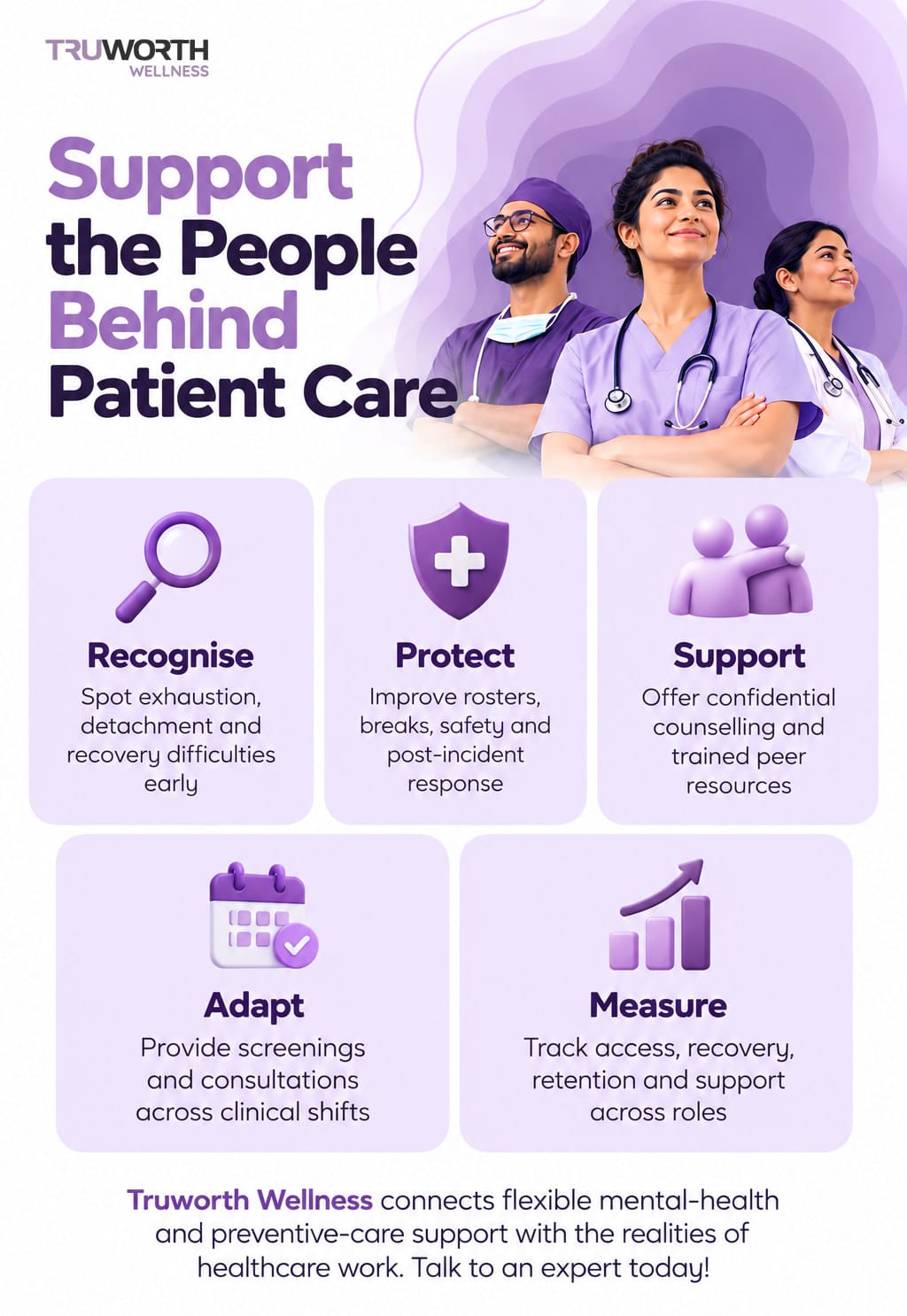
Truworth Wellness helps healthcare organisations connect mental wellbeing, preventive care and sustained engagement through an accessible employee experience.
Its wellness solutions for doctors and nurses can include confidential counselling, burnout assessments, wellbeing resources, virtual consultations and preventive screening support.
- For wellness programs for healthcare workers, delivery can be adapted around clinical rosters rather than a fixed corporate schedule. Digital access and flexible appointments help reach employees who cannot attend daytime sessions, while targeted communication can increase awareness without disrupting patient care.
- Truworth Wellness can also support employee wellness programs for hospital staff across different roles and locations. Journeys can reflect the needs of clinicians, technicians, administrative employees and frontline support teams while maintaining consistent access and privacy principles.
- Privacy-conscious reporting can help organisations understand aggregated participation and broad wellbeing patterns without revealing confidential counselling information. This enables more responsive corporate wellness for healthcare organizations in India while protecting the trust required for engagement.
These wellness solutions for doctors and nurses should remain equally accessible to employees across departments, seniority levels and shift timings.
Measuring Whether Support Is Making a Difference
Attendance alone does not show whether employees feel safer or receive care earlier. Measurement should examine reach across shifts, roles and facilities.
Useful indicators may include:
- Awareness of confidentiality and available services
- Time to access counselling or a consultation
- Participation across day, evening and night shifts
- Burnout and recovery trends from voluntary aggregated assessments
- Preventive-screening follow-through
- Confidence in manager and peer support
- Absence, overtime and retention patterns
- Use of post-incident support
Effective employee wellness programs for hospital staff should review whether employees in the most demanding roles can use support without sacrificing rest or patient responsibilities.
Likewise, corporate wellness for healthcare organizations in India should combine wellbeing data with staffing, safety and operational context. A counselling programme cannot be judged fairly without considering the conditions producing distress.
Supporting the People Who Sustain Patient Care
Healthcare workers should not need to reach crisis before receiving care. Hidden burnout grows when professional identity, confidentiality concerns and shift patterns make help difficult to access.
Strong wellness programs for healthcare workers respond by combining private support, preventive care, peer resources and healthier workplace practices. When employee wellness programs for hospital staff fit clinical schedules, employees can seek help earlier without stepping away from essential responsibilities for long periods.
Accessible mental wellness support for medical professionals helps make early care a normal part of workforce health rather than a response reserved for crisis.
Help healthcare teams access confidential, flexible and compassionate wellbeing support with Truworth Wellness.
Frequently Asked Questions
What are common signs of hidden burnout in healthcare workers?
Signs may include persistent exhaustion, emotional detachment, irritability, sleep disruption, reduced sense of effectiveness and difficulty recovering between shifts. These signs are not a diagnosis and may require professional assessment.
What should EAP support for frontline medical staff include?
It should offer confidential counselling, flexible access, crisis escalation, post-incident support and clear privacy communication. It should complement—not replace—safe staffing and healthier work practices.
How can hospitals make mental-health support easier to use?
Offer digital and rotating appointment times, repeat confidentiality messaging, provide private access routes and train managers to refer employees without diagnosing or judging them.
Can peer support prevent healthcare worker burnout?
Peer support can reduce isolation and guide employees towards care, but it cannot prevent every case of burnout. Peer supporters need training, boundaries, supervision and their own access to professional help.
How should hospitals measure employee wellbeing programmes?
Measure awareness, access time, participation across shifts, aggregated burnout trends, screening follow-through, manager support, absence and retention. Interpret results alongside staffing and operational changes.