Going Beyond "The Typical 5" Types Of Wellness Programs

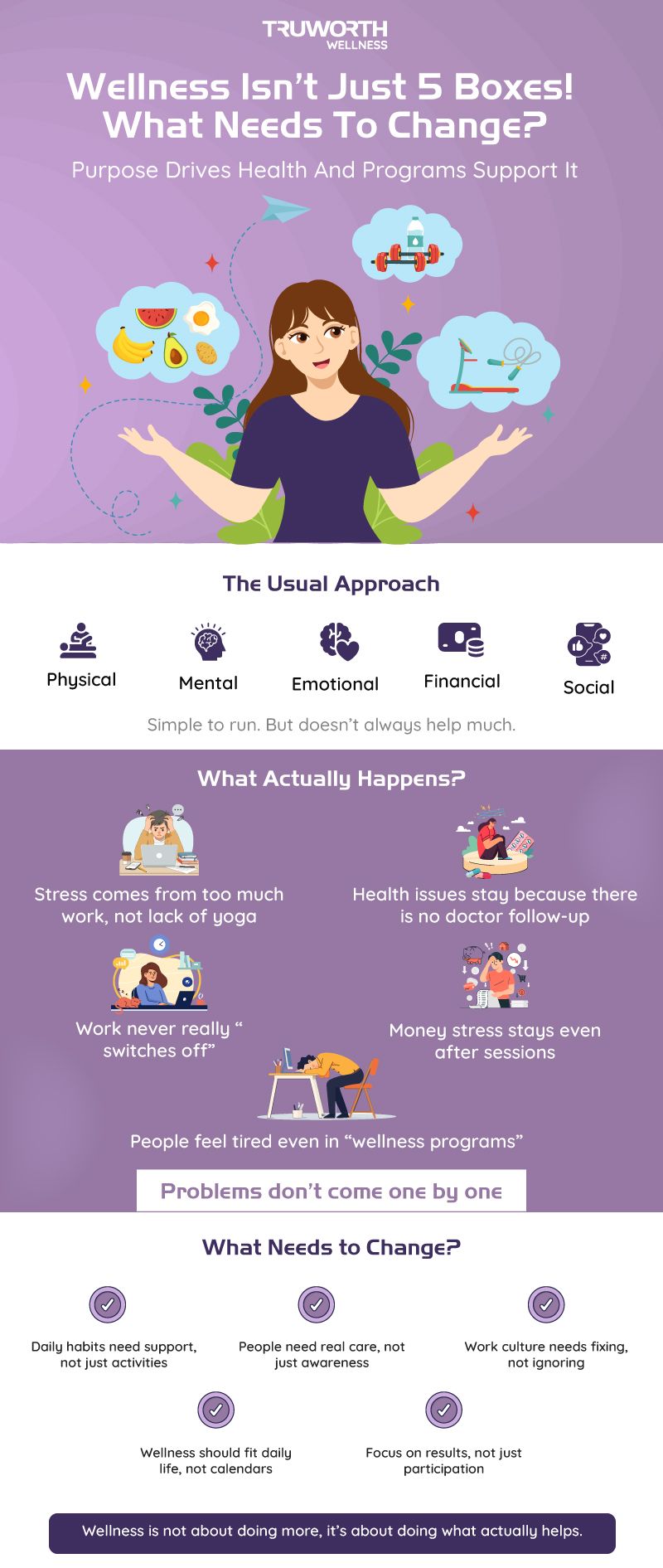
For years, corporate wellness has been neatly packaged into five categories: physical, mental, emotional, financial, and social wellbeing. It is simple, structured, and easy to communicate.
But simplicity is also the problem.
Organizations today are more complex, employee needs are more layered, and health outcomes are influenced by far more than these five buckets can capture. When companies rely only on this traditional framework, they often mistake activity for impact.
The result: high participation, low transformation.
If wellness is meant to improve real lives and business outcomes, it needs to evolve beyond these five categories.
The Problem With the “5 Types” Framework
The traditional model works well as a starting point, but it falls short in three critical ways:
1) It Focuses on Categories, Not Context
Knowing that mental health matters does not tell you why your employees are stressed. Is it workload, leadership style, job insecurity, or lack of growth?
Without context, programs remain generic.
2) It Measures Inputs, Not Outcomes
Step challenges, webinars, and EAP usage are easy to track. But do they reduce burnout, improve resilience, or enhance productivity?
Most organizations do not measure what truly matters.
3) It Ignores Systemic Influences
Employee wellbeing is shaped by culture, policies, leadership behavior, and access to care. A yoga session cannot fix a toxic manager or unrealistic deadlines.
Wellness cannot sit in isolation from the workplace itself.
What Modern Wellness Needs to Include?
To move from performative wellness to meaningful impact, organizations must expand beyond the traditional five.
1) Behavioral and Habit-Based Wellness
Instead of one-off activities, focus on daily behaviors.
Small habits, like how employees eat during work hours, how often they take breaks, or how they manage screen time, have a compounding impact on health.
Programs should guide and reinforce sustainable behavior change, not just create temporary engagement spikes.
2) Clinical and Preventive Care Integration
Wellness without medical backing is incomplete.
Employees often struggle with recurring issues like digestive problems, fatigue, or chronic pain that go unaddressed until they escalate. Preventive screenings, doctor access, and continuity of care need to be built into wellness strategies.
This shifts wellness from awareness to actual health management.
3) Workplace and Cultural Wellness
Culture is the invisible driver of wellbeing.
Psychological safety, workload design, leadership empathy, and communication patterns directly affect stress levels. If these are not addressed, no wellness initiative will sustain.
Organizations must treat culture as a core wellness lever, not a separate HR initiative.
4) Digital and Attention Wellness
Always-on work has created a silent crisis of attention fatigue.
Constant notifications, multitasking, and blurred work-life boundaries are reducing focus and increasing cognitive load. Digital wellness strategies, such as structured work hours, meeting discipline, and mindful tech use, are becoming essential.
5) Purpose and Meaning at Work
Employees today are not just looking for benefits, they are looking for meaning.
When people feel their work matters and aligns with their values, their mental and emotional health improves significantly. Purpose-driven wellness is not about motivation posters, it is about role clarity, growth pathways, and meaningful contribution.
6) Financial Reality, Not Just Literacy
Traditional financial wellness focuses on education.
Modern financial wellness must address real-life stressors like debt, rising living costs, and financial insecurity. Support systems, not just knowledge sessions, are needed to reduce financial anxiety.
7) Environmental and Lifestyle Wellness
Factors like commute, workspace ergonomics, food access, and even air quality impact health daily.
Wellness programs need to consider the physical and environmental conditions employees operate in, especially in urban work settings.
A Shift in How We Design Wellness Programs?
To make this expanded approach work, organizations need to rethink execution.
1) Move From Activities to Ecosystems: Wellness should not be a calendar of events. It should be an interconnected system that supports employees across their daily lives.
2) Move From Engagement to Impact: Participation numbers look good on reports, but outcomes matter more. Focus on metrics like reduced absenteeism, improved energy levels, and better health markers.
3) Move From One-Size-Fits-All to Personalization: Employees are at different life stages and health conditions. Personalized journeys create relevance and sustained engagement.
4) Move From Awareness to Action: Information alone does not change behavior. Programs must enable action through access, nudges, and continuous support.
What This Looks Like in Practice?
A future-ready wellness program would look like this:
- Employees can consult doctors easily for recurring issues
- Preventive screenings catch risks early
- Managers are trained to build psychologically safe teams
- Digital overload is actively managed
- Employees receive guidance tailored to their habits and health status
- Wellness is embedded into everyday work, not treated as an add-on
This is not more complex for the sake of it. It is more aligned with how health actually works.
Where Most Organizations Get Stuck?
Even with the right intent, many organizations struggle because:
- Wellness is treated as a benefits function, not a business strategy
- There is no integration between HR, leadership, and healthcare providers
- Data is fragmented and underutilized
- Programs are designed for visibility, not effectiveness
Bridging these gaps requires both strategic thinking and the right ecosystem.
Conclusion
The “5 types of wellness programs” framework helped start the conversation.
But today, it is not enough.
Employee wellbeing is shaped by behavior, access to care, workplace culture, and everyday realities. Organizations that recognize this and evolve their approach will not just see healthier employees, but more resilient, productive, and engaged teams.
Wellness is no longer about offering options. It is about creating outcomes.
Moving From Programs to Real Health Outcomes?
At Truworth Wellness, the focus goes beyond traditional wellness categories.
With integrated OPD services, preventive care, and continuous health support, organizations can move from surface-level initiatives to measurable health outcomes. Employees do not just participate, they get the care and guidance they actually need.
Because real wellness is not about what you offer. It is about what changes.