How Cashless OPD Boosts Daily Productivity?

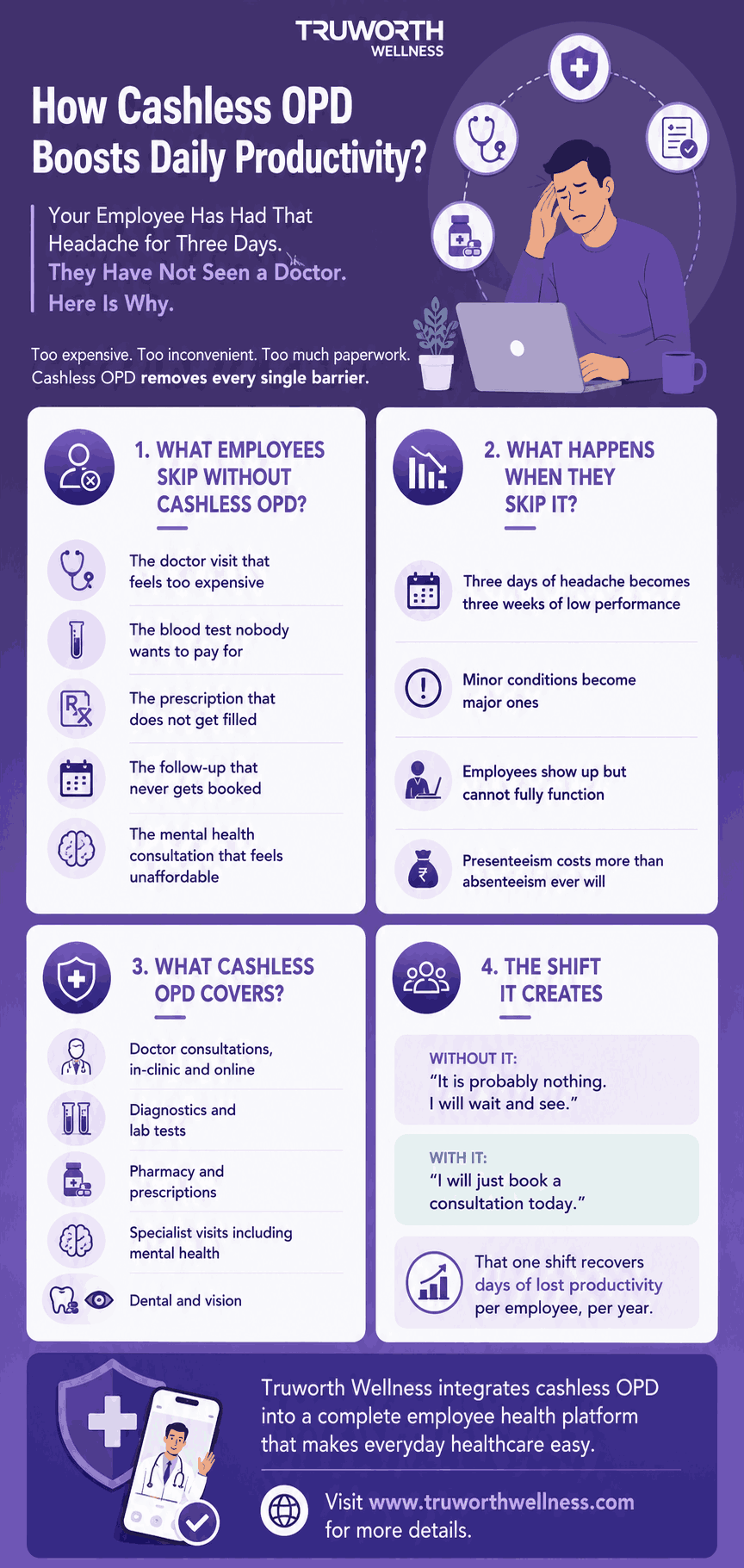
Most employees skip the doctor because it is too inconvenient and too expensive. Cashless OPD removes both barriers at once. Here is what that means for your workforce every single day.
Think about the last time you had a headache that would not go away.
Not a hospitalisation. Not an emergency. Just a persistent, annoying, concentration-destroying headache that sat behind your eyes for three days straight.
Did you see a doctor?
Most people did not. Because seeing a doctor for something that feels minor involves a whole chain of decisions that are easy to avoid. Finding a clinic. Checking if it is in the insurance network. Paying out of pocket and hoping reimbursement comes through. Taking time off work. Filling a form. Waiting for approval.
So the headache gets ignored. Paracetamol gets taken. Work continues at seventy percent capacity for three days while the body quietly tries to resolve something that a fifteen-minute consultation might have sorted in an afternoon.
Multiply that by a workforce of five hundred people. Multiply it by twelve months.
That is the hidden productivity cost of a workforce that does not access everyday healthcare because accessing it is too inconvenient and too expensive.
Cashless OPD changes that equation entirely. And in doing so, it changes what your workforce is capable of on an ordinary Tuesday.
First, What Is Cashless OPD?
OPD stands for Outpatient Department. It covers all the healthcare that happens outside of a hospital admission. Doctor consultations, diagnostics, pharmacy, physiotherapy, dental, vision. The everyday, routine, non-emergency healthcare that most people need several times a year.
Traditional corporate health insurance covers hospitalisation. It kicks in when something serious happens, when an employee is admitted to a hospital for surgery, a major illness or an emergency.
What it does not cover is the ninety percent of healthcare interactions that happen before that point. The GP visit. The blood test. The prescription. The follow-up. The physiotherapy session for the back that has been hurting for six weeks.
These costs come entirely out of the employee's pocket. And for a large proportion of Indian corporate employees, particularly those in mid-level roles, these out-of-pocket costs are a genuine barrier to seeking care.
Cashless OPD changes this. It gives employees the ability to access everyday healthcare without paying upfront, without filing reimbursement claims, and without the administrative friction that keeps people away from doctors they actually need to see.
The result is a workforce that seeks care earlier, manages health conditions better, and shows up to work more consistently capable of doing their actual job.
Also Check: Simplifying OPD Claims For A Stress-Free Health Experience
The Everyday Health Problems Nobody Is Treating
Before getting into the productivity connection, it helps to understand the scale of what cashless OPD is actually addressing.
Here are the most common health issues that Indian corporate employees are currently managing without proper medical attention:
1) Musculoskeletal pain
- Lower back pain from prolonged sitting
- Neck and shoulder tension from screen posture
- Wrist and forearm pain from keyboard use
- Knee pain from sedentary lifestyle and stairs
Most employees manage these with painkillers and willpower. Left untreated, they become chronic conditions that affect concentration, mood, sleep and long-term physical function.
2) Respiratory and ENT issues
- Recurring cold and cough
- Sinus infections
- Allergies triggered by office air conditioning
- Throat infections
These feel minor. They are rarely hospitalisation-worthy. But they drain energy, affect sleep and reduce the cognitive sharpness that knowledge work requires.
3) Digestive issues
- Acidity and reflux from irregular meals and stress
- Irritable bowel symptoms
- Chronic bloating and discomfort
These are among the most common and most quietly debilitating conditions in the corporate workforce. They are also among the most treatable when someone actually sees a doctor.
4) Eye strain and vision problems
- Digital eye strain from screen exposure
- Uncorrected vision that has changed but never been rechecked
- Dry eyes from air-conditioned environments
A significant proportion of Indian corporate employees are working with vision that needs correction or symptoms that need treatment and have not had an eye examination in years because it involves cost and time they have not prioritised.
5) Mental health
- Anxiety and stress that a counsellor could help with
- Sleep disorders that a physician could address
- Low mood that medication or therapy might improve
Under traditional insurance structures, mental health consultations are either not covered or require complex pre-authorisation. Cashless OPD that includes mental health consultations removes a significant barrier to early intervention.
The Productivity Connection
Now here is the part that connects all of this to what happens in your office every day.
Every one of the conditions listed above affects an employee's ability to do their job well. Not dramatically. Not in ways that show up in an absence record. But consistently, daily, in the quality of their concentration, their decision-making, their communication and their energy.
This is called presenteeism. And it is one of the most underestimated costs in any organisation.
What presenteeism actually costs?
Research consistently shows that the productivity loss from employees who are physically present but not fully functioning is significantly larger than the productivity loss from absenteeism. Employees who are in pain, unwell or managing an untreated health condition are not performing at their potential. They are performing at whatever their health allows on that particular day.
The employee with an untreated sinus infection is at their desk. They are responding to emails. They are attending meetings. They are doing the basic requirements of the job while feeling genuinely terrible and thinking at a fraction of their usual capacity.
That cost never appears on an HR report. But it is real, it is daily, and it is enormous at scale.
Cashless OPD reduces presenteeism directly
When accessing a doctor is easy, free at the point of use and does not require a half-day of administrative effort, employees seek care earlier. Earlier care means faster recovery. Faster recovery means the employee returns to full capacity sooner rather than dragging through days or weeks of suboptimal functioning.
The three-day headache that resolves after a fifteen-minute consultation and a prescription becomes a three-hour issue rather than a three-day one. That is two and a half days of full-capacity productivity recovered. Per employee. Per episode.
How Cashless OPD Changes Employee Behaviour?
The biggest shift that cashless OPD creates is not in what employees do when they are seriously ill. It is in what they do when something feels minor.
Without cashless OPD, the internal calculation looks like this:
"It is probably nothing. It is not bad enough to pay for. It will probably resolve on its own. I will see how it goes."
That calculation results in deferred care, prolonged symptoms and conditions that occasionally escalate from something minor into something significantly more serious.
With cashless OPD, the calculation changes:
"I can just book a consultation today. It will not cost me anything. I will find out what this actually is."
That shift in behaviour is where the real productivity and health value of cashless OPD lives. It is not in the individual consultation. It is in the culture of early healthcare-seeking that it creates across the whole workforce.
An organisation where employees routinely seek care early is an organisation with:
- Lower rates of condition escalation from minor to serious
- Fewer extended absences driven by conditions that were left too long
- Better management of chronic conditions through regular monitoring
- Lower long-term insurance claims from preventable complications
- A workforce that feels genuinely cared for rather than simply insured against catastrophe
The Financial Barrier Is Real. Cashless OPD Removes It.
It is worth being specific about the financial dimension because it is often underestimated by organisations designing benefits for employees whose salaries look comfortable on paper.
The actual financial reality of many Indian corporate employees, particularly at mid-level roles, involves:
- Significant EMI commitments on home loans, car loans or personal loans
- Family financial obligations including support for parents or siblings
- Children's education costs
- Rent in expensive metro cities
In this context, a doctor consultation that costs eight hundred to fifteen hundred rupees is not a trivial expense. It is a decision. And for many employees, the decision gets made in favour of waiting and hoping rather than spending money that has already been allocated elsewhere.
Cashless OPD removes that decision entirely. The cost becomes zero at the point of use. The barrier disappears. The consultation happens.
Beyond the Doctor: What a Comprehensive Cashless OPD Covers?
A well-designed cashless OPD benefit goes beyond GP consultations. Here is what comprehensive coverage looks like:
Diagnostics and lab tests: Blood tests, urine tests and other diagnostics covered without upfront payment. This matters enormously for preventive health, because employees who know a blood test will not cost them anything are far more likely to get one when a doctor recommends it.
Pharmacy: Prescription medications covered at the point of dispensing. The employee who cannot afford to fill a prescription does not take the medication. The medication that does not get taken does not manage the condition. A pharmacy benefit closes this gap.
Specialist consultations: Access to specialists without requiring hospitalisation or complex referral pathways. An employee who needs to see a dermatologist, a physiotherapist or an ENT specialist can do so without the cost becoming a barrier.
Mental health consultations: Counsellor and psychiatrist consultations covered under the cashless OPD benefit. This is one of the most important inclusions for corporate populations where mental health help-seeking is often blocked by both stigma and cost.
Dental and vision: Often excluded from traditional insurance entirely. Dental pain and uncorrected vision are two of the most common and most productivity-affecting health issues in any office. Covering them under cashless OPD addresses a gap that standard insurance leaves open.
Teleconsultation: The ability to consult a doctor via phone or video without leaving the office or taking time off work. For busy employees who would otherwise skip a consultation entirely, teleconsultation removes the time barrier as effectively as cashless removes the cost barrier.
How Truworth Wellness Integrates Cashless OPD?
Truworth Wellness integrates cashless OPD as part of a comprehensive employee health benefit platform rather than as a standalone insurance product.
Here is what that integration means in practice:
- Seamless access through The Wellness Corner platform: Employees book consultations, access teleconsultations, find network providers and manage their OPD benefit through a single, simple digital interface. No separate app, no separate login, no separate process.
- Connected to the health risk framework: Because the OPD benefit sits within the broader Truworth wellness ecosystem, consultation data and health patterns can inform personalised wellness recommendations. An employee who is regularly consulting for stress-related symptoms is nudged toward EAP resources. An employee with recurring metabolic concerns is connected to nutrition coaching. The OPD benefit becomes an entry point into a broader health support system rather than a transactional insurance product.
- Real-time cashless processing: No upfront payment, no reimbursement forms, no waiting periods for routine approvals. The cashless process works in real time so the barrier of administrative friction is removed alongside the financial barrier.
- Network designed for the Indian corporate context: Network providers selected for quality, accessibility and relevance to the cities and regions where client workforces are located. Including teleconsultation options for employees in locations where physical network coverage is limited.
- Utilisation data that informs organisational health strategy: Aggregated, anonymised OPD utilisation data gives HR and wellness leaders insight into the most common health issues affecting their workforce. This intelligence informs program design, canteen decisions, ergonomic investments and wellness communication strategy in ways that make every subsequent health investment more targeted and more effective.
What Employees Actually Say About Cashless OPD?
The feedback from employees in organisations that have introduced cashless OPD consistently highlights the same themes.
- They sought care for things they would previously have ignored
- They felt the organisation actually cared about their everyday health, not just emergencies
- They discovered health issues they did not know they had because they finally got a blood test
- They managed existing conditions better because follow-up consultations became routine rather than occasional
- They felt less financial stress around health decisions for themselves and their families
That last point is significant. The financial anxiety of managing health costs on a stretched budget is itself a health and productivity issue. Removing it has a benefit that goes beyond the individual consultation.
The Quiet Competitive Advantage?
Here is something worth thinking about from a talent perspective.
In a job market where compensation packages across similar roles are increasingly comparable, benefits that address everyday quality of life stand out in ways that salary numbers alone do not.
Cashless OPD is one of those benefits. It is tangible, immediately useful and felt by employees on an ordinary weekday rather than only in a crisis. It signals that the organisation thinks about the full spectrum of employee health rather than just protecting itself against catastrophic claims.
Employees notice this. And they remember it when a recruiter calls.
The Bottom Line
Productivity is not just about strategy, tools and talent. It is about how healthy your people feel on the day they are trying to do their best work.
An employee with an untreated infection, an unmanaged chronic condition, a back that has been hurting for two months or a mental health concern they cannot afford to address is not performing at their potential. They are performing at whatever their unaddressed health allows.
Cashless OPD does not solve every health problem. But it removes the two barriers that stop most employees from addressing health problems early: cost and inconvenience.
And when health problems get addressed early, the employee gets better faster, stays healthier longer, and shows up to work more consistently capable of doing what they were hired to do.
That is not a wellness benefit. That is a productivity investment.
Truworth Wellness integrates cashless OPD as part of a comprehensive employee health platform that connects everyday healthcare access to personalised wellness support, condition management and preventive health programs. If you want to understand what genuinely accessible employee healthcare looks like for your workforce, start the conversation with us here.