Can Spiritual Wellbeing Actually Drive Business Outcomes?

Most organizations today invest in wellness. Step challenges, health check-ups, stress management sessions, engagement activities, the list is growing.
But despite all this, one question still remains:
Why do employees still feel disconnected, overwhelmed, or unfulfilled?
The answer often lies in something deeper that is rarely addressed, how employees feel within.
Not just physically or mentally, but at a more personal level:
- Do they feel calm or constantly rushed?
- Do they find meaning in their work or just complete tasks?
- Do they feel aligned or internally conflicted?
This is where spiritual wellbeing becomes relevant.
Not as religion or belief systems, but as inner awareness, purpose, reflection, and alignment.
And when this inner layer is strengthened, the impact does not
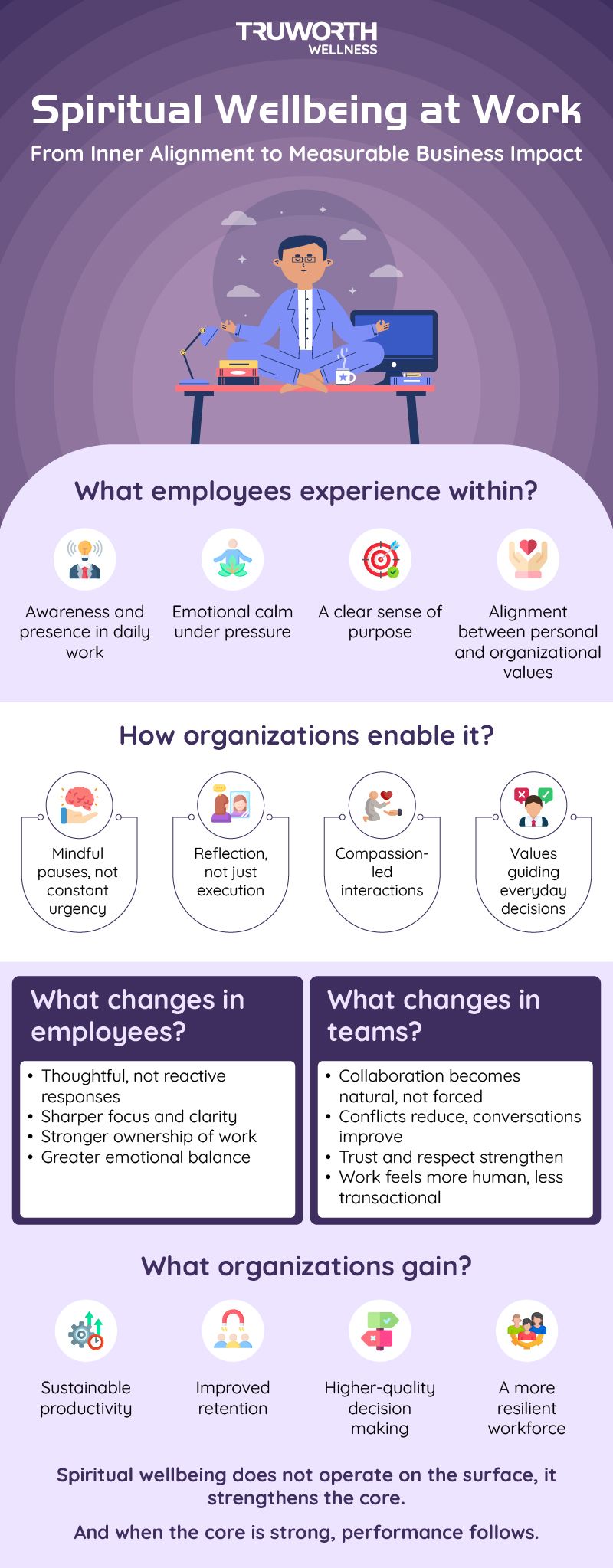
stay personal. It begins to influence how people think, behave, collaborate, and ultimately perform.
Understanding Spiritual Wellbeing at Work
Spiritual wellbeing in the workplace is often misunderstood. It is not about introducing philosophies or structured practices that feel forced.
It is about enabling employees to experience:
- Awareness: Being present and conscious of thoughts, emotions, and reactions
- Calmness: The ability to stay steady even in high-pressure situations
- Purpose: Feeling that their work has meaning beyond routine tasks
- Alignment: No disconnect between personal values and workplace expectations
- Connection: A sense of belonging, not just to a team, but to the work itself
These are subtle shifts, but powerful.
For example, an employee who is self-aware is less likely to react impulsively in stressful situations. Someone who feels a sense of purpose is more likely to stay engaged and committed.
In this way, spiritual wellbeing quietly reshapes the work experience, from something that feels mechanical to something that feels meaningful.
How Inner Alignment Translates into Business Outcomes?
At first, spiritual wellbeing may seem difficult to measure. But its effects are clearly visible when you look at how employees behave and perform.
1) Better Focus and Decision Making
When employees are mentally cluttered or emotionally overwhelmed, decision-making suffers.
But when they have:
- Inner calm
- Awareness of their reactions
- Clarity of thought
They are able to:
- Think more rationally
- Respond instead of reacting
- Make balanced, well-considered decisions
This reduces errors and improves the quality of outcomes.
2) Higher Engagement and Ownership
Engagement is often driven through external efforts, rewards, recognition, or activities.
But real engagement comes from within.
When employees feel:
- Their work has meaning
- They are contributing to something valuable
- Their role matters
They naturally:
- Take ownership
- Go beyond minimum expectations
- Stay more invested in outcomes
This is the difference between participation and genuine commitment.
3) Stronger Team Dynamics
Spiritual wellbeing also changes how people interact with each other.
Employees who are:
- Self-aware
- Emotionally balanced
- Empathetic
Are more likely to:
- Listen actively
- Communicate respectfully
- Handle disagreements calmly
This reduces friction and builds trust within teams.
Over time, this creates a culture where collaboration feels natural, not forced.
Must Check: Signs That You Lack Self-Awareness Or Not
4) Resilience in Times of Pressure
Workplace stress and uncertainty are inevitable.
But how employees respond to them depends on their inner state.
Employees with stronger spiritual wellbeing tend to:
- Stay composed during challenges
- Adapt more easily to change
- Avoid extreme burnout cycles
This creates a workforce that is not just productive, but sustainably productive.
How Organizations Can Inculcate Spiritual Wellbeing?
Spiritual wellbeing does not require large, complex programs. It is built through small, intentional changes in everyday work culture.
1) Encourage Inner Awareness
Organizations can introduce simple practices like:
- Short mindfulness or breathing breaks
- Encouraging employees to pause before reacting
- Promoting presence during meetings
These small moments help employees become more aware of their thoughts and responses.
Impact: Less reactivity, more clarity
2) Create Space for Reflection
Workplaces are often designed for constant action, not reflection.
But reflection is where meaning is built.
Organizations can:
- Introduce short pause moments
- Use prompts like “What made your work meaningful this week?”
- Encourage quiet thinking time
Impact: Employees feel more connected to their work, not just busy with it
Connect Work to Purpose
Employees disengage when work feels like a checklist.
Leaders can:
- Share real impact stories
- Show how roles contribute to larger goals
- Reinforce contribution, not just completion
Impact: Work becomes meaningful, not mechanical
Encourage Compassion and Empathy
A spiritually healthy workplace is also a human one.
This can be built by:
- Encouraging active listening
- Normalizing supportive conversations
- Training managers to respond with empathy
Impact: Stronger relationships and better team dynamics
Align Actions with Values
Misalignment between values and actions creates internal stress.
Organizations should:
- Clearly define their values
- Recognize ethical behaviour
- Encourage integrity in decisions
Impact: Trust, consistency, and reduced internal conflict
Conclusion: The Quiet Driver of Performance
Organizations often focus on improving outcomes like productivity, engagement, and retention directly.
But these are results, not starting points.
The real shift begins with how employees feel within.
When employees experience:
- Calm instead of constant stress
- Purpose instead of routine
- Alignment instead of conflict
They do not just work better. They work with clarity, intention, and commitment.
And that is what drives long-term business success.
Building Deeper Wellbeing with Truworth Wellness
At Truworth Wellness, we believe wellbeing goes beyond the visible.
Our approach integrates inner awareness, purpose, and emotional alignment into workplace wellness, helping organizations:
- Build more engaged teams
- Improve resilience and retention
- Create meaningful work experiences
Because when employees feel aligned within, business outcomes follow naturally.