Corporate Wellness For IT Employees And Cognitive Saturation

Why technology companies must address more than screen time?
A software engineer can spend an entire day working without completing a long period of focused thought. Messages interrupt code reviews, incident alerts compete with meetings, and unfinished tasks remain mentally active long after the laptop closes. The result is not simply tired eyes. It is cognitive saturation: a gradual reduction in the mental capacity required to concentrate, prioritise and solve complex problems.
Effective corporate wellness for IT employees must recognise how technology work is actually experienced. A corporate wellness program for IT companies India needs to combine mental-health support with cognitive-load assessment, digital fatigue education, recovery habits and manager-led workload practices. When these elements work together, technology teams can protect attention, reduce avoidable errors and sustain performance without normalising exhaustion.
Table of Contents
- The short answer
- What cognitive saturation means in technology work?
- Why technology employees become mentally fatigued?
- The impact on people and performance
- What an effective wellness program should include?
- Structural practices that protect focus
- How Truworth Wellness supports technology teams?
- Measurement and a 90-day action plan
- Frequently asked questions
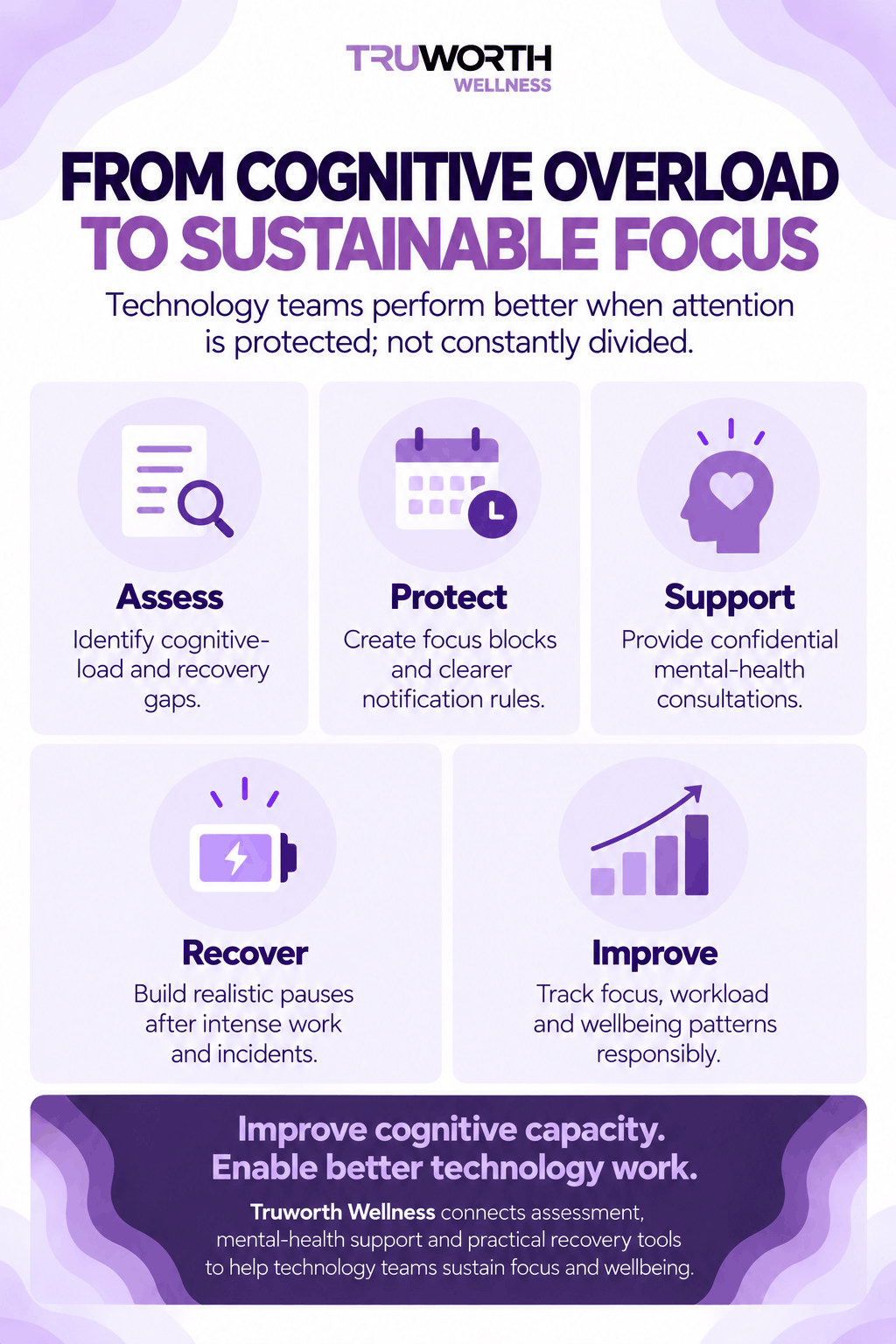
Short Answer
Why must IT companies address cognitive saturation? Because technology employees rely on sustained attention, working memory and sound judgement, yet their workdays are frequently divided by meetings, alerts, incident pressure and rapid task switching. When mental demand repeatedly exceeds recovery, concentration falls, errors become more likely and employees may extend work into personal time.
The solution is not another generic screen-break campaign. Corporate wellness for IT employees should combine confidential mental-health support and practical recovery tools with better meeting, notification, incident and workload practices. A corporate wellness program for IT companies India becomes more useful when wellbeing is built into how work happens—not added beside an unchanged high-pressure system.
What Is Cognitive Saturation in Technology Work?
Cognitive saturation occurs when incoming demands repeatedly consume more attention than the mind can restore. It may develop through constant task switching, difficult problem-solving, production pressure, long meetings and unresolved notifications. Employees can remain functional while their working memory, judgement and emotional regulation gradually weaken.
This distinction matters for IT employee mental health in India. Digital fatigue is often reduced to screen time, even though two hours of uninterrupted design work may feel less exhausting than one hour spent switching between a video call, chat messages, dashboards and urgent tickets.
Signs of cognitive saturation may include:
- Difficulty starting or completing complex tasks
- Re-reading requirements or forgetting recent decisions
- More avoidable coding, configuration or communication errors
- Irritability after routine interruptions
- Reduced creativity and slower problem-solving
- Working late to recover focus lost during the day
- Feeling mentally active even after work has ended
These patterns can contribute to burnout in IT employees in India, but they may appear long before an employee identifies as burned out. Early action is therefore essential.
Why IT Employees Experience Mental Fatigue?
Understanding why IT employees experience mental fatigue requires employers to examine the structure of technology work rather than blaming individual resilience.
1) Context Switching Consumes More Capacity Than It Appears
Software teams move between coding, debugging, documentation, reviews, planning and stakeholder communication. Each transition requires the mind to reload context: what the system is doing, what has already been tested and what decision comes next.
This repeated reorientation contributes to mental fatigue software engineers may experience even on days without unusually long hours. Effective corporate wellness for IT employees should therefore address interruption patterns alongside personal recovery habits.
2) Incident Pressure Keeps the Nervous System Activated
Production incidents create urgency, uncertainty and accountability. Even after a service is restored, employees may continue thinking about root causes, customer impact or the possibility of recurrence. On-call rotations can also disturb sleep and make recovery unpredictable.
For organisations managing workplace stress IT industry in India, incident response should include workload recovery, fair rotations and post-incident support—not only technical review.
3) Notification Overload Fragments Attention
Email, project tools, chat platforms, monitoring systems and calendars all compete for immediate attention. Employees may fear missing a critical update, so they monitor several channels while attempting focused work. This creates the meeting and screen fatigue IT industry teams often describe as an unavoidable part of the job.
The scale of this fragmentation is visible in Microsoft’s 2025 Work Trend Index special report: employees in the highest-volume group studied were interrupted by meetings, email or chat roughly every two minutes. Although this is not an India-specific measure of cognitive saturation, it illustrates how quickly digital activity can erode sustained attention.
The problem is not every notification. It is the absence of shared rules about what is urgent, which channel should be used and when employees are expected to respond.
4) Hybrid Work Can Extend Mental Availability
Remote and hybrid arrangements offer flexibility, but they can also blur the end of the working day. Employees may move directly from the final meeting to personal responsibilities while their minds remain engaged with unresolved work.
Microsoft’s analysis also found that after-hours chats rose 15% year over year, while meetings beginning after 8 p.m. increased 16%. These wider knowledge-work indicators reinforce the need for clearer availability norms and genuine end-of-day boundaries.
Hybrid work fatigue in India can be intensified by commuting, limited home workspace, cross-time-zone collaboration and expectations of constant responsiveness. A corporate wellness program for IT companies India should reflect these different working realities instead of applying one generic digital-detox message.
How Cognitive Saturation Affects People and Performance?
Cognitive capacity is central to technology work. When it is depleted, employees may still appear busy while producing less reliable output. The wider business stakes are substantial: the World Health Organization estimates that depression and anxiety lead to 12 billion lost working days and approximately US$1 trillion in lost productivity globally each year. WHO also identifies excessive workloads, low job control and inflexible hours as workplace mental-health risks—conditions employers can address through work design as well as individual support.
Concentration Becomes Harder to Sustain
Deep work requires uninterrupted time and enough mental energy to hold complex information. Persistent interruptions weaken mental fatigue software engineers experience, forcing them to spend additional time reconstructing context.
Error Risk Can Increase
Fatigue can affect attention to detail, judgement and memory. A rushed configuration change or overlooked requirement may create rework and operational risk. This does not mean every error is caused by fatigue, but cognitive load should be considered alongside process and technical causes.
Burnout Can Build Quietly
Employees may compensate by working longer, skipping breaks or remaining online after hours. Over time, this pattern can contribute to burnout in IT employees in India, particularly when high demand is paired with low control or insufficient recovery.
Collaboration Can Become More Difficult
Overloaded employees may become less patient, more defensive or less able to process feedback. Improving IT employee mental health in India can therefore support team communication as well as individual wellbeing.
Why Traditional Digital Wellness Advice Falls Short?
Advice such as “take a screen break” or “switch off notifications” can be useful, but it assumes employees control the systems around them. A developer cannot ignore production alerts, and a junior team member may not feel able to decline recurring meetings.
This gap between intent and implementation is not unusual. Deloitte’s research on integrating technology and wellbeing found that 80% of surveyed organisations considered wellbeing important or very important to organisational success, yet only 12% felt very ready to address it. For technology employers, readiness means translating concern into practical changes employees can experience during the workday.
Corporate wellness for IT employees becomes credible when individual guidance is supported by workload design. Employers need to clarify urgency, protect focus time, improve meeting practices and create recovery after incidents. Otherwise, wellness content can feel disconnected from the realities creating workplace stress IT industry in India.
This is why corporate wellness programs for tech companies in India should connect HR, wellbeing, managers and technology leadership. Cognitive saturation is not owned by one function; it sits at the intersection of work design, team norms and personal health.
What an Effective Corporate Wellness Program for IT Companies India Should Include?
A strong programme should make cognitive strain visible without turning wellbeing into employee surveillance.
1) Cognitive Load and Digital Fatigue Assessments
Short, voluntary assessments can help employees reflect on concentration, recovery, sleep, meeting load and notification pressure. Aggregated insights can help organisations identify common friction without exposing individual responses.
For corporate wellness for IT employees, assessments should lead to relevant actions. A team reporting high interruption load may need protected focus blocks; a team experiencing incident pressure may need rotation and recovery changes.
2) Confidential Mental Health Consultations
Employees need simple access to qualified professionals when stress, anxiety, sleep disruption or emotional exhaustion persists. Clear confidentiality messaging is essential for IT employee mental health in India, especially where employees worry that seeking care may affect career opportunities.
Those concerns deserve deliberate attention. A Deloitte India workplace mental-health study involving 3,995 corporate employees highlighted stigma and delayed access to support as important workforce issues. While the study was not limited to IT, it strengthens the case for private, clearly explained and easy-to-access counselling pathways.
Consultations should not replace organisational responsibility. They provide individual support while leaders address the working conditions contributing to strain.
3) Practical Digital Fatigue Education
Education should explain context switching, cognitive residue, attention recovery and the relationship between digital habits and sleep. It should also provide realistic techniques for employees who cannot fully disconnect during working hours.
This makes wellness programs for software engineers in India more useful than generic screen-time advice. Employees can learn to batch low-priority communication, protect demanding tasks and use transitions intentionally.
4) Recovery Nudges Within the Workday
Small prompts can encourage movement, hydration, eye rest, breathing or a short reset after prolonged concentration. The purpose is not to interrupt employees with another notification; nudges should be timely, optional and easy to dismiss.
Recovery practices can reduce the intensity of mental fatigue software engineers experience, particularly when managers allow employees to act on them.
5) Manager Led Workload Practices
Managers shape meeting volume, response expectations, sprint scope and the psychological safety to raise workload concerns. Training should help them identify overload, prioritise transparently and create space for recovery after intense delivery periods.
These practices are critical for addressing burnout in IT employees in India. Individual coping strategies cannot correct permanently unrealistic capacity planning.
Structural Practices That Protect Cognitive Capacity
Employers can translate wellbeing strategy into daily operating norms.
1) Protect Deep Work Blocks
Teams can reserve predictable periods without routine meetings or non-critical messages. Focus blocks should be visible and supported by leadership, with clear rules for genuine emergencies. This directly addresses meeting and screen fatigue IT industry teams experience.
2) Define Notification and Escalation Norms
Specify which channels carry urgent issues, expected response windows and when delayed replies are acceptable. Employees should not need to monitor every platform continuously. These norms are particularly helpful for reducing hybrid work fatigue in India.
3) Build Recovery Into Incident Management
Rotate on-call responsibility fairly, avoid scheduling intensive work immediately after overnight incidents and include human impact in post-incident reviews. Managers should check workload and wellbeing without forcing personal disclosure.
4) Reduce Unnecessary Meetings and Status Reporting
Replace routine updates with asynchronous communication where appropriate. Keep essential meetings focused, invite only relevant contributors and preserve transition time. These changes help reduce mental fatigue software engineers face before complex work even begins.
5) Plan Capacity Beyond Delivery Hours
Capacity planning should account for meetings, support, documentation, learning and recovery—not only development estimates. A mature corporate wellness program for IT companies India complements this operating discipline rather than attempting to compensate for poor planning.
How Truworth Wellness Supports Technology Workforces?
Truworth Wellness helps organisations connect cognitive-load awareness, mental-health support and sustained wellbeing engagement through a coordinated employee experience. This makes corporate wellness for IT employees relevant to the pressures employees encounter during real working days.
Organisations can integrate voluntary assessments, confidential consultations, digital fatigue education, recovery challenges and targeted communication. These capabilities can support corporate wellness programs for tech companies in India across software development, infrastructure, customer support, cybersecurity and other high-focus roles.
Truworth Wellness can also help tailor journeys for different workforce groups and working arrangements. A support team operating shifts may need different touchpoints from a hybrid engineering team. This configurability helps address workplace stress IT industry in India without relying on a one-size-fits-all campaign.
Privacy-conscious reporting can help employers understand participation and broad wellbeing patterns while protecting personal information. This trust is essential for IT employee mental health in India and for meaningful engagement with confidential care.
Measuring Impact Without Measuring Every Employee
Employers should measure whether systems are becoming healthier, not monitor individual output or health behaviour. Useful indicators include employee-reported concentration, uninterrupted focus time, meeting load, after-hours work, recovery after incidents and confidence in available support.
Organisations may also track aggregated participation, counselling access time, repeat engagement, preventable rework, absence and attrition. These measures should be interpreted carefully because several operational and personal factors can influence them.
A corporate wellness program for IT companies India should define success before launch. Measures might include improved awareness, faster access to support, healthier manager practices and fewer employees reporting persistent cognitive overload.
A Practical 90 Day Plan for Technology Employers
Days 1 to 30: Assess the Work Experience
Use voluntary check-ins and operational data to understand meeting load, notifications, incident pressure and recovery. Ask teams what interrupts focused work and how hybrid work fatigue in India appears across locations and roles. The assessment should also identify the everyday practices contributing to workplace stress IT industry in India teams may have normalised.
Days 31 to 60: Introduce Support and Structural Changes
Launch confidential consultations, digital fatigue education and relevant recovery tools. Train managers, define notification norms and protect focus blocks. Position corporate wellness for IT employees as a shared organisational responsibility.
Days 61 to 90: Review and Adapt
Evaluate awareness, participation and employee-reported changes. Adjust communication and practices for teams with different demands. Continue improving the corporate wellness program for IT companies India rather than treating cognitive fatigue as a one-time campaign. A sustained corporate wellness program for IT companies India should evolve as technologies, team structures and working patterns change.
This approach helps organisations respond to burnout in IT employees in India before exhaustion becomes the accepted cost of technology work.
From Constant Activity to Sustainable Focus
Technology teams do not need fewer ambitions. They need working conditions that protect the cognitive capacity required to deliver them. Addressing context switching, incident pressure, notifications and prolonged activation can improve concentration while supporting healthier boundaries and reducing hybrid work fatigue in India.
When a corporate wellness program for IT companies India combines structural workload practices with Truworth Wellness support, employees gain clearer routes to assessment, recovery and confidential care. This makes corporate wellness for IT employees part of sustainable performance rather than an activity outside the real workday.
Help technology teams protect focus, recover effectively and perform sustainably with Truworth Wellness.
Frequently Asked Questions
What is cognitive saturation at work?
Cognitive saturation occurs when continuing demands exceed the mind’s available attention and recovery. Employees may struggle with concentration, memory, prioritisation or emotional regulation even when they remain active and productive-looking.
Is digital fatigue only caused by screen time?
No. Screen exposure can contribute, but task switching, notification pressure, meetings, difficult problem-solving and after-hours mental activation may be equally important. Effective corporate wellness for IT employees should address the complete work pattern.
How can managers identify cognitive overload?
Managers can look for repeated rework, difficulty prioritising, longer hours, withdrawal or reduced patience. These signs are not diagnoses. Managers should discuss workload and support options without making assumptions about an employee’s health.
How can companies reduce mental fatigue among software engineers?
Protect deep-work time, reduce unnecessary meetings, define notification norms, plan realistic capacity and provide recovery after intense incidents. Relevant wellness programs for software engineers in India can reinforce these structural changes.
What causes hybrid work fatigue?
Common contributors include blurred work boundaries, video-meeting overload, cross-time-zone communication, commuting variability and limited recovery between professional and personal responsibilities. Policies should account for different employee circumstances.
How should an IT wellness program measure success?
Track focus time, after-hours work, meeting load, support awareness, voluntary participation and employee-reported cognitive strain. Use aggregated data and avoid intrusive monitoring that could weaken trust.
How can Truworth Wellness help IT companies?
Truworth Wellness can connect cognitive-load awareness, confidential consultations, digital fatigue education, recovery activities and targeted engagement. This creates a more relevant employee experience for technology teams across locations and roles.