Is Your Workplace Ready For Everyday Health Needs And Medical Emergencies?

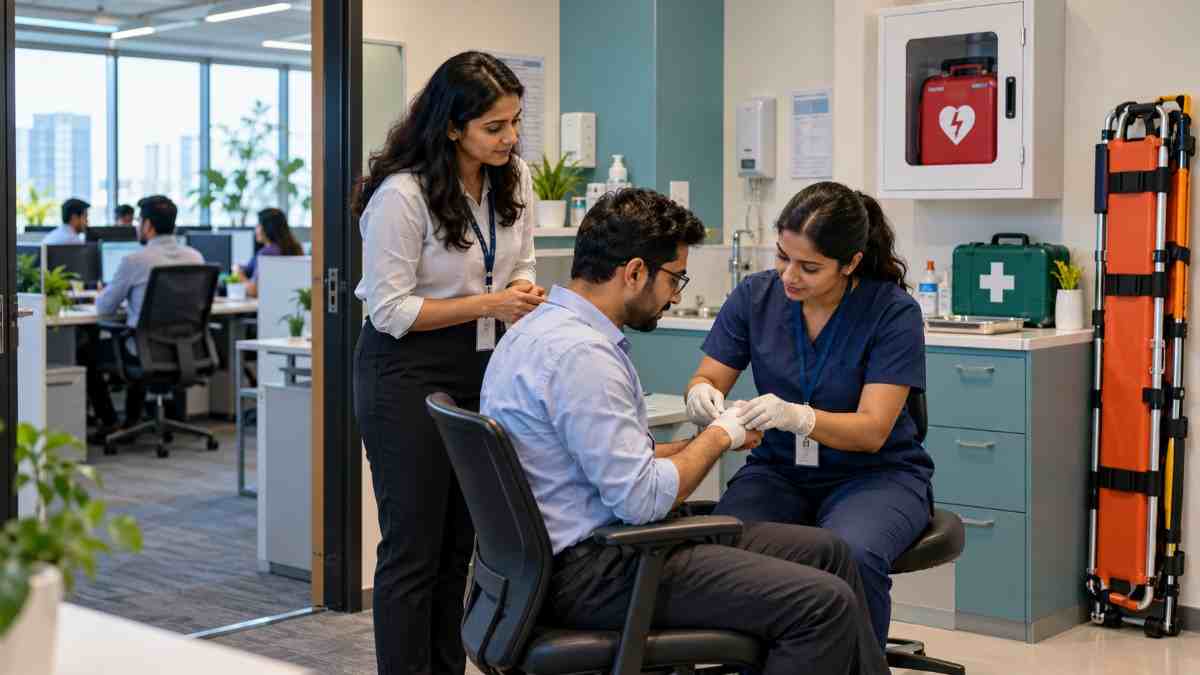
Workplace health readiness is often judged by fire drills, evacuation maps and an ambulance number. Yet employees are more likely to first encounter a migraine, fever, minor injury, breathing difficulty, dizziness or a sudden worsening of an existing condition. Corporate wellness and emergency medical services should therefore function as one connected care pathway—not as separate benefits employees must figure out under pressure.
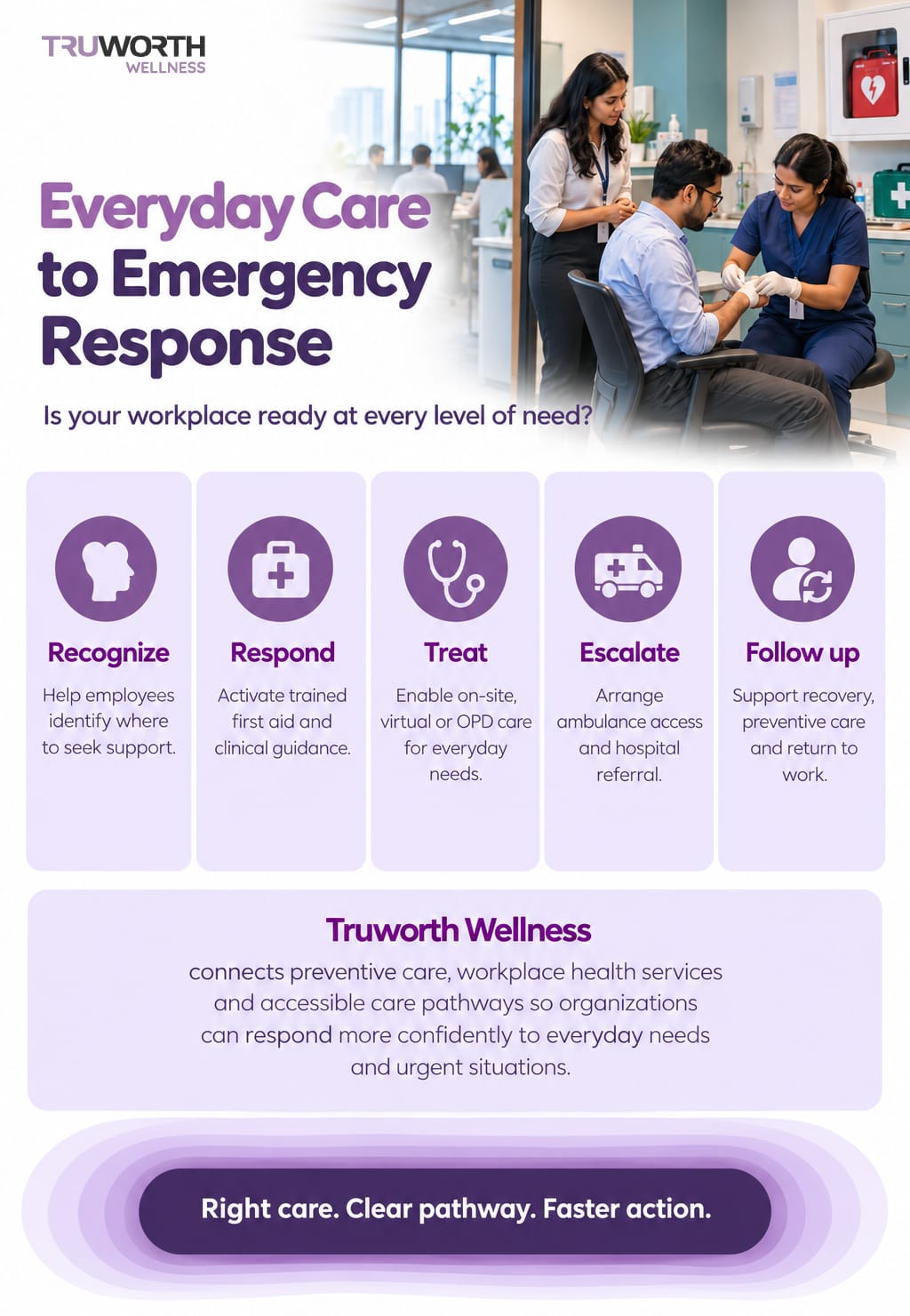
Effective wellness and emergency response programs for workplaces help employees answer three questions quickly: Where should I go? Who can help? What happens if the situation becomes urgent? By connecting first aid, on-site clinical support, teleconsultations, OPD access and escalation protocols, employers can respond appropriately to both everyday health needs and medical emergencies.
Short Answer
Why Corporate Wellness and Emergency Medical Services Must Work Together?
Emergency preparedness matters, but emergencies are only one part of workplace health. Employees also need help with symptoms that are uncomfortable, distracting or potentially serious but do not initially appear life-threatening. Delayed support can turn a manageable problem into prolonged absence, an avoidable hospital visit or a more urgent event.
The scale of occupational harm reinforces the need for prevention and response to work as one system. The International Labour Organization estimates that nearly 3 million workers die each year from work-related accidents and diseases, while 395 million sustain non-fatal work injuries. These figures are global and extend beyond office-based illness, but they show why workplace health cannot begin only after a major incident.
At the same time, not every headache requires an ambulance and not every episode of chest discomfort should be sent back to a desk.
Wellness programs that cover everyday health and emergencies create a sensible middle ground: assess early, offer the right level of care and escalate without delay when warning signs appear.
The Everyday Health Needs Workplaces Commonly Miss
Everyday health concerns may seem small individually, but repeated delays in care can affect attendance, concentration and employee confidence. A connected model should anticipate:
- headaches, fever, dehydration and seasonal infections;
- minor cuts, sprains, strains and workplace injuries;
- gastric discomfort, allergies and skin concerns;
- blood-pressure or blood-sugar symptoms;
- menstrual-health concerns and pain;
- medication questions and follow-up needs;
- anxiety, panic symptoms or acute emotional distress; and
- warning signs requiring urgent clinical assessment.
This is where comprehensive employee wellness and health services add value. They create access before an issue becomes disruptive while preserving a clear route to emergency care. Employees should not need to decide alone whether to use a medical room, book a virtual consultation, access OPD care or request urgent help.
 Truworth Wellness

Where Disconnected Workplace Healthcare Fails
Many employers already have a first-aid box, insurance helpdesk, teleconsultation benefit and ambulance contact. The problem is that these services may sit with different teams, vendors or communication channels. Availability does not automatically create readiness.
Common gaps include:
- employees do not know the location or working hours of the medical room;
- reception, security and managers follow different escalation steps;
- first-aid responders are trained once but not refreshed or rostered;
- teleconsultation and OPD benefits are poorly communicated;
- ambulance contacts are available but site access and hospital-routing details are unclear;
- incident information is not handed over consistently; and
- aftercare ends once the employee leaves the workplace.
This fragmentation explains why wellness programs must include emergency preparedness.
Routine care and emergency response share the same foundation: clear access, trained people, defined escalation, reliable communication and continuity after the first intervention.
What Wellness and Emergency Response Programs For Workplaces Should Include?
1. Trained First-Aid Teams and Visible Response Roles
Corporate wellness programs with first aid support need more than stocked boxes. Employers should identify trained responders by shift and location, schedule refresher training and make responsibilities visible to employees. Reception, security, facilities and floor wardens should know whom to call and how to guide medical access.
The WHO Community First Aid Response framework emphasizes recognizing emergencies, providing simple life-saving interventions and supporting safe transfer or handover. In a workplace, this means responders must know both what to do and when to stop, escalate and transfer care to qualified professionals.
2. On-Site Doctors, Nurses and Medical Rooms
The right on-site model depends on workforce size, location, operating hours and risk profile.
A large plant may require a staffed medical room across shifts; a distributed office network may combine scheduled clinical presence with virtual access.
Wellness solutions with onsite doctor and ambulance support should be configured to actual site needs rather than copied across every location.
On-site clinicians can assess common symptoms, provide first-level care, guide medicines within approved protocols, review screening results and decide whether an employee can return to work, needs an OPD consultation or requires urgent transfer. This reduces guesswork without treating the workplace clinic as a substitute for a hospital.
3. Teleconsultations and Accessible OPD Care
Employees may need care outside medical-room hours, while travelling, at a small branch or after reaching home. Teleconsultations extend clinical access and help determine the next appropriate step. OPD support then enables consultations, diagnostics, pharmacy access and follow-up for concerns that need continued care.
This is an important part of corporate wellness and emergency medical services because prevention, early treatment and emergency readiness influence one another. A blood-pressure concern detected during a screening, for example, may lead to a consultation and follow-up plan before it becomes an urgent workplace event.
4. Ambulance Coordination and Hospital Linkages
An ambulance number alone is not an emergency plan. Employers should clarify who activates the service, who meets the vehicle, which gate is used, how security clearance is handled, who accompanies the employee and how the receiving facility is informed.
India’s Press Information Bureau describes ambulance services as the first critical link in the emergency response chain, supporting pre-hospital care, stabilization, safe transport and timely referral. Practical corporate health and wellness with 24x7 medical support should therefore connect the initial workplace response with transport and the appropriate care destination.
5. Screenings and Preventive Risk Identification
Health screenings can identify risks such as hypertension, high blood glucose or other concerns that may otherwise remain unnoticed. The purpose is not simply to generate reports. Employees need clear explanations, referral options and follow-up support.
Well-designed comprehensive employee wellness and health services connect screening findings to consultations, coaching, diagnostics and condition-management support. This helps employers move from periodic events to continuous care while keeping individual health information confidential.
6. Documented Protocols and Practice Drills
Protocols should distinguish routine symptoms, urgent concerns and emergencies. They should cover location-specific hazards, shift coverage, contact trees, clinical handover, transport, family notification, incident documentation and return-to-work follow-up.
India’s Occupational Safety, Health and Working Conditions Code, 2020 provides the national framework for occupational safety, health and working conditions. Organizations should confirm the requirements that apply to their establishment, industry and state, then design corporate wellness programs with first aid support that meet operational as well as employee-care needs.
How to Design One Clear Employee Care Journey?
The employee experience should remain simple even when several services operate behind it. A practical care pathway can use four levels:
Well-designed wellness and emergency response programs for workplaces make these levels easy to understand before an employee needs them.
Level | Employee need | Suitable response | Escalation trigger |
Self-care guidance | Mild, familiar symptoms | Verified guidance, wellbeing resources or pharmacy support | Symptoms persist or worsen |
Clinical advice | A new or concerning non-emergency symptom | On-site clinician or teleconsultation | Clinician identifies urgent risk |
OPD care | Examination, diagnostics, prescription or follow-up required | Network clinic, diagnostic centre or specialist | Acute deterioration or emergency signs |
Emergency response | Severe, sudden or potentially life-threatening symptoms | First aid, emergency activation, ambulance and hospital handover | Immediate by protocol |
The WHO emergency-care system highlights timely first-contact care for acute illness and injury. The principle applies directly to wellness and emergency response programs for workplaces: employees need early recognition, an appropriate first response and a reliable referral pathway.
To make the journey usable, employers should provide one memorable access point—such as a single helpline, app entry point or prominently displayed response number—supported by location-aware routing. Communication should use plain language and repeat at onboarding, benefit launches, shift briefings and periodic drills.
Building Readiness Across Different Workplace Models
A headquarters, factory, warehouse, retail branch and remote workforce will not need identical infrastructure. Wellness programs that cover everyday health and emergencies should adapt the care network without changing the employee promise: help must remain easy to find and escalation must remain clear.
- Large campuses: staffed medical room, shift-based first-aid roster, ambulance linkage, screenings and OPD referrals.
- Factories and warehouses: risk-specific first aid, occupational-health coverage, transport protocols and shift-ready clinical access.
- Small branches: trained local responders, teleconsultation access, mapped clinics and a verified emergency contact process.
- Hybrid and remote teams: virtual consultations, digital triage guidance, EAP access, OPD navigation and location-based emergency information.
- Mobile or field teams: portable first-aid resources, supervisor protocols, teleconsultation and pre-mapped referral options.
This flexible approach strengthens comprehensive employee wellness and health services without forcing every site into the same operating model.
Across these settings, wellness and emergency response programs for workplaces should preserve consistent response roles, communication and follow-up even when the delivery model changes.
How Truworth Wellness Can Support Connected Workplace Care?
Truworth Wellness can help organizations connect preventive care, on-site services, teleconsultations, health screenings, OPD access and employee wellbeing support within a coordinated experience.
Instead of leaving employees to navigate separate services, the model can guide them toward the most appropriate available care channel.
This connected approach makes comprehensive employee wellness and health services easier for organizations to administer and easier for employees to use.
- For employers designing corporate wellness and emergency medical services, Truworth Wellness can support a needs-based ecosystem that aligns workplace demographics, locations, operating hours and health priorities.
- Depending on the program design, this may include on-site doctors or nurses, medical-room support, screening journeys, virtual consultations, OPD navigation, employee communication and utilization insights.
- Where ambulance or emergency partners form part of the employer’s arrangement, wellness solutions with onsite doctor and ambulance support can be coordinated through clearer access and escalation pathways.
The goal is not to make every health concern an emergency; it is to help employees reach the right support faster and reduce uncertainty at critical moments.
- Truworth Wellness can also help align corporate wellness programs with first aid support so employees can move from initial assistance to clinical care without navigating disconnected channels.
- For multi-site employers, wellness solutions with onsite doctor and ambulance support can be adapted to local availability while maintaining a clear organization-wide care pathway.
The design of wellness solutions with onsite doctor and ambulance support should always specify service hours, activation responsibilities and location-level contingencies.
What Organizations Should Measure?
The value of wellness programs that cover everyday health and emergencies should be measured through access, responsiveness and continuity—not only the number of activities delivered. Useful indicators include:
- awareness of available care channels;
- time to first response and clinical consultation;
- medical-room and teleconsultation utilization;
- OPD referrals completed;
- first-aid training and refresher coverage by shift;
- emergency drill observations and protocol gaps;
- ambulance activation and handover times, where applicable;
- follow-up completion after screenings or incidents; and
- employee confidence in finding help.
Review only aggregated, privacy-conscious information for program improvement. Individual clinical details should remain appropriately protected. Strong corporate wellness programs with first aid support build trust when employees understand both how to access care and how their information is handled.
Regular review keeps wellness and emergency response programs for workplaces aligned with changing shifts, locations, vendors and workforce risks.
From Prepared on Paper to Ready in Practice
Workplace readiness is not defined by the presence of a first-aid kit, a wellness calendar or an emergency contact saved in a file. It is defined by what happens when an employee needs help on an ordinary Tuesday—and when that ordinary situation suddenly becomes urgent.
Integrated corporate wellness and emergency medical services bring prevention, first response, clinical access, OPD care and escalation into one practical employee journey. With Truworth Wellness, organizations can build a connected care ecosystem that supports everyday health needs while strengthening readiness for the moments that cannot wait.
That continuity is what turns wellness and emergency response programs for workplaces from a collection of services into a dependable employee experience.
Create a workplace where employees know where to turn—whether they need timely everyday care or urgent medical support.
Frequently Asked Questions
1. What should a workplace health-readiness program include?
It should combine trained first-aid responders, clear emergency protocols, suitable on-site clinical support, teleconsultations, OPD access, ambulance coordination, health screenings and follow-up pathways. The exact mix should reflect workforce size, shifts, locations and risks.
2. Why should corporate wellness include emergency preparedness?
Because everyday care and emergencies use the same access and escalation system. Why wellness programs must include emergency preparedness becomes clear when symptoms change quickly: employees and responders need to know who assesses the situation, when to escalate and how safe transfer will occur.
3. Can teleconsultation replace an on-site doctor or emergency service?
No. Teleconsultation is useful for clinical guidance, follow-up and employees without immediate on-site access, but it does not replace hands-on emergency assessment, first aid, ambulance transport or hospital care when those are required.
4. How can employers support employees at smaller branches or remote locations?
They can combine trained local responders, virtual consultations, nearby OPD networks, verified ambulance contacts and location-specific escalation instructions. This makes wellness and emergency response programs for workplaces more consistent across distributed teams.
5. What is the role of OPD services in workplace preparedness?
OPD services provide timely consultation, diagnostics, pharmacy access and follow-up for non-emergency concerns. They help employees address health needs early and can reduce avoidable escalation when supported by appropriate clinical guidance.
6. How often should workplace emergency protocols be reviewed?
Review them at least periodically and whenever sites, shifts, vendors, access routes or workforce risks change. Drills and real incidents should trigger immediate learning reviews so contact lists, handovers and response steps stay workable.